The concept was developed from the creation of enterprise data systems, cloud computing, and digital transformation strategies. Once organizations started generating large amounts of data, traditional approaches to decision-making became insufficient. The need for approaches to analyze the data and identify patterns, trends, and relationships in the data was required.
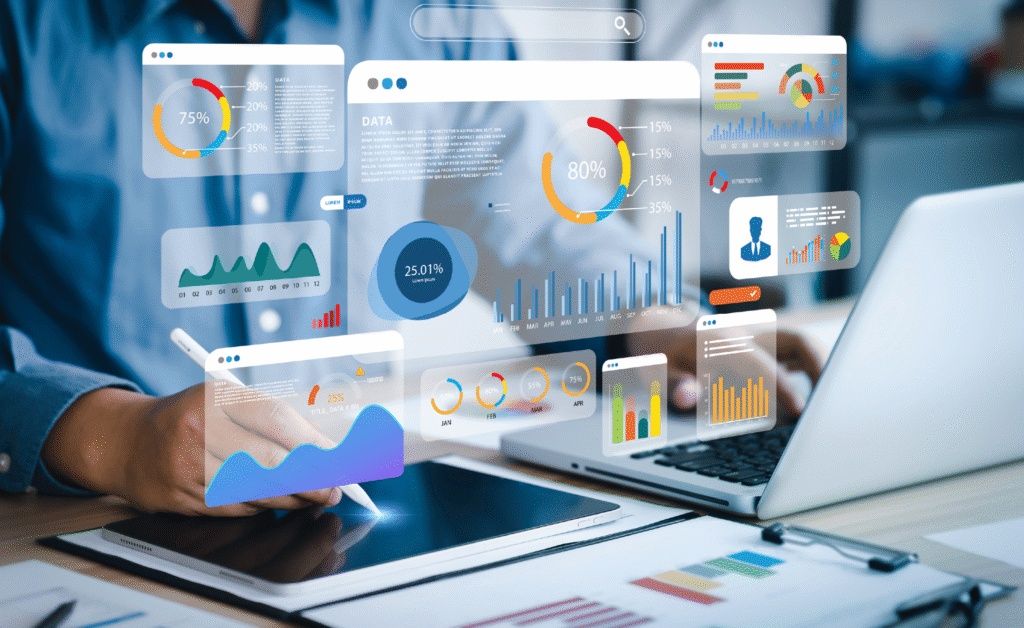
Business analytics typically involves four key approaches:
| Analytics Type | Description | Example Use |
|---|---|---|
| Descriptive Analytics | Examines historical data to understand what happened | Sales performance reports |
| Diagnostic Analytics | Investigates why something happened | Customer churn analysis |
| Predictive Analytics | Uses models and machine learning to forecast outcomes | Demand forecasting |
| Prescriptive Analytics | Suggests optimal decisions based on simulations | Supply chain optimization |
Modern business intelligence platforms, data visualization dashboards, and predictive analytics software allow organizations to analyze performance indicators quickly. These technologies support strategic planning, operational efficiency, and data-driven leadership.
In simple terms, business analytics exists because modern organizations operate in complex environments where decisions must be supported by accurate, measurable information.
Why Business Analytics Matters in the Modern Economy
In today’s digital economy, businesses are working in an environment where a tremendous amount of structured and unstructured data is available. However, businesses cannot make use of most of the available data without proper analytical techniques. Business analytics provides businesses with an opportunity to make use of available data for business knowledge.
Some key factors that have led business analytics to be used as one of the key tools for businesses in today’s economy include:
Improvement in Decision-Making
Businesses that make use of data analytics techniques are not heavily dependent on assumptions but are heavily focused on making use of data analytics techniques, key performance indicators, and predictions for decision-making. The analytical tool provides business leaders with an opportunity to make use of identifying trends in their business and understand how to move forward before implementation.
Operational Efficiency
Business analytics can be applied by businesses to identify areas of inefficiency in the business's supply chain, production, and operations through the analysis of performance metrics.
Customer Behavior Insights
Customer analytics can be applied by businesses to analyze the behavior of their customers, which can be helpful to the business in terms of marketing strategies.
Risk management
Organizations can identify risks such as financial volatility, fraud patterns, and changes in operations, which can be managed by the organization.
Competitive advantage
Organizations that use data analysis tools, machine learning algorithms, and data visualization tools can gain competitive advantage over other organizations by gaining insights about the changes occurring in the market.
The following table illustrates how analytics influences key business functions.
| Business Area | Analytics Application | Outcome |
|---|---|---|
| Marketing | Customer segmentation analysis | Improved campaign targeting |
| Finance | Financial forecasting models | Better budget planning |
| Operations | Process performance analytics | Increased productivity |
| Human resources | Workforce analytics dashboards | Improved talent planning |
| Supply chain | Inventory forecasting analytics | Reduced shortages |
As digital ecosystems continue expanding, analytics increasingly becomes a central component of strategic planning.
Emerging Trends and Developments in Business Analytics
In the past year, there have been a number of developments in technology and industry that are changing the landscape in business analytics.
Growth of Generative AI in Analytics
In 2025, many analytics systems are adding a feature that is providing a type of artificial intelligence that can help in automated data exploration and report generation, where a user can simply ask a question in a natural language and receive data insights.
Expansion of Real-Time Analytics
Real-time analytics systems are becoming more mainstream in industries such as financial services, e-commerce, and logistics.
More emphasis on data governance
Organizations are enhancing their data governance practices, privacy management systems, and data quality monitoring systems to ensure proper use of data. This is a result of increased global attention to data governance.
More emphasis on analytics and cloud infrastructure integration
The use of analytics in cloud computing environments increased significantly in 2024 and 2025. Organizations are using various data warehouse systems in the cloud.
Increased use of embedded analytics
More software applications are integrating analytics into business applications such as CRM systems, enterprise resource planning systems, and financial systems.
Regulations, Policies, and Data Governance Considerations
Business analytics is governed by legal guidelines that ensure personal data protection, promote data transparency, and encourage data utilization.
Data protection laws
Data protection laws of different countries influence data collection and analysis. Organizations should ensure that personal data is used responsibly and promote data transparency.
Some of the key legal influences on business analytics include:
Data protection laws
Regulations such as the General Data Protection Regulation (GDPR) of Europe, as well as other data privacy regulations of different regions of the world, ensure that personal data is used responsibly by organizations.
India’s Digital Personal Data Protection Act (2023)
In India, the Digital Personal Data Protection Act, which was introduced in 2023, has laid out a set of rules to govern the processing of personal data for various organizations. Organizations that have adopted various analytics systems should ensure the responsible processing of personal data.
Industry-specific regulations
There are industry-specific regulations in place, and some of them have been listed in the following list.
Examples:
Compliance regulations for financial services in banking institutions
Data privacy in the healthcare industry
Data protection in the telecommunications industry
Government digital transformation programs
Government initiatives and digital transformation programs
In various parts of the world, governments have been encouraging data-driven innovations in their countries by implementing digital transformation programs. In India, digital infrastructure, smart governance, and data management have been adding to the development of analytics capabilities in industries.
Useful Tools, Platforms, and Learning Resources for Business Analytics
Many tools support business analytics workflows, from data collection to visualization and predictive modeling.
Common categories of analytics tools include:
• Business intelligence platforms
• Data visualization dashboards
• Statistical analysis software
• Machine learning frameworks
• Data integration platforms
Frequently Asked Questions About Business Analytics
What is the difference between business analytics and business intelligence?
Business intelligence primarily focuses on reporting and data visualization. Business analytics extends business intelligence by using statistical models to forecast business outcomes.
Do organizations need large data sets to perform analytics?
Not really. Organizations can still get some information out of small data sets. However, having large data sets can allow organizations to get better results out of the predictive analytics model.
Which industries tend to use business analytics?
All industries can use business analytics, such as finance, retail, healthcare, manufacturing, telecommunication, logistics, and technology. Data-driven decision-making has become a phenomenon in almost every industry.
Is programming necessary to perform business analytics?
Some business analytics can be performed without the need to know programming languages. However, some business analytics requires the knowledge of programming languages such as Python, R, or SQL.
Conclusion
Business analytics is a vital component of the overall business strategy in today’s world. With the integration of data analysis, prediction, business intelligence, and machine learning, businesses are able to understand complex data and make better decisions.
The rapid advancement in digital technology, artificial intelligence, and cloud computing has enhanced the capabilities of analytics systems. However, data governance and data privacy are still impacting the overall management of data in an organization.