Air conditioners can account for a major share of residential electricity consumption during hot summer months, depending on the local climate, house size, occupancy, and total daily operating hours.
Take a look at the technical sticker on the side of a typical 1.5-ton AC, and you will usually spot Rated Power Input: 1,450 Watts. The natural temptation is quick back-of-the-envelope math—multiply 1,450 watts by 8 hours of sleep and assume you have burned through 11.6 units (kWh) by morning—yet real-world power draw rarely works that way.
In real-world refrigeration engineering, rated wattage is not continuous running power. An air conditioner's actual power draw fluctuates dynamically based on compressor technology, indoor thermostat setpoint, outdoor ambient heat, room insulation, and operational duration.
Why Nameplate "Rated Wattage" Is Not Continuous Power
When you inspect an air conditioner's technical specification plate or energy label, you will typically find two distinct electrical ratings:
- Cooling Capacity (Watts or BTU/hr): The amount of heat energy the AC can remove from the room per hour (e.g., ~5,100 Watts / ~17,400 BTU for a standard 1.5 Ton unit).
- Rated Power Input (Watts): The nominal electrical power drawn under standardized rating test conditions specified by regulatory standards (e.g., IS 1391 / ISO 5151 full-capacity rating condition: typically 35°C outdoor dry bulb, 27°C indoor dry bulb / 19°C wet bulb). Actual operating power can be lower or higher depending on real-time voltage, ambient temperature, and compressor operating limits.
Crucially, nameplate rated wattage does not equal continuous hourly power draw. While the technical label may state 1,450 Watts, real-world power draw constantly fluctuates—ranging from as low as ~250 Watts in steady cruising mode up to ~1,700 Watts during initial room pull-down. Over the course of a typical cooling hour, this dynamic operation results in an average electricity consumption of roughly 0.75 to 1.10 kWh per hour.
In actual household use, an air conditioner rarely draws its maximum rated wattage continuously throughout an entire hour:
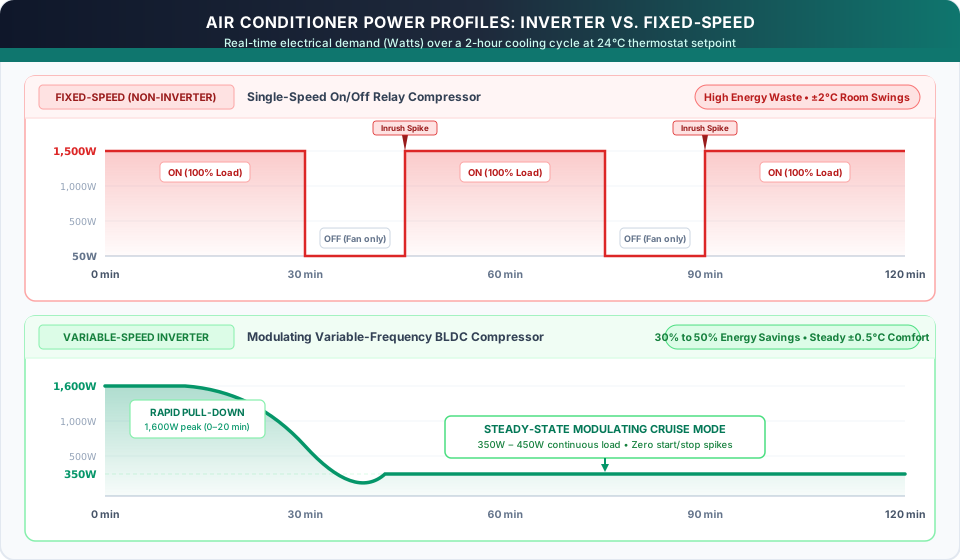
- Inverter ACs: The compressor accelerates to high wattage (e.g., 1,400W–1,800W) during the initial "pull-down" phase to cool a warm room, but throttles down to low cruising wattage (e.g., 250W–450W) once the setpoint is reached.
- Non-Inverter ACs: When running, the compressor typically draws relatively steady operating power, although the actual wattage depends on the specific model and operating conditions. Once the thermostat setpoint is satisfied, the compressor shuts off entirely, leaving only the indoor blower fan drawing ~30W–50W.
Consequently, electricity consumption must be calculated as energy consumed over time (kWh per hour) rather than multiplying nominal rated watts by elapsed hours.
Compressor Technology: Inverter vs. Fixed-Speed (Non-Inverter)
The underlying compressor design is the single biggest factor governing an AC's hourly power profile:
1. Fixed-Speed Non-Inverter ACs
Traditional non-inverter units operate via a simple on/off relay:
- When running, the compressor operates at a single fixed motor speed, drawing relatively steady operating power (though exact wattage varies with ambient outdoor temperature and line voltage).
- When the room drops below the set temperature, the compressor shuts off entirely.
- When the room warms by 1.5°C to 2°C, the compressor restarts with a high inductive inrush current.
- Efficiency Impact: Frequent start-stop cycles waste electrical energy and create noticeable room temperature swings.
2. Variable-Speed Inverter ACs
Modern inverter units use a variable-frequency drive (VFD) controlling a brushless DC (BLDC) motor:
- Pull-Down Phase: Operates at high frequency during the first 20 to 40 minutes to rapidly remove heat.
- Cruising Phase: Instead of switching off, the compressor slows down to match the remaining heat entering the room. How low the compressor can modulate depends on the specific inverter model, room heat load, and engineered minimum operating frequencies.
- Efficiency Impact: Eliminating stop-start cycling and operating at lower speeds significantly improves heat exchanger efficiency, helping reduce overall seasonal energy consumption compared to older fixed-speed units over extended operating periods, though actual savings depend on room insulation, setpoint temperature, and continuous runtime.
4 Real-World Drivers That Dictate Actual Power Draw
An air conditioner's real hourly consumption is determined by the thermal load of the room rather than the machine's label alone:
1. Temperature Differential (ΔT)
The difference between the outdoor ambient temperature and your indoor thermostat setpoint is the primary driver of compressor workload:
- When the outdoor temperature is 34°C and the thermostat is set to 24°C (ΔT = 10°C), an inverter compressor in a reasonably sealed room can stabilize and cruise at reduced power draw.
- When outdoor temperatures reach 42°C peak summer heat and the thermostat is dialed down to 20°C (ΔT = 22°C), the larger temperature difference significantly increases the room's cooling load. Under such conditions, the compressor is forced to operate at elevated frequencies for extended periods to extract continuous heat ingress.
2. Room Envelope & Thermal Insulation
How well your room retains cooled air dictates how often the compressor must work:
- Top-Floor Roof Exposure: Rooms directly beneath an uninsulated concrete roof absorb intense solar radiation. In hot summer weather, an exposed roof can reach 60°C, noticeably elevating the room's thermal cooling load and forcing the compressor to work harder compared to intermediate floors.
- Window Glazing & Solar Heat Gain: Large unshaded windows facing south or west admit significant infrared heat. Single-pane glass transfers heat rapidly compared to double-glazed or film-treated glass.
- Air Infiltration: Gaps under doors, unsealed window frames, and open ventilation grilles allow cool air to escape and hot, humid air to infiltrate, forcing the compressor to dehumidify and cool incoming ambient air continuously.
3. Tonnage Sizing Relative to Room Dimensions
- Undersized AC (e.g., 1.0 Ton in a 200 sq. ft. room): The unit cannot reach the setpoint on hot days. It remains permanently trapped in high-power pull-down mode, consuming more electricity than a properly sized 1.5 Ton unit that can quickly cruise.
- Oversized AC (e.g., 2.0 Ton in a 100 sq. ft. room): Cools the room too quickly without running long enough to adequately dehumidify the space, causing a cold, clammy feeling and unnecessary equipment cost.
4. Day vs. Night Operation
At night, solar radiation ceases, and outdoor ambient temperatures typically drop by 6°C to 12°C. The outdoor condenser dissipates heat much more efficiently, and human metabolic heat loads drop during sleep. An AC operating overnight typically consumes noticeably fewer units than during peak daytime hours, as lower night ambient temperatures improve condenser heat rejection and the absence of solar radiation reduces building heat gain.
Hourly Consumption Benchmarks by Capacity & Technology
Under Bureau of Energy Efficiency (BEE) standards (governed by IS 1391 Part 1 & 2 / ISO 16358 testing procedures), air conditioners are evaluated using ISEER (Indian Seasonal Energy Efficiency Ratio) and labeled with tested Annual Energy Consumption (standardized kWh per 1,600 operating hours).
Because BEE updates its star rating schedules periodically—gradually raising efficiency thresholds every few years—ISEER bands vary depending on the specific notification schedule under which a unit was certified. Rather than relying on static, generic star-tier brackets, consumers should evaluate an appliance's performance using its certified ISEER and annual energy consumption printed directly on the label.
Certified Real-World Commercial Model Benchmarks
To see how statutory testing translates into physical equipment nameplates and energy labels, the following data reflects specific commercial models registered on the official BEE Star Labeling Portal under the variable-capacity inverter split AC test standard (IS 1391 Part 2 / ISO 16358):
- Daikin 1.5 Ton 5-Star Inverter Split AC (Model: MTKM50U / MTKM50UV16U):
- Nominal Full-Load Cooling Capacity: 5,280 Watts (dynamic operational range: 1,580 W – 5,750 W)
- Rated Full-Load Power Input: 1,325 Watts (modulating down to ~267 W at low load, and up to ~1,639 W in boost mode)
- Certified ISEER: 5.20 Wh/Wh
- Certified Annual Electricity Consumption on BEE Label: 785.67 kWh/year (calculated across standard 1,600 annual operating hours)
- Reference: Daikin India Engineering Product Specifications & BEE Star Label Appliance Registry.
- LG 1.5 Ton 5-Star AI Dual Inverter Split AC (Model: TS-Q19YNZE):
- Nominal Full-Load Cooling Capacity: 5,000 Watts (scalable up to 5,800 W in peak capacity mode)
- Rated Full-Load Power Input: 1,284 Watts (modulating down to ~350 W at low speed)
- Certified ISEER: 5.20 Wh/Wh
- Certified Annual Electricity Consumption on BEE Label: 744.99 kWh/year (calculated across standard 1,600 annual operating hours)
- Reference: LG Electronics Technical Specifications & BEE Star Label Appliance Database.
- Voltas 1.5 Ton 3-Star Inverter Split AC (Model: 183V Vectra Prism):
- Nominal Full-Load Cooling Capacity: 4,800 Watts
- Rated Full-Load Power Input: ~1,615 Watts (operating input under rated test condition)
- Certified ISEER: 3.81 Wh/Wh
- Certified Annual Electricity Consumption on BEE Label: 975.26 kWh/year (calculated across standard 1,600 annual operating hours)
- Critical Distinction on Metrics: The figure of 975.26 is the annual cumulative energy consumption in kWh on the BEE Star Label, distinct from the instantaneous full-load electrical input wattage (~1,615 W). Some retail listings erroneously conflate these two separate metrics.
- Reference: Voltas Technical Specification Sheet & Croma / BEE certified product directory.
Crucial Distinction: Certified Model Data vs. General Planning Ranges: The individual models listed above reflect specific laboratory-certified ratings registered with BEE. In contrast, the figures in the summary table below are generalized illustrative planning scenarios across broad equipment classes. They are not certified test benchmarks or universal empirical meter measurements for any single model. Real-world hourly wattage varies continuously with compressor modulation, outdoor ambient heat, room solar heat gain, building envelope insulation, line voltage, and filter cleanliness. For verified data for your specific unit, always inspect the certified annual kWh and rated input printed on the appliance's physical BEE Star Label or verify it on the official BEE Star Labeling Portal.
| Equipment Capacity & Technology Tier | Generalized Rated Input Range (Watts)* | Illustrative Annual Energy Range (kWh/yr)** | Illustrative Moderate Hourly Draw (35°C / 24°C)*** | Illustrative Peak Hourly Draw (42°C / 21°C)*** |
|---|---|---|---|---|
| 1.0 Ton 3-Star Inverter | ~980 W – 1,150 W | ~680 – 760 kWh / yr | 0.65 – 0.85 kWh / hr | 0.95 – 1.15 kWh / hr |
| 1.0 Ton 5-Star Inverter | ~820 W – 980 W | ~520 – 600 kWh / yr | 0.50 – 0.70 kWh / hr | 0.80 – 1.00 kWh / hr |
| 1.5 Ton 3-Star Inverter | ~1,480 W – 1,650 W | ~960 – 1,050 kWh / yr | 0.95 – 1.15 kWh / hr | 1.30 – 1.55 kWh / hr |
| 1.5 Ton 5-Star Inverter | ~1,200 W – 1,450 W | ~680 – 840 kWh / yr | 0.70 – 0.90 kWh / hr | 1.10 – 1.35 kWh / hr |
| 2.0 Ton 5-Star Inverter | ~1,650 W – 1,950 W | ~980 – 1,120 kWh / yr | 1.10 – 1.40 kWh / hr | 1.60 – 2.00 kWh / hr |
| 1.5 Ton Older Non-Inverter | ~1,550 W – 1,800 W | ~1,200 – 1,450 kWh / yr | 1.30 – 1.60 kWh / hr | 1.60 – 1.90 kWh / hr |
*Disclaimer: The values in this table are generalized engineering planning estimates rather than certified empirical measurements for any individual installation. Real-world electricity draw fluctuates continually with ambient weather, room solar exposure, building envelope insulation, line voltage stability, and filter cleanliness. For verified, legally certified data for your specific appliance, refer to the rated power input and certified annual consumption printed on the unit's official BEE Star Label or check the BEE Star Labeling Portal.
Step-by-Step Monthly Energy Calculations
To calculate your estimated monthly electricity consumption and running cost, apply this formula:
Worked Example A: Nighttime Bedroom Cooling (Optimized Conditions)
- Equipment: 1.5 Ton 5-Star Inverter Split AC.
- Operating Profile: 8 hours per night (10:00 PM to 6:00 AM) for 30 days (240 hours total).
- Environment: Well-insulated master bedroom, curtains drawn, thermostat set to 24°C, night ambient temperature ~31°C.
- Calculation:
- Average power draw: ~0.75 kWh per hour.
- Monthly units consumed:0.75 kWh/hr × 8 hrs/day × 30 days = 180 kWh (units)
- Estimated cost (assuming an illustrative tariff of ₹8.00 per unit):180 kWh × ₹8.00 = ₹1,440 per month
Worked Example B: Daytime Living Room Cooling (High Thermal Load)
- Equipment: Identical 1.5 Ton 5-Star Inverter Split AC.
- Operating Profile: 10 hours per day (10:00 AM to 8:00 PM) for 30 days (300 hours total).
- Environment: Top-floor living room with uninsulated roof exposure, large unshaded west-facing windows, thermostat set to 21°C, outdoor ambient averaging ~41°C.
- Calculation:
- Average power draw: ~1.25 kWh per hour (compressor forced to run at elevated frequency).
- Monthly units consumed:1.25 kWh/hr × 10 hrs/day × 30 days = 375 kWh (units)
- Estimated cost (at ₹8.00 per unit):375 kWh × ₹8.00 = ₹3,000 per month
Important Billing Caveat: These worked examples are illustrative planning calculations based on assumed average power draws (0.75 kWh/hr and 1.25 kWh/hr). They do not represent guaranteed utility bills. Actual monthly electricity bills depend on instantaneous power fluctuations, progressive utility tariff slabs (where higher total consumption moves into more expensive unit brackets), fixed monthly standing charges, fuel surcharges (FPPPA), and power consumed by other household appliances.
The 24°C Thermostat Rule & Estimated Savings
A common misconception is that setting an air conditioner to 16°C or 18°C cools the room faster. In many air conditioners, lowering the setpoint does not increase the unit's instantaneous cooling capacity; it simply forces the compressor to operate for a longer period or remain locked at high capacity. Actual cooling speed depends on the equipment's rated cooling capacity, fan airflow, room thermal load, and real-world environmental conditions. Setting the thermostat to 16°C does not make the cooling process faster; the air exiting the indoor unit does not suddenly become substantially colder.
Instead, an excessively low setpoint merely keeps the compressor running at high output for much longer, preventing it from transitioning into efficient low-power cruise mode. Setting the temperature unnecessarily low simply forces the compressor to run near maximum capacity continuously if ambient heat enters as fast as the AC can extract it.
Estimated Potential Savings from Thermostat Adjustments
According to official consumer guidance in the Bureau of Energy Efficiency (BEE) FAQ on Temperature Setting of Air Conditioners, establishing a default setpoint of 24°C delivers healthy thermal comfort while substantially curbing power demand compared to lower setpoints:
- Estimated Per-Degree Savings: BEE's advisory highlights an estimated potential electricity saving of approximately 6% for every 1°C increase in thermostat temperature under standardized modeling conditions.
- Estimated 20°C to 24°C Shift: Adjusting an AC thermostat setting upward from 20°C to 24°C corresponds to an estimated potential energy reduction of roughly 20% to 24% across representative domestic operating profiles.
Crucial Applicability & Real-World Limitations:
- Indicative Model Estimates, Not Guaranteed Results: These percentages reflect theoretical potential savings derived under standardized conditions; they do not represent guaranteed billing reductions for every individual household.
- Latent Heat & Humidity: In high-humidity coastal climates, an air conditioner expends considerable electrical energy on dehumidification (latent heat load) before reaching comfort levels, irrespective of thermostat setpoint.
- Infiltration & Envelope Quality: If room doors are opened frequently or unsealed gaps permit warm air ingress, external heat load will dominate consumption, significantly blunting thermostat-based savings.
- Inverter vs. Fixed-Speed Dynamics: Inverter units capture savings by modulating down to lower compressor speeds and operating at higher heat-exchanger efficiency, whereas non-inverter units realize savings purely through prolonged compressor idle periods between cooling cycles.
5 Practical Methods to Reduce AC Electricity Draw
- Adopt the 24°C to 26°C Comfort Baseline: Setting the thermostat to 24°C provides comfortable indoor conditions while preventing continuous high-frequency compressor loading.
- Pair with a Low-Speed Ceiling Fan: A ceiling fan running on low speed (consuming only 25W–40W) generates gentle air circulation over the skin. The resulting wind-chill evaporation effect makes a 24°C room feel like 22°C without lowering the AC thermostat.
- Clean Air Filters Every 15 Days: Dust-choked mesh filters restrict evaporator airflow, dropping cooling efficiency and forcing the blower fan and compressor to work harder. Regular washing restores designed airflow.
- Maintain Outdoor Condenser Clearances & Unobstructed Airflow: Avoid enclosing or boxing in the outdoor unit with makeshift covers that restrict airflow or trap hot discharge air. Ensure the manufacturer's recommended clearances around all sides are strictly maintained, keep the coil fins free of dust and debris, and follow manufacturer installation guidance regarding direct sunlight exposure.
- Weatherstrip Doors and Windows: Sealing the gap beneath bedroom doors and installing blackout curtains on sun-facing windows minimizes external thermal infiltration.
Authoritative Standards & References
For official energy efficiency standards, star rating verification, and thermal comfort guidelines, consult the following resources:
- Bureau of Energy Efficiency (BEE India) — Statutory regulatory authority under the Ministry of Power governing energy-conservation standards and star-rating thresholds.
- BEE Recommendations on Air Conditioner Temperature Settings — Press Information Bureau — Government of India FAQ — explaining the 24°C default temperature setting, thermal comfort considerations, and estimated energy-saving potential.
- BEE Star Labeling Verification Portal — Official portal for verifying ISEER ratings, model registrations, and certified annual energy consumption figures for residential air conditioners.
- ASHRAE Standard 55: Thermal Environmental Conditions for Human Occupancy — International technical standard establishing indoor temperature, air velocity, and humidity criteria for human thermal comfort.