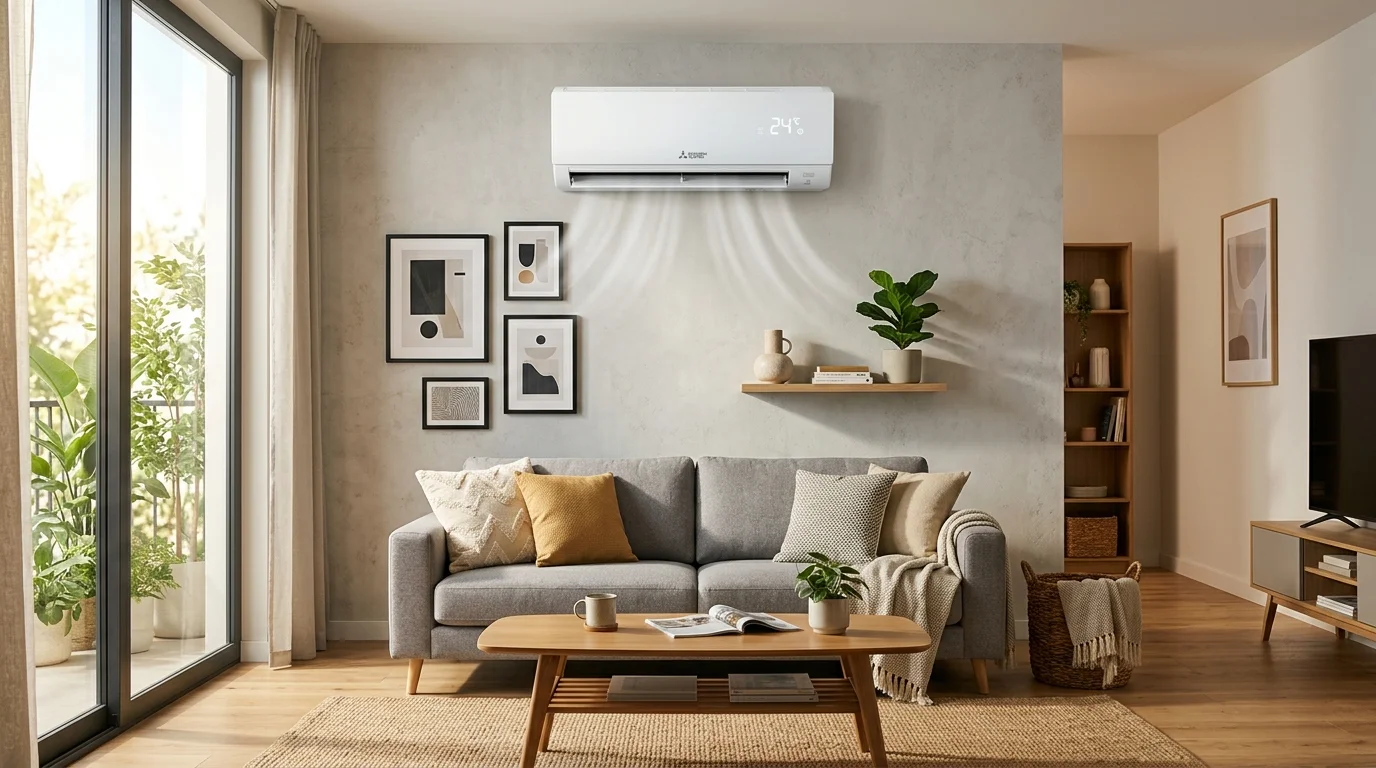
When shopping for a new air conditioner, the first major technical decision is choosing between an Inverter AC and a Non-Inverter (Fixed-Speed) AC.
While inverter models carry a higher upfront purchase price, retail marketing frequently claims they will cut electricity bills by "up to 50%." Conversely, skeptics caution against complex outdoor electronics and costly printed circuit board (PCB) replacements when a unit malfunctions outside of warranty.
Does an inverter air conditioner genuinely save enough electricity to justify its initial price premium? Under what operating hours and room conditions does an inverter deliver rapid payback—and when does a basic fixed-speed model remain the pragmatic choice?
This engineering guide examines the compressor mechanics of both technologies, contrasts power consumption under identical thermal conditions, clarifies BEE EER and ISEER efficiency standards, and models realistic financial payback timelines.
1. How Compressor Mechanics & Motor Control Differ
The compressor typically accounts for a major share of an air conditioner's total electrical draw, though the exact proportion depends on operating conditions, fan speeds, and specific model engineering. The core engineering distinction between inverter and non-inverter systems lies in how this compressor motor is energized and controlled:
Fixed-Speed Non-Inverter AC (On/Off Thermostatic Relay)
A non-inverter compressor operates using a single-speed single-phase induction motor running at a fixed rotational speed (typically ~2,900 RPM at 50 Hz):
- Binary Operation: The motor has only two operational states: 100% capacity (ON) or 0% capacity (OFF).
- Starting Inrush Current: Each time the compressor restarts, it draws a substantial inductive starting surge—termed Locked Rotor Amps (LRA)—which can be 4 to 6 times its normal running current.
- Thermostatic Deadband: Once the indoor temperature drops to the user's setpoint (e.g., 24°C), an electronic relay cuts power, shutting the compressor off entirely while the indoor fan continues blowing. As ambient heat infiltrates and the room warms by 1.5°C to 2.0°C (the thermostat deadband), the compressor restarts at 100% full power.
- Efficiency & Comfort Impact: Frequent start-stop cycling creates noticeable indoor temperature swings (cycling between chilly and stuffy) and incurs thermodynamic cycling losses, as refrigerant pressures equalize every time the unit shuts down.
Variable-Speed Inverter AC (DC Inverter Motor Control)
An inverter air conditioner utilizes an electronic variable-frequency drive (VFD) controlling a Brushless DC (BLDC) motor or Permanent Magnet Synchronous Motor (PMSM):
- Dynamic Frequency Modulation: The outdoor unit's microprocessor rectifies incoming 230V AC mains into direct current (DC), then uses an Intelligent Power Module (IPM) with high-speed switching transistors (IGBTs) to generate a synthesized variable-voltage, variable-frequency 3-phase AC supply.
- Operational Range: By modulating electrical frequency (typically across a range from 15 Hz up to 90+ Hz), the compressor can adjust its rotational speed and volumetric displacement dynamically between roughly 20% and 120% of its nominal rated capacity.
- Two-Stage Cooling Profile:
- Pull-Down Phase: When switched on in a warm room, the compressor accelerates to high frequency (e.g., 1,400W–1,750W for a 1.5-ton unit) to rapidly evacuate room heat.
- Cruising Phase: As the indoor temperature nears the 24°C setpoint, the microprocessor smoothly throttles down compressor frequency to a low-power cruise mode (e.g., 300W–500W), precisely balancing heat entering the room through walls and windows.
- Efficiency & Comfort Impact: Running continuously at modulated speeds significantly increases heat exchanger effectiveness, stabilizes indoor temperature within a narrow band of ±0.5°C, and generally reduces the abrupt compressor-starting current associated with fixed-speed systems.
2. Power Consumption Comparison Under Identical Operating Conditions
To provide a fair and scientifically sound comparison, electricity consumption must be evaluated under a strictly standardized thermal load and operating envelope:
Standardized Comparison Envelope:
- Room Specifications: 150 sq. ft. residential bedroom, 9.5 ft ceiling height, intermediate floor (no direct sun-baked roof exposure), shaded windows, occupancy of 2 adults.
- Operational Profile: 8 hours per night (10:00 PM to 6:00 AM) over a 30-day billing month (240 total operating hours).
- Thermostat Setting: Constant 24°C setpoint across all compared units.
- Outdoor Ambient Temperature: Nighttime summer ambient averaging 32°C dry bulb.
- Illustrative Electricity Tariff: ₹7.50 per kWh (representative domestic tiered slab rate).
Table 1: Illustrative Hourly & Monthly Estimates (Not measured test results for specific retail models)
| Technical Metric / Specification | Older Fixed-Speed (Non-Inverter) | 3-Star Inverter AC | 5-Star Inverter AC |
|---|---|---|---|
| Compressor Motor Technology | Single-Speed Induction Motor | Variable-Speed Compressor | Variable-Speed Compressor (design varies by model; often rotary or twin-rotary) |
| BEE Efficiency Metric & Star Level (2026–2028 Schedule) | Legacy EER: ~2.80 – 3.10 W/W (or baseline 1-Star/2-Star ISEER) | 3-Star: ISEER 4.30 – 4.99 (Split AC) | 5-Star: ISEER 5.60 or higher (Split AC) |
| Rated Nameplate Power Input | ~1,550 W – 1,700 W | ~1,480 W – 1,650 W | ~1,220 W – 1,350 W |
| Illustrative Average Hourly Draw* | 1.50 – 1.65 kWh / hr | 1.00 – 1.15 kWh / hr | 0.75 – 0.85 kWh / hr |
| Estimated Monthly Units (240 hrs) | ~372 kWh (units) | ~258 kWh (units) | ~192 kWh (units) |
| Monthly Energy Charges (@ ₹7.50/kWh) | ₹2,790 | ₹1,935 | ₹1,440 |
| Monthly Savings vs. Non-Inverter | — (Baseline) | ₹855 / month (~31%) | ₹1,350 / month (~48%) |
Note: Data Disclaimer: Average hourly power draw figures in this table are illustrative engineering estimates under the specified moderate nighttime conditions. Real-world consumption varies continuously with outdoor weather severity, room envelope airtightness, solar exposure, line voltage stability, and filter cleanliness. Certified annual benchmarks for specific commercial models should always be verified on the physical BEE Star Label.
Key Takeaway from the Comparison:
Under the specified illustrative assumptions, the 5-star inverter scenario uses about 48% less electricity than the older fixed-speed baseline. Actual savings depend on the models, cooling load, weather, installation and usage rather than representing a guaranteed laboratory test result. Under the same illustrative conditions, the 3-star inverter scenario achieves approximately 31% energy savings over the baseline.
3. Star Ratings, EER, and ISEER Standards Explained
A common point of consumer confusion is how BEE star ratings evaluate fixed-speed and inverter air conditioners:
- Both Fixed-Speed and Inverter ACs Use ISEER: Under current regulations from the Bureau of Energy Efficiency (BEE), the mandatory Star Labeling Scheme covers both fixed-speed and variable-speed (inverter) room air conditioners. Both types are evaluated using the Indian Seasonal Energy Efficiency Ratio (ISEER) based on IS 1391 (Part 1 and Part 2) and ISO 16358 calculation methods.
- Evolution from EER to ISEER: Prior to 2018, fixed-speed ACs were rated on steady-state Energy Efficiency Ratio (EER) at a single fixed test condition (35°C outdoor / 27°C indoor), while inverter ACs operated under a voluntary seasonal scheme. In January 2018, BEE unified both technologies under ISEER, which assesses cooling performance across an annual temperature bin distribution (24°C to 43°C) that mirrors real Indian climatic conditions.
- Official BEE Star Labeling Schedule for Split ACs (1 Jan 2026 – 31 Dec 2028): BEE periodically tightens ISEER rating bands under defined schedule validity periods. Under the schedule valid from 1 January 2026 to 31 December 2028, the official ISEER thresholds for Split Air Conditioners are:
| Star Rating | ISEER Threshold (Split AC: 2026–2028 Schedule) |
|---|---|
| 1-Star | 3.50 – 3.79 |
| 2-Star | 3.80 – 4.29 |
| 3-Star | 4.30 – 4.99 |
| 4-Star | 5.00 – 5.59 |
| 5-Star | 5.60 or higher (≥ 5.60) |
Important Note: These thresholds apply specifically to Split Air Conditioners. Unitary (Window) air conditioners operate under separate, lower ISEER threshold schedules due to form-factor constraints. Always check the label validity dates printed on the physical BEE star label or verify on the BEE Star Labeling Portal rather than assuming permanent universal cutoffs.
4. Financial Payback Analysis: Is the Inverter Premium Worth It?
An inverter air conditioner commands a higher retail price than a fixed-speed or lower-star unit. To evaluate whether this extra investment makes financial sense, consider two distinct usage profiles:
Scenario Assumptions:
- Upfront Price Delta:
- 5-Star Inverter vs. Basic Non-Inverter: ₹9,000 premium (e.g., ₹42,000 vs. ₹33,000).
- 5-Star Inverter vs. 3-Star Inverter: ₹5,500 premium (e.g., ₹42,000 vs. ₹36,500).
- Electricity Tariff: ₹7.50 per kWh (illustrative blended slab rate).
- Illustrative Hourly Energy Savings Delta: 0.75 kWh saved per operating hour (based strictly on the 1.55 kWh baseline vs. 0.80 kWh 5-star inverter illustrative scenario; not an empirical measurement for every commercial AC pairing).
- Hourly Financial Savings: 0.75 kWh × ₹7.50 = ₹5.625 per operating hour.
- Maintenance Cost: Assumes an equal annual preventive wet-jet servicing cost (~₹600–₹800/year) for both technologies.
Profile A: Moderate Seasonal Use (North/Central India Household)
- Runtime: 120 days per year (4 summer months), 8 hours per day = 960 annual operating hours.
- Monthly Savings (5-Star Inverter vs. Non-Inverter): ₹1,350 per month.
- Annual Savings (4 operating months): Annual Savings = 960 hours × ₹5.625/hour = ₹5,400 per year
- Simple Payback Period: Payback Period = ₹9,000 price difference ÷ ₹5,400 annual savings ≈ 1.67 Years (approx. 20 operating months)
Profile B: Intensive Year-Round Use (Coastal / Tropical Household)
- Runtime: 210 days per year (7 hot/humid months), 10 hours per day = 2,100 annual operating hours.
- Annual Electricity Savings: Annual Savings = 2,100 hours × ₹5.625/hour ≈ ₹11,812 per year
- Simple Payback Period: Payback Period = ₹9,000 price difference ÷ ₹11,812 annual savings ≈ 0.76 Years (under 10 months)
The Financial Verdict & Realistic Payback Range:
To understand the relationship between annual operating hours and payback period under this illustrative scenario (assuming an illustrative savings delta of 0.75 kWh/hr and a ₹7.50/kWh tariff = ₹5.625/hr):
Moderate Seasonal Cooling (600 operating hours/year, e.g., 75 days at 8 hrs/day):
- Annual Savings: 600 hours × ₹5.625/hour = ₹3,375 per year
- Simple Payback Period: ₹9,000 ÷ ₹3,375 ≈ 2.67 years (approximately 2.5 to 3 cooling seasons).
Very Low Seasonal Cooling (Under 200 operating hours/year, e.g., guest room or ~1.5 hours/day across 100 summer days):
- Annual Savings: 180–200 hours × ₹5.625/hour ≈ ₹1,012 to ₹1,125 per year
- Simple Payback Period: ₹9,000 ÷ ₹1,125 ≈ 8.0 years (or ~8.9 years at 180 hours). This directly explains why an inverter AC in an infrequently used guest room or holiday home takes 8+ years to recover its upfront purchase difference.
Intensive Year-Round Cooling (1,500 to 2,100 operating hours/year):
- Payback drops to under 1 cooling season (0.76 to 1.1 years).
Under these illustrative assumptions, households operating an AC for 600 to 1,000 hours per year can realistically expect a simple payback period of 1.5 to 3.5 years.
Importantly, this is an illustrative engineering estimate rather than a universal guarantee. Actual financial payback depends on:
- The actual retail price delta between specific models,
- Local utility tariff slabs and fuel adjustment charges,
- Ambient temperature severity and room insulation (which dictate how many hours the compressor operates in low-power cruise mode),
- Routine preventive maintenance and proper refrigerant levels.
Over an expected 8-to-10-year appliance lifespan, cumulative electricity bill savings for moderate and heavy users may exceed the initial purchase premium, depending on actual usage and measured savings.
5. Maintenance, PCB Reliability, and Out-of-Warranty Repair Costs
While inverter ACs deliver clear thermodynamic and billing advantages, their electronic complexity introduces specific maintenance and reliability considerations:
+-----------------------------------+-----------------------------------+
|       FIXED-SPEED NON-INVERTER    |         VARIABLE-SPEED INVERTER   |
+-----------------------------------+-----------------------------------+
| • Simple electro-mechanical relay | • Complex outdoor microprocessor  |
| • Low-cost contactor / capacitor  | • Sensitive IPM / IGBT transistors|
| • Highly tolerant to voltage spikes| • Requires voltage surge protection|
| • Relay/capacitor: ~₹800-₹1,800*  | • Out-of-warranty PCB: ~₹5,000-₹9,500*|
+-----------------------------------+-----------------------------------+
Note: Indicative informal trade estimates based on field technician feedback and non-standardized multi-brand service contractor pricing; not statutory standardized figures. Actual repair expenses vary substantially by brand, model tonnage, local service availability, component tier, and technician inspection fees.
Key Technical Reliability Factors:
- Outdoor PCB Vulnerability: Inverter air conditioners house sensitive power electronics (the main inverter PCB and Intelligent Power Module) inside the outdoor condensing unit. In coastal locations exposed to salty sea breezes or near open storm drains emitting hydrogen sulfide gases (H₂S), exposed copper traces on circuit boards can corrode rapidly.
- Conformal Coating Protection: Tier-1 manufacturers address environmental corrosion by applying industrial resin or silicone conformal coatings across outdoor circuit boards (marketed under proprietary names like "Ocean Black Protection", "Gold Fin", or "Hyper PCB").
- Indicative Out-of-Warranty Replacement Costs: If a fixed-speed AC's starting capacitor or relay fails, component replacement typically ranges from an indicative ₹800 to ₹1,800 including visiting charges based on multi-brand technician trade estimates. If an inverter outdoor power PCB fails outside of warranty, authorized manufacturer replacement costs generally range between ₹5,000 and ₹9,500+ according to trade estimates, depending on compressor tonnage, PCB generation, and labor fees. Because component pricing is set privately by individual brand service networks without standardized statutory price caps, consumers should obtain a formal written job-sheet estimate from their brand's authorized service center.
- Manufacturer Warranty Coverage Terms: While promotional advertising frequently highlights "5-year PCB" or "10-year compressor" warranties, these terms are not an industry-wide universal standard. Standard manufacturer warranty in India is typically 1 year comprehensive. Extended warranties (such as 5 or 10 years on specific components) are brand- and model-dependent policies with strict contractual stipulations. For example, LG India Air Conditioner Warranty Terms & Policy outline specific eligibility rules, component coverage limits, and mandatory registration requirements. Furthermore, manufacturer warranties routinely exclude defects resulting from external voltage surges, environmental gas corrosion, or uncertified third-party tampering. Consumers should always inspect the exact written warranty terms on the manufacturer's official portal prior to purchase.
6. When Does a Non-Inverter AC Still Make Pragmatic Sense?
Despite the clear energy superiority of inverters, fixed-speed non-inverter models remain a reasonable engineering and financial choice in specific circumstances:
- Infrequent Low-Usage Rooms: Guest bedrooms or vacation cottages occupied for only 15 to 25 days per year cannot generate sufficient electricity savings to ever recover the ₹9,000 upfront price difference.
- Server & Dedicated Equipment Closets: Small data closets or server rooms with continuous, high internal thermal loads may keep the compressor running at or near full capacity continuously. When an air conditioner operates predominantly at 100% load without opportunities to modulate down into low-frequency cruising mode, the seasonal part-load efficiency advantage of an inverter compressor narrows significantly, making the initial price premium less economically compelling.
- Temporary Rental Living: If you reside in a rental property and anticipate relocating within 12 months, the initial price premium may not be recouped before you move.
Summary & Buying Recommendation
| Usage Scenario | Recommended AC Choice | Primary Engineering Rationale |
|---|---|---|
| Daily bedroom or living room cooling (>6 hrs/day) | 5-Star Inverter AC | Lowest operating cost; typical payback within 1.5–3.5 years under moderate to high seasonal use; superior temperature stability. |
| Regular domestic cooling (4–6 hrs/day) | 3-Star Inverter AC | Balanced upfront price and operating efficiency; excellent comfort without high entry cost. |
| Very low seasonal use (<200 hrs/year or guest room) | Fixed-Speed Non-Inverter | Low initial cost; at under 200 annual hours (~₹1,125/year savings), recovering the ₹9,000 premium takes 8+ years. |
Authoritative Standards & References
For statutory energy standards, star-label schedules, and thermal testing criteria, consult the following official resources:
- Bureau of Energy Efficiency (BEE India) — Statutory regulatory authority under the Ministry of Power governing energy-conservation thresholds and ISEER star-labeling schedules.
- BEE Star Labeling Verification Portal — Official database for verifying ISEER ratings, model registrations, and certified annual energy consumption metrics.
- Bureau of Indian Standards (BIS) - IS 1391 (Part 1 & 2) — Indian technical standard for room air conditioners: Part 1 (Unitary / Fixed-Speed) and Part 2 (Split / Variable-Capacity Inverter Systems).
- ISO 16358: Non-ducted air conditioners and heat pumps — International standard establishing testing and calculation methods for seasonal energy efficiency factors (CSPF/ISEER).
- LG India Air Conditioner Warranty Terms & Policy — Manufacturer warranty conditions, compressor coverage guidelines, and authorized service terms.
- BEE Air Conditioner Temperature Setting & Energy Efficiency FAQ — Official advisory on thermal comfort, 24°C setpoints, and seasonal electrical energy conservation.