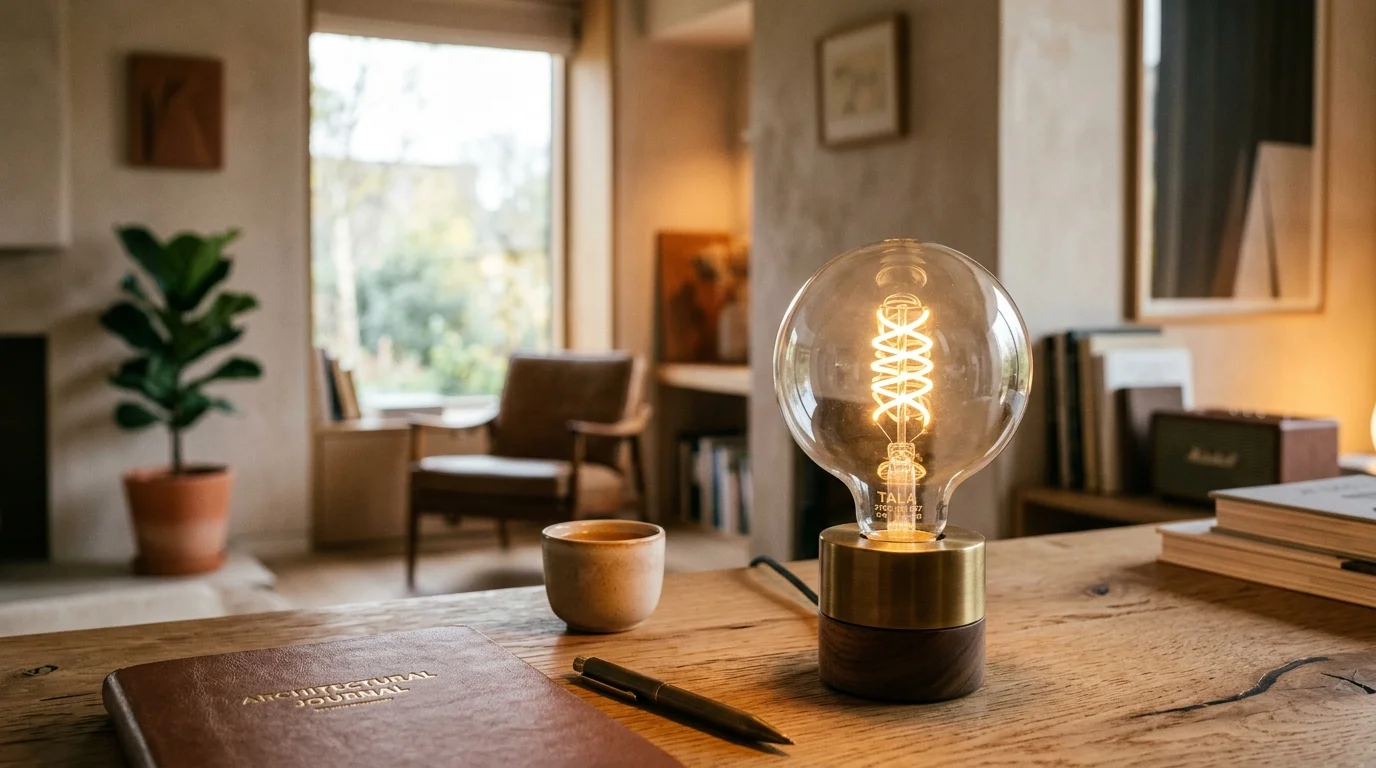
Lighting's share of residential electricity consumption varies with household size, climate, occupancy, and usage patterns. Replacing inefficient bulbs with LEDs can reduce the electricity used for lighting, although the actual savings depend on how often the lights are used and which bulbs they replace. While swapping out light bulbs may seem like a minor adjustment compared to purchasing a new five-star refrigerator or installing a rooftop solar array, the mathematical return on investment (ROI) makes lighting one of the quickest energy-saving upgrades available to homeowners.
Despite the global phase-out of inefficient lighting, millions of households still operate older incandescent lamps, halogen spotlights, and aging Compact Fluorescent Lamps (CFLs).
In this article, we analyze the physics of light generation, compare energy consumption at identical brightness levels, calculate annual running costs with explicit variables, and evaluate long-term lifecycle savings backed by official regulatory benchmarks.
1. Watts vs. Lumens: Redefining How We Measure Light
For over a century, consumers evaluated light bulbs based on Watts. However, wattage measures electrical power input ($1\text{ Watt} = 1\text{ Joule per second}$), not light output.
Modern lighting is measured by two fundamental scientific metrics:
- Luminous Flux (Lumens, lm): The total quantity of visible light emitted by a lamp as perceived by the human eye. Higher lumens equal brighter light.
- Luminous Efficacy (Lumens per Watt, lm/W): The metric of energy efficiency, showing how many lumens of visible light a bulb produces for every single Watt of electricity consumed.
[ Electrical Energy In (Watts) ] ──► [ Bulb / Light Source ] ──► [ Visible Light (Lumens) ]
                                                              └─► [ Wasted Heat (Infrared) ]
When an incandescent bulb draws 60 Watts, roughly 90% of its energy is released as heat, producing only about 800 lumens of visible light (~13.3 lm/W). By contrast, a modern solid-state Light Emitting Diode (LED) requires only 8.5 to 9 Watts to produce the exact same 800 lumens (~89 to 94 lm/W; higher efficacy models producing 850 lumens at 8.5W can achieve 100 lm/W).
Standard Brightness Equivalence Chart Across Technologies
To compare bulbs accurately, you must evaluate fixtures providing identical luminous output (lumens). However, keep in mind that while lumens measure total light output in all directions, the actual perceived illumination in a room also depends on the bulb's beam angle, diffuser optics, and the physical design of the light fixture:
| Light Output (Brightness) | Typical Household Application | Incandescent (Legacy) | Halogen (Intermediate) | CFL (Fluorescent) | LED (Modern Solid-State) |
|---|---|---|---|---|---|
| 450 Lumens | Bedside lamps, accent & mood lighting | 40 Watts | 28 Watts | 9 – 11 Watts | 5 – 6 Watts |
| 800 – 850 Lumens | Standard bedrooms, living areas, hallways | 60 Watts | 42 Watts | 13 – 15 Watts | 8.5 – 9.5 Watts |
| 1,100 Lumens | Kitchens, reading lamps, study desks | 75 Watts | 53 Watts | 18 – 20 Watts | 11 – 13 Watts |
| 1,600 Lumens | Workshops, large living rooms, commercial spaces | 100 Watts | 70 Watts | 23 – 26 Watts | 14 – 17 Watts |
2. Direct Technical Comparison: 800 Lumens Benchmark
Taking the standard residential 60W-equivalent brightness tier (~800 lumens) as an exact benchmark, here is how the primary bulb technologies compare across engineering specifications:
| Specification | Incandescent (Filament) | CFL (Compact Fluorescent) | LED (Solid-State Diode) |
|---|---|---|---|
| Power Consumed to Produce 800 lm | 60 Watts | 14 Watts | 8.5 – 9.0 Watts |
| Luminous Efficacy | ~13.3 lm/W | ~57 lm/W | ~89 – 94 lm/W (up to 100 lm/W for 850 lm models) |
| Average Rated Operating Lifespan | 1,000 hours (~200 days at 5 hours/day; actual life varies) | 8,000 hours (~4 to 5 years; electrode depletion) | 15,000 – 25,000 hours ($L_{70}$ lumen maintenance benchmark)* |
| Thermal Characteristics & Heat Dissipation | ~90% of its energy is released as heat | Substantial heat loss via discharge tube and ballast | Low radiated heat; residual heat is conducted internally to heat sink |
| Switching Cycle Durability | High (unaffected by toggles) | Low (frequent on/off cycling shortens cathode life) | Switching durability varies by product; frequent cycling may affect some lower-cost driver designs |
| Contains Hazardous Mercury? | No | Yes (requires specialized hazardous disposal) | Generally no mercury; check product specifications and local disposal guidance |
| Warm-Up Time to Full Brightness | Instant (<0.1 sec) | Some CFLs take time to reach full brightness; warm-up varies by model and temperature | Instantaneous (<0.1 sec) |
| Dimmability Compatibility | Universal (triac dimmers) | Rare (requires specialized dimmable CFLs) | Requires compatible dimmable LED bulb and dimming control hardware; pairing compatibility should be checked before installation |
(Note on LED Lifespan: Unlike incandescent bulbs that fail abruptly when the tungsten filament snaps, LEDs experience gradual lumen depreciation. Under ENERGY STAR guidelines, rated LED lifespan is typically defined as $L_{70}$—the number of operating hours until light output diminishes to 70% of its initial rated lumens).
3. Annual Running Cost Calculation: Mathematical Breakdown
To calculate the comparative operating cost of lighting, we define the following engineering variables:
- $P$ = Rated Electrical Power (Watts)
- $t$ = Daily Operating Hours ($5\text{ hours/day}$ standard residential usage)
- $D$ = Operating Days per Year ($365\text{ days}$)
- $R$ = Electricity Tariff Rate ($\text{₹}7.50\text{ per kWh}$, approximately $$0.09\text{ USD/kWh}$)
(Note: The tariff of ₹7.50/kWh and bulb retail prices of ₹15 for incandescent, ₹80 for CFL, and ₹90 for LED are illustrative baseline assumptions for comparison; actual tariffs, retail prices, and product lifespans vary by state, utility, and brand).
Mathematical Formula:
$$\text{Annual Energy Consumption (kWh)} = \frac{P\text{ (Watts)} \times t\text{ (Hours/Day)} \times D\text{ (Days)}}{1,000}$$ $$\text{Annual Electricity Cost (₹)} = \text{Annual Energy Consumption (kWh)} \times R\text{ (₹/kWh)}$$
Step-by-Step Calculation for a Single 800-Lumen Fixture:
60W Incandescent Lamp: $$\text{Annual Energy} = \frac{60\text{ W} \times 5\text{ hrs} \times 365\text{ days}}{1,000} = \mathbf{109.50\text{ kWh/year}}$$ $$\text{Annual Cost} = 109.50\text{ kWh} \times \text{₹}7.50 = \mathbf{\text{₹}821.25\text{ / year}}$$
14W Compact Fluorescent Lamp (CFL): $$\text{Annual Energy} = \frac{14\text{ W} \times 5\text{ hrs} \times 365\text{ days}}{1,000} = \mathbf{25.55\text{ kWh/year}}$$ $$\text{Annual Cost} = 25.55\text{ kWh} \times \text{₹}7.50 = \mathbf{\text{₹}191.63\text{ / year}}$$
9W Solid-State LED Bulb: $$\text{Annual Energy} = \frac{9\text{ W} \times 5\text{ hrs} \times 365\text{ days}}{1,000} = \mathbf{16.425\text{ kWh/year}}$$ $$\text{Annual Cost} = 16.425\text{ kWh} \times \text{₹}7.50 = \mathbf{\text{₹}123.19\text{ / year}}$$
Annual Savings Summary Per Single Socket:
| Technology Comparison | Annual Electricity Used | Annual Electricity Cost | Annual Net Savings Per Socket | Percentage Energy Reduction |
|---|---|---|---|---|
| Incandescent (60W) | 109.50 kWh | ₹821.25 | Baseline | Baseline |
| CFL (14W) | 25.55 kWh | ₹191.63 | ₹629.62 saved vs Incandescent | 76.7% reduction vs Incandescent |
| LED (9W) | 16.43 kWh | ₹123.19 | ₹698.06 saved vs Incandescent (₹68.44 saved vs CFL) |
85.0% reduction vs Incandescent (35.7% reduction vs CFL) |
Whole-House Impact (12 Active Light Fixtures):
In a typical home operating 12 active light fixtures for 5 hours daily:
- Incandescent Home (12 × 60W): Consumes $1,314\text{ kWh/year}$, costing ₹9,855.00/year.
- Full LED Home (12 × 9W): Consumes $197.1\text{ kWh/year}$, costing ₹1,478.25/year.
- Net Annual Household Savings: $1,116.9\text{ kWh}$ saved and $\text{₹}8,376.75$ cash savings every year.
4. 25,000-Hour Lifecycle Economics & Payback Period
To understand the full financial lifecycle, we evaluate both electricity consumed and the capital replacement cost of purchasing new bulbs over an illustrative 25,000-hour service life (approximately 13.7 years at 5 hours/day, or 11.4 years at 6 hours/day):
These are illustrative lifecycle estimates, not guaranteed outcomes. They assume the stated rated lifespans, purchase prices, constant electricity tariff, and continuous replacement when a bulb reaches its assumed service life. Actual costs vary by product quality, operating conditions, replacement timing, and local electricity rates. The calculation excludes labour, disposal, and changes in electricity prices.
(Note on LED Lifespan Consistency: While residential LED models in the market commonly have rated lifespans ranging from 15,000 to 25,000 hours, the calculation below models an illustrative scenario using a 25,000-hour rated LED. In accordance with ENERGY STAR guidelines, LED operational life is typically defined by lumen maintenance—the number of operating hours until light output diminishes to 70% of initial rated lumens ($L_{70}$)—rather than sudden catastrophic failure).
| Cost Factor | Incandescent (60W) | CFL (14W) | LED (9W) |
|---|---|---|---|
| Rated Lifespan per Bulb | 1,000 hours | 8,000 hours | 25,000 hours |
| Bulbs Needed for 25,000 Hours | 25 bulbs | 3.125 bulbs (~4 bulbs)* | 1 bulb |
| Bulb Replacement Hardware Cost | 25 × ₹15 = ₹375.00 | 4 × ₹80 = ₹320.00 | 1 × ₹90 = ₹90.00 |
| Lifetime Electricity Consumed | 1,500 kWh ($60\text{W} \times 25,000\text{h}$) | 350 kWh ($14\text{W} \times 25,000\text{h}$) | 225 kWh ($9\text{W} \times 25,000\text{h}$) |
| Lifetime Electricity Cost (@ ₹7.50/kWh) | ₹11,250.00 | ₹2,625.00 | ₹1,687.50 |
| Total Combined 25,000-Hour Cost | ₹11,625.00 | ₹2,945.00 | ₹1,777.50 |
(Note on replacement counts: Over 25,000 hours, a CFL rated at 8,000 hours requires $25,000 \div 8,000 = 3.125$ bulbs. Pricing 4 whole bulbs represents a conservative purchasing model, though the fourth bulb's full rated service life is not entirely consumed within this comparison window).
Net Lifecycle Savings: Operating a single 9W LED instead of a 60W incandescent bulb saves an estimated ₹9,847.50 per socket over 25,000 hours under these assumptions. Across a 12-fixture home, total cumulative savings can exceed ₹118,000.
Payback Period Analysis:
Assuming a representative retail purchase price of ₹90 for a quality 9W LED bulb and ₹15 for a 60W incandescent lamp:
- Daily Electricity Savings vs. 60W Incandescent: $$\Delta E = \frac{(60\text{ W} - 9\text{ W}) \times 5\text{ hours}}{1,000} = 0.255\text{ kWh / day}$$
- Daily Financial Savings: $$0.255\text{ kWh} \times \text{₹}7.50 = \mathbf{\text{₹}1.9125\text{ / day}}$$
- Full-Cost Simple Payback: $$\text{Full Payback} = \frac{\text{₹}90\text{ (LED Price)}}{\text{₹}1.9125\text{ / day}} \approx \mathbf{47\text{ Operating Days}}$$
- Incremental-Cost Payback: $$\text{Incremental Payback} = \frac{\text{₹}90 - \text{₹}15}{\text{₹}1.9125\text{ / day}} = \frac{\text{₹}75}{\text{₹}1.9125\text{ / day}} \approx \mathbf{39\text{ Operating Days}}$$
After the simple payback period, continued use can generate further electricity-bill savings compared with the assumed incandescent alternative. Actual net savings depend on bulb prices, lifespan, replacement costs, and the electricity tariff.
5. The Thermal Factor: Impact on Air Conditioning
Incandescent bulbs release a large share of their electrical energy as heat, while LEDs generally produce the same useful light with much less electrical input. In air-conditioned rooms, replacing incandescent bulbs with LEDs can reduce the heat load that the cooling system needs to remove. The actual electricity savings from reduced cooling depend on the room, climate, air-conditioner efficiency, and hours of use.
ENERGY STAR highlights that incandescent bulbs release about 90% of their energy as heat, while energy-efficient LEDs emit significantly less ambient heat, reducing parasitic thermal loads on indoor living spaces. By contrast, LEDs conduct their residual heat away from the diode via an internal aluminum heat sink, keeping the optical beam cool.
6. Practical Consumer Guide: How to Buy the Right LED
When replacing traditional bulbs, use the following engineering checklist:
- Match Lumens, Not Watts:
- 450 lumens $\to$ 40W replacement
- 800–850 lumens $\to$ 60W replacement
- 1,600 lumens $\to$ 100W replacement
- Choose the Right Color Temperature (Kelvin Scale):
- Warm White (2,700K – 3,000K): Warm, amber tone matching traditional incandescent filaments; best for living rooms, bedrooms, and dining spaces.
- Neutral White (4,000K – 4,500K): Crisp, balanced white without yellow or blue bias; optimal for kitchens, bathrooms, and home offices.
- Cool Daylight (6,500K): High-contrast blue-white light; ideal for workshops, garages, and commercial utility areas.
- Check the Color Rendering Index (CRI / $R_a$):
- Choose bulbs with $\text{CRI} \ge 80$ for general residential rooms.
- Choose $\text{CRI} \ge 90$ for vanity mirrors, kitchen food prep, and reading areas to ensure colors appear vivid and accurate rather than dull or greenish.
- Inspect Dimmer Compatibility:
- Some LED bulbs may flicker, buzz, or fail to dim properly when used with older incandescent dimmers. If you use a dimmer switch, choose a bulb explicitly rated as dimmable and check the manufacturer's compatibility guidance for the dimmer model. Compatibility depends on the bulb's driver and the dimmer hardware.
7. Authoritative Standards & Regulatory References
For verified technical performance standards, efficiency criteria, and energy conservation data, refer to the following official regulatory bodies:
- ENERGY STAR / U.S. EPA & DOE: ENERGY STAR — Learn About LED Lighting — Official technical specifications establishing that ENERGY STAR-certified residential LED bulbs use up to 75% to 85% less energy than standard incandescent lighting, meet strict color rendering metrics, and last up to 15 to 25 times longer.
- Bureau of Energy Efficiency (BEE), Ministry of Power, India: BEE — Self-Ballasted LED Lamps Regulations & Star Labeling — Official statutory schedule under the Energy Conservation Act specifying standards and labeling criteria, testing protocols, and luminous efficacy thresholds for self-ballasted LED lamps for general lighting services.
- U.S. Department of Energy (DOE): Building Technologies Office — Solid-State Lighting — National research and development reports tracking the metrological progress, luminous efficacy limits, and thermal performance of solid-state semiconductors.