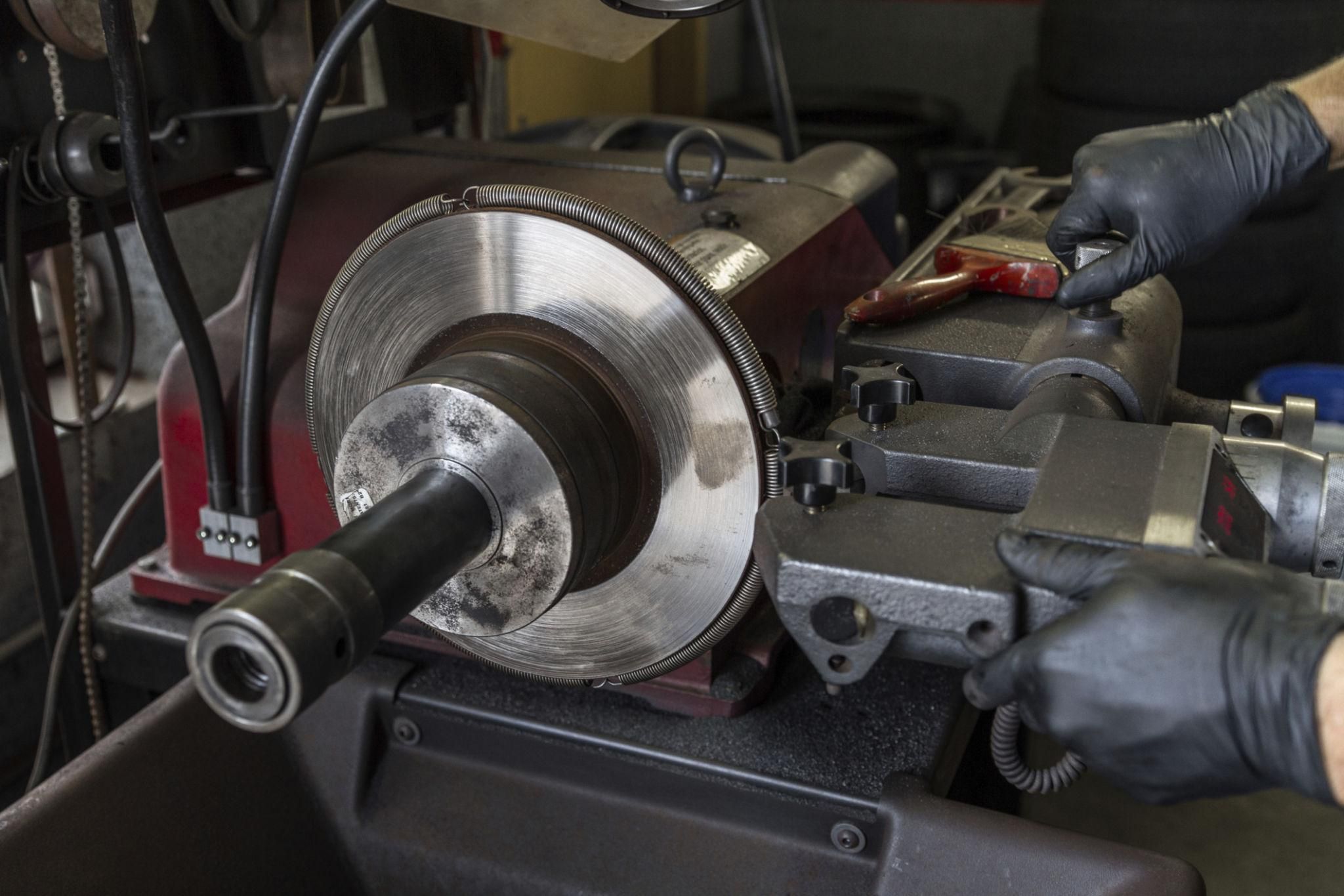
When you press the brake pedal at highway speeds and feel a vibration through the steering wheel, a worn rotor surface is usually to blame. Repeated braking subjects metal discs to continuous friction and high heat. Over thousands of miles, this creates surface grooves, uneven wear, or lateral runout across the face.
Rather than replacing every worn rotor, repair shops often resurface them on a specialized lathe. Machining removes a thin layer of metal, restoring a flat, smooth braking surface so new pads make even contact.
Here is how brake disc turning machines work step by step, how bench and on-car lathes compare, and which safety limits keep brake repairs reliable.
What Is a Brake Disc Turning Machine and How It Works Step by Step
Garages rely on brake lathes when resurfacing a worn rotor. These machines mount the disc on a spinning arbor and slice away damaged metal with twin carbide bits. The resurfacing process follows five basic steps.
First, check the rotor for deep cracks or heavy rust pitting, then take a micrometer reading to verify disc thickness. Second, secure the disc onto the lathe arbor using matching steel adapter cones so it turns true without wobble. Third, set the adjustable tool arms so both carbide bits touch the friction surfaces at the same time. Fourth, start the electric drive motor to spin the rotor while the power feed advances the cutting tools across the disc face from the inner hub out. Fifth, once machining finishes, wash the rotor thoroughly with warm soapy water to scrub microscopic iron dust out of the surface grooves.
Common Reasons Rotors Need Resurfacing
Daily driving subjects brake discs to heavy friction and thermal cycling. Over time, several surface defects develop. Road grit, rust scale, or worn pad backing plates carve shallow channels into the rotor face. Variations in disc thickness make the brake pedal pulse under your foot. Vehicles parked in damp weather build up surface rust patches that ruin pad bite. In addition, overheated pad friction material bakes onto the iron, causing spotty pad contact and brake noise. Resurfacing removes these flaws, giving new brake pads a flat, clean surface to bed into right away.
Off-Car Bench Lathes vs. On-Car Brake Lathes
Workshops generally rely on two machine configurations depending on the vehicle layout and repair workflow.
Off-Car Bench Lathes
Bench lathes sit mounted on a sturdy shop workbench. The mechanic unbolts the brake disc from the wheel hub, secures it onto the lathe arbor using adapter cones, and runs the cut. Bench lathes are fast to set up, highly versatile, and allow technicians to machine rotors while the vehicle stays on the hoist for other service tasks.
On-Car Brake Lathes
An on-car lathe attaches directly to the vehicle wheel hub while the rotor stays installed on the spindle. An electric drive turns the hub while the cutter head trims both friction faces simultaneously. Because the disc is machined directly on the hub, the machine automatically compensates for minor runout in the hub bearing assembly itself.
Essential Components of a Brake Lathe
Under the casing, four primary mechanical assemblies handle the cutting process. An electric drive motor rotates the arbor or wheel hub at a controlled speed suited for cast iron. Precision steel adapter cones lock different hub bore sizes dead-center on the shaft. Dual cutting tool arms hold sharp carbide bits to machine both friction faces in a single pass. Finally, an automated feed drive advances the cutting arms smoothly across the rotor face at a set feed rate.
Minimum Rotor Thickness and Critical Safety Limits
Rotor thickness is the most critical safety factor in brake resurfacing. Machining must never reduce disc thickness below the manufacturer's specified discard limit.
Every brake rotor has a minimum thickness spec stamped directly on the outer edge or mounting hat, such as "MIN THICK 24.0 MM". Technicians measure the thinnest point on the disc with a micrometer before starting the lathe.
If machining will drop the disc below this minimum limit, replace the rotor. Rotors below minimum thickness lose heat capacity, warp quickly under load, and risk structural cracking during heavy emergency braking.
Rotor Runout and Surface Cleaning Best Practices
Achieving a smooth, noise-free brake job requires attention to alignment and proper cleaning.
First, clean the hub mating faces. Rust scale or debris trapped between the wheel hub and rotor hat will tilt the disc on the lathe arbor, ruining your alignment. Wire-brushing those mating surfaces clean before mounting is essential.
Second, wash the rotor thoroughly after machining. Once off the lathe, scrub the disc with warm soapy water and a stiff nylon brush. Do not rely on brake cleaner aerosol alone. Solvents evaporate quickly and leave fine iron dust trapped in the microscopic machining grooves, which can glaze fresh brake pads right away.
When to Resurface vs. When to Replace
Resurface the rotor if: You have light grooves, mild surface rust, or minor pedal pulsation, provided remaining thickness stays well above the discard spec.
Replace the rotor if: Thickness is near or below the minimum limit, or if the disc shows deep thermal cracks, heavy rust pitting, blue heat spots, or structural damage beyond allowable limits.
Quick Summary Checklist
- ✔ Brake lathes remove small amounts of metal to restore flat braking surfaces.
- ✔ On-car lathes machine rotors directly on the vehicle to correct hub runout.
- ✔ Bench lathes provide fast, versatile resurfacing for dismounted discs.
- ✔ Always measure minimum thickness specifications with a micrometer before cutting.
- ✔ Never re-use rotors below the stamped discard limit because thin iron loses heat capacity.
- ✔ Wash machined rotors with warm soapy water to scrub out metal dust before installing new pads.