This article discusses the basics of producing these materials, the technologies involved, and their relevance in various fields. The text below provides an insight into the manufacturing process and the importance of wires and cables.
What Is Cable and Wire Manufacturing?
Cable and wire manufacturing is an umbrella term that covers the processes of making electrical conductors. Although these terms are often used interchangeably, wires and cables differ from each other. The former refers to a single electrical conductor, while the latter consists of multiple conductors enclosed within an insulating material.
Modern manufacturing technologies enable the production of high-quality electrical conductors capable of withstanding extreme conditions. The general process involves several stages, such as:
- Preparing the conductor
- Applying insulation materials
- Quality tests
Each step is mandatory since it plays a significant role in the performance of the final product. In general, the manufacturing process of these materials is complex and involves various elements of production technology.
Importance of Cable and Wire Manufacturing
Cables and wires are essential components in most electrical systems. Their main function is to facilitate the flow of current in various electrical devices and machines. Modern manufacturing processes ensure that these materials possess enhanced characteristics, enabling them to fulfill their functions efficiently.
In addition to their role in enabling the operation of most electrical devices, conductors are critical components in the functioning of the modern world. For example, a typical office building consists of multiple electrical systems. All of these systems rely on conductors to facilitate the flow of electricity. Each of these systems uses a different type of cable, which is manufactured according to its specifications. This is just one example of how these materials are critical enablers of modern infrastructure.
Types of Cables and Wires
There are several types of electrical conductors used in different applications. Modern manufacturers offer a wide variety of conductors with different specifications.
Generally, these materials can be grouped into four broad categories, depending on their application. These include:
- Communication cables and wires
- Power cables
- Control cables
- Specialty industrial cables and wires
Power Cables
Power cables are used in most aspects of modern infrastructure. These are typically used in electrical systems that rely on alternating current (AC) to supply electricity to residential and commercial buildings. In addition to residential and commercial buildings, these materials also find application in industrial facilities.
Communication Cables
Communication cables are used in all electrical devices that involve data transmission. Most modern devices rely on data transmission, and such properties are critical for their proper operation.
Control Cables
Control cables are used in most automated systems, where they facilitate the transmission of electrical impulses. Most automated industrial systems use these materials to transmit information between industrial equipment and control panels.
Specialty Industrial Cables
Industrial facilities often require highly-specialized materials that are capable of withstanding extremely severe operating conditions. For example, some manufacturers specialize in producing materials designed for use in specific environments or applications, such as marine, renewable energy, mining, and transportation.
Raw Materials Used in Manufacturing
The properties of the final product largely depend on the raw materials used during manufacturing. There are several materials that can be used to make electrical conductors. However, there are only a few materials that are considered ideal for this purpose.
Conductive Materials
There are several materials that are used in making the conductive core of wires and cables. The most common materials are copper and aluminum. Both materials offer excellent conductivity, and their use depends on the intended application. In general, copper offers better conductivity and is considered to be stronger than aluminum.
Insulating Materials
The primary function of insulating materials is to prevent unwanted current flow outside the conductor’s core. To achieve this objective, manufacturers use a wide range of materials that offer mechanical protection and insulation. In general, most manufacturers use polymers that offer high performance.
Cable and Wire Manufacturing Processes
Modern manufacturers use a wide range of technologies to produce cables and wires. Most of these technologies help to improve the performance of the final product.
Some of the key steps in this process are described below.
Conductor Production
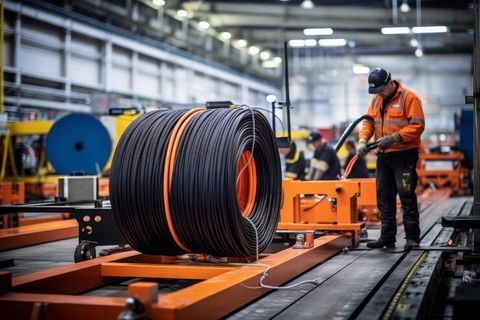
All conductors have a metallic core that facilitates the flow of current. This aspect of manufacturing involves extruding the conductor and reducing the cross-section of its wire. The production of the conductor is a relatively simple process. It is also vital to note that this step is the foundation upon which the manufacture of all other components is built.
Insulation
After producing the metallic core of the conductor, the next step involves insulating it. This process involves extruding insulation materials around the metallic core. The purpose of this step is to protect the conductor, thus ensuring that it operates correctly under normal conditions.
Cabling
In some cases, electrical conductors may have more than one core. In such cases, cores are bonded together in a process referred to as cabling. During this stage, the manufacturer arranges the cores in a certain way according to the specifications of the desired product.
Protective Sheathing
The sheathing refers to the outermost layer of the conductor, whose main purpose is to offer mechanical protection. This step is relatively simple and involves applying protective materials to the conductor.
Testing and Final Inspection
Before a wire or cable is deemed fit for use, it undergoes a series of tests and inspections. The tests conducted during this stage help to ensure that the conductor is manufactured according to the required specifications.
Production Technologies Used in the Process
Modern production technology has introduced new ways of making electrical conductors. Many of these technologies have been adopted by most manufacturers to improve the performance of the products.
Modern manufacturing technologies have enabled the production of conductors with enhanced performance characteristics.
The major production technologies used in manufacturing are discussed below.
Automated Production Lines
Advanced technologies have allowed most manufacturers to embrace automation in their production process. Apart from improving the production rate, automation also reduces the possibility of human error. Computerization also helps to maintain the optimal operating conditions throughout the production process.
Precision Extrusion Technologies
Extrusion technology has played a critical role in the production of these materials. This technology has enabled manufacturers to produce conductors with enhanced performance characteristics that meet the required specifications. One of the major advantages of this technology is the ability to produce materials with uniform insulation thickness.
Digital Manufacturing Technologies
Most modern manufacturers have adopted the use of digital technologies to monitor the production process. These technologies allow manufacturers to ensure that there are no deviations from the set production standards.
Electrical Systems That Relied on Cables and Wires
Electrical conductors are used in almost all types of electrical systems. Most residential, commercial, and industrial buildings rely on the electrical systems. Modern cable manufacturing technologies enable the production of materials that help different electrical systems perform better.
Residential Electrical Systems
Residential electrical systems form the foundation of modern society. Almost all homes require electrical systems that involve multiple conductors. Each of these conductors plays a specific role, thus being vital to the overall operation of the entire system. As such, it is critical to use high-quality materials to ensure that the system operates reliably.
Commercial Electrical Systems
Commercial buildings are complex structures that involve multiple electrical systems. Almost all of these systems require conductors to perform their intended function. For example, air conditioning systems rely on specific types of conductors. This highlights the need to use appropriate materials when installing electrical systems in commercial buildings.
Industrial Electrical Systems
Industrial structures and facilities involve sophisticated electrical systems, and therefore require specialized conductors. Since most of these systems are involved in continuous operation, it is necessary to use conductors that are capable of withstanding severe operating conditions.
Industrial Applications of Cables and Wires
Electrical conductors have a wide range of industrial applications. Most of these materials are manufactured using advanced technologies that improve their performance characteristics. Conductors find application in almost all aspects of the modern world.
Some of the major industries that rely on cables and wires are described below.
Energy and Power Industries
Most electrical systems are powered by electricity, making it one of the most vital aspects of the modern world. The power industry relies on a wide array of materials without which it would be impossible to distribute electricity over long distances.
Telecommunications Industry
Most of the current telecommunication infrastructure relies on several types of conductors to ensure that it operates reliably. The importance of these materials cannot be underestimated. It is only through these materials that telecommunication equipment can effectively transmit data over long distances.
Transportation and Logistics Industries
This sector requires conductors that operate reliably under severe operating conditions. Some of the most critical infrastructure within this industry is manufactured using high-quality materials. This ensures that the infrastructure is durable and capable of operating under extreme conditions.
Cable and Wire Manufacturing Advantages
Modern cable manufacturing technologies offer numerous benefits over conventional methods.
Some of the most important advantages are listed below:
Enhanced Electrical Performance
The latest technologies have enabled the production of materials with enhanced performance characteristics. This allows the conductors to fulfill their intended use efficiently.
Superior Manufacturing Consistency
Advanced technologies have also improved the level of manufacturing consistency. These technologies ensure that the conductor produced adheres to the set manufacturing specifications.
Increased Durability
The production process of these materials involves incorporating additional materials to improve their resistance to wear and tear. As such, the conductors produced are highly durable and therefore suitable for use in harsh operating conditions.
Higher Production Rates
The use of advanced production technologies has significantly improved the production rate of conductors. These technologies also minimize the chance of defects occurring during the production process.
Future Trends in Cable and Wire Manufacturing
Looking ahead, it is evident that this field will witness a number of significant developments in the near future. Some manufacturers are already investing in new technologies that will redefine the manufacturing landscape. The adoption of new production technologies is expected to continue in the future, resulting in enhanced performance of conductors.
Cable manufacturing will also see an increased focus on new production technologies. At the same time, there will be greater emphasis on minimizing the environmental impact of manufacturing these materials.
Conclusion
Cable and wire manufacturing has evolved significantly over time, aided by various technological innovations. These materials are vital components of most electrical devices and systems. Modern manufacturing processes have enabled the production of conductors with advanced performance capabilities. As such, these materials find application in a wide range of infrastructures, such as residential buildings and industrial facilities.