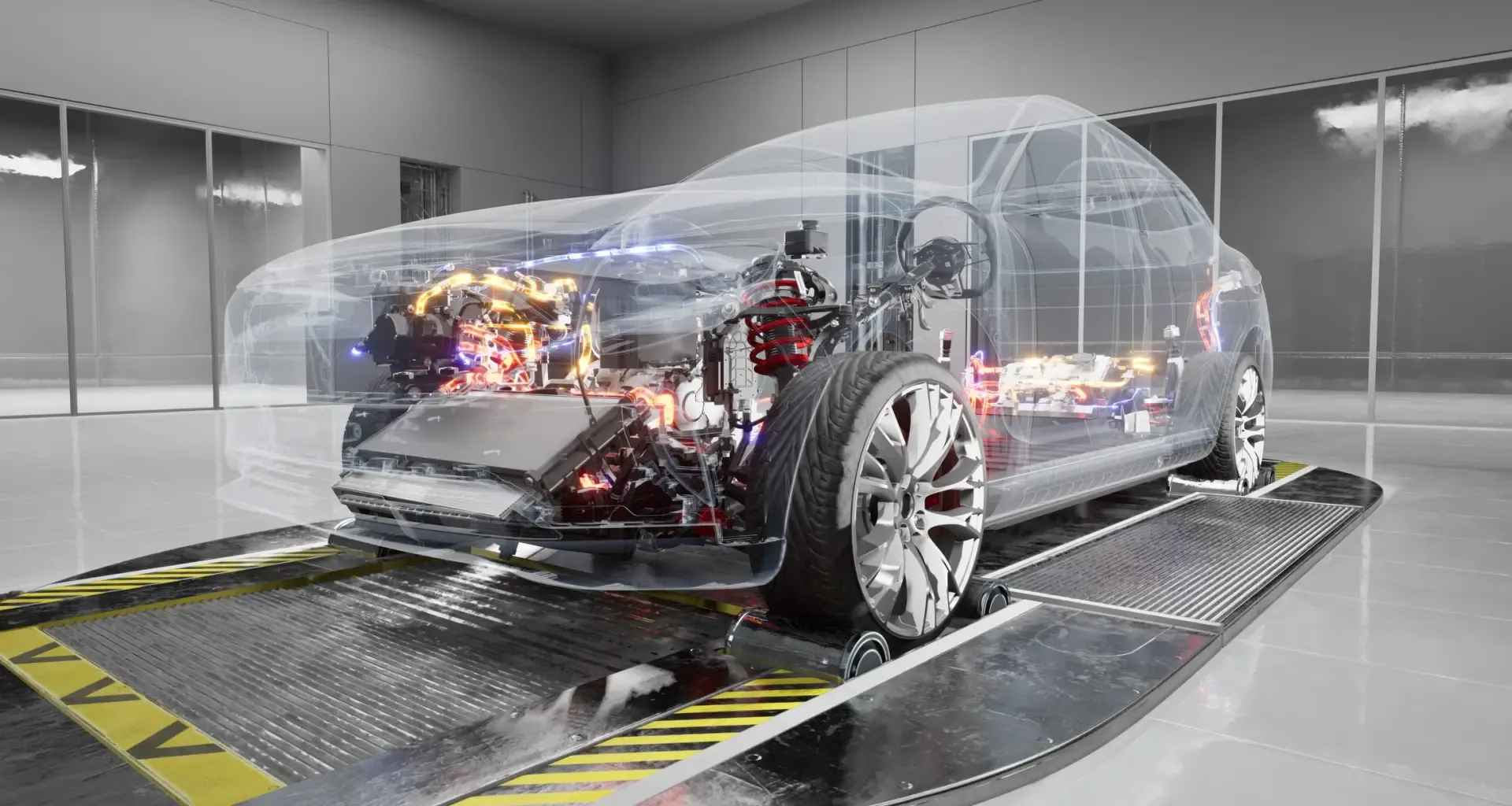
 Building Electric Vehicles Without Flying Blind
Pop the hood on a modern electric car, and you won't find an engine block, oil dipstick, or exhaust manifold. Instead, you see thick orange cables, a compact electric motor, power electronics, and a massive battery pack tucked under the floor.
Having fewer moving parts makes electric cars look simple from the outside, but building one that won't break down is a different story. You have to handle high-voltage circuits, rapid heat transfer, custom motor code, and fast vehicle networks all at once.
Nobody wants to build a physical prototype car for every tiny design change. It drains your budget fast and wrecks your launch schedule. Bricking a hand-built prototype battery pack during lab testing can cost hundreds of thousands of dollars in a single afternoon.
That's why specialized EV engineering tools are so important.
Simulation platforms, automated test benches, and hardware-in-the-loop rigs let your team test vehicle behavior, debug control software, and fix thermal headaches long before a real car ever hits the test track.
Simulating Powertrains Before Cutting Metal
Before you order custom motor castings or spot-weld battery modules, start your EV design on a computer screen.
1D system modeling tools like MATLAB, Simulink, and Simscape form the foundation of early powertrain sizing. You hook up virtual battery packs, motor inverters, traction motors, and reduction gearboxes to run simulated test drives across standard routes like WLTP or EPA drive cycles.
Running drive cycles in simulation software lets you test different hardware choices in minutes.
You can tweak battery cell capacity to check real-world range, compare 400-volt setups against 800-volt architectures, or see how gear ratios alter 0-to-60 times. Inverter models track power loss in silicon carbide switches, while motor simulation tools model permanent magnet motors to estimate torque output, efficiency maps, and heat build-up under hard acceleration.
Catching a bad gear ratio or an underpowered inverter in simulation takes five minutes to fix in code, saving your team months of physical re-tooling later on.
Testing Battery Cells Under Extreme Temperatures
The high-voltage battery pack is the single most expensive and temperature-sensitive component in an electric vehicle.
You need to test battery performance at three distinct levels: individual cells, multi-cell modules, and complete battery packs. Automated battery cyclers charge and discharge cells inside climate-controlled chambers ranging from freezing winter cold to desert heat.
Battery cyclers measure voltage drops, internal resistance, current capacity, and thermal rise during rapid charge and discharge pulses.
Testing cells across wide temperature ranges shows you how fast batteries degrade over years of driving. It also tells you how much fast-charging a pack can handle before overheating or damaging internal cell chemistry.
Thermal safety testing goes even further by simulating worst-case scenarios. Test bays use nail penetration rigs and heat plates to force thermal runaway, checking whether thermal insulation barriers and pressure vents stop fire from spreading to neighboring cells.
Validating BMS Software Without Blowing Up Prototypes
Managing a high-voltage battery pack requires a smart Battery Management System, or BMS.
The BMS keeps tabs on individual cell voltages, balances charge levels, calculates battery health, and trips safety relays if an electrical fault or thermal spike occurs.
Testing unproven BMS firmware on a live high-voltage battery pack is dangerous. A single bug in your code can melt contactors, cause a short circuit, or ignite a pack fire in seconds.
That's where Hardware-in-the-Loop, or HIL, testing comes in.
In a BMS HIL rig, your production BMS controller board plugs directly into a simulator computer that mimics battery cells, thermocouples, and current sensors electronically. You can inject fake over-voltage signals, short circuits, or temperature spikes into the controller to verify that safety relays trip properly, without risking a battery fire or ruining hardware.
HIL rigs run automated test scripts overnight, testing thousands of rare edge cases that would be unsafe to try on a physical test track.
Keeping High-Voltage Components Cool
Managing heat is one of the biggest headaches in EV design.
Lithium-ion batteries degrade quickly if operated above 45 degrees Celsius, traction motors lose efficiency when hot, and fast charging generates intense heat in power electronics inverters.
Electrothermal simulation tools model heat moving across battery cooling plates, liquid coolant channels, pumps, and radiators. You simulate coolant flow speeds and heat exchanger sizes to keep battery temperatures steady and cabin climate controls working smoothly.
Computer models give great predictions, but lab testing on physical hardware is still required before road trials.
Motor test benches and dynamometers link physical electric motors and inverters to load machines inside a lab cell. You run the motor through its full speed and torque range, measuring electrical power input against mechanical shaft power to plot exact efficiency numbers. Dynamometer testing also tunes regenerative braking, making sure energy recovery feels smooth to the driver.
Tracking CAN Bus Signals and Sensor Telemetry
An electric vehicle depends on dozens of electronic control units sharing messages across vehicle networks every millisecond.
Automotive CAN bus, CAN FD, and Automotive Ethernet tools capture communication traffic between the BMS, motor controller, vehicle control unit, and charging port. Analyzing bus data helps you spot missing messages, timing delays, or sensor noise during vehicle road testing.
During physical track tests, data acquisition systems record streams of sensor data like high-voltage current, phase voltages, temperatures, and shaft speeds to compare real road performance against earlier simulation models.
At the same time, mechanical CAD tools let you package heavy battery enclosures into the chassis floor, design motor mounts, and verify that high-voltage cables stay clear of moving suspension parts.
Checking Fast Charging Safety and Protocols
Charging systems require thorough validation to ensure safety across different charging stations.
Specialized charging test equipment evaluates onboard chargers, DC fast-charging controllers, and communication protocols between the vehicle and charging station. Testing verifies that high-current fast charging starts smoothly, handles communication handshakes properly, and shuts off safely if ground faults occur.
Practical Takeaways for EV Operations
Don't try to skip simulation or early lab testing. Focus on virtual powertrain modeling and cell thermal limits first. Once your BMS code is validated on HIL rigs, you can move to motor dynamometer cells and full chassis road trials with confidence.