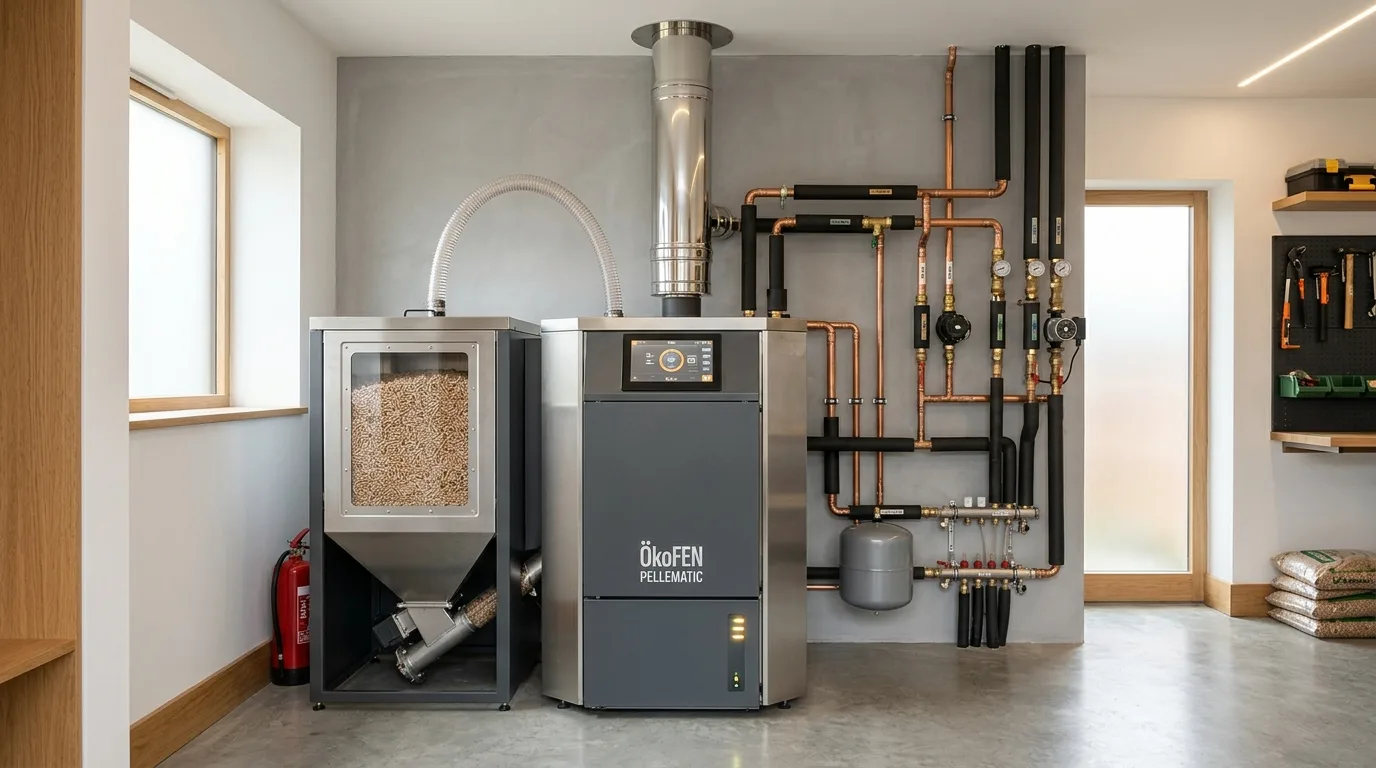
Biomass energy refers to energy produced from organic biological matter, such as wood, agricultural residues, forestry waste, and organic kitchen waste. For millennia, humanity relied on open wood fires for basic warmth and cooking. Biomass was the largest source of total annual U.S. energy consumption until the mid-1800s. According to the U.S. Energy Information Administration (EIA), biomass accounted for about 5% of U.S. total primary energy consumption in 2025. Along with this, it also plays an important role as a fuel in many developing countries.
Today, modern systems like automated wood pellet stoves and household biogas digesters offer a practical, cleaner alternative to traditional open fires. When set up properly and run on dry, quality fuel, they produce more usable heat with significantly less smoke and wasted energy.
This guide explains how pellet heating and home biogas systems work, their actual efficiency and emissions, and how to determine if either option makes sense for your household.
1. How Modern Wood Pellet Stoves Work
A wood pellet stove is a modern, self-contained residential heating appliance that burns standardized, compressed biomass pellets. Unlike traditional wood-burning equipment that relies on manual log additions and natural chimney draft, pellet stoves use automated, electronically governed mechanisms to control fuel delivery, combustion airflow, and heat distribution.
Pellet stoves can serve as primary or supplemental space heaters for individual rooms or open floor plans. In central heating applications, larger pellet boilers connect directly to residential radiator or underfloor hydronic systems to provide whole-home heating and domestic hot water.
What Are Wood Pellets?
Wood pellets are uniform cylindrical granules (typically 6 mm to 8 mm in diameter and 10 mm to 30 mm in length) manufactured by extruding dry sawmill sawdust, planer shavings, and clean forestry residues through high-pressure industrial dies. Natural lignins present in the wood act as a natural binding agent under heat and compression, eliminating the need for chemical adhesives or glues.
- Moisture Content Specifications: Moisture content depends on the specific pellet grade and certification standard. Under standards set by the Pellet Fuels Institute (PFI) in North America, Premium grade pellets must maintain a moisture content of ≤ 8.0%, whereas European ENplus A1 specifies ≤ 10.0%. Low moisture content allows the fuel to ignite readily and burn with high thermal efficiency.
- Energy Content (Calorific Value): For certified residential wood pellets made from clean softwood or hardwood sawmill residues, international quality standards (such as ISO 17225-2 and ENplus) establish a minimum net calorific value (lower heating value, as-received basis) of ≥ 16.5 MJ/kg (approx. 4.6 kWh/kg). On an oven-dry gross basis, energy content typically ranges between 18.0 and 19.5 MJ/kg, depending on the wood species and natural resin content.
- Ash Content by Certification Grade: Residual ash content is not a universal fixed figure; it is strictly defined by the applicable certification grade. For example, PFI standards specify ash limits of ≤ 0.5% for Super Premium, ≤ 1.0% for Premium, and up to 2.0% for Standard grade, while European ENplus A1 specifies ≤ 0.7% (at 550°C). Lower ash levels reduce how often the burn pot and ash collection drawer require cleaning.
Core Components and Heating Operation
A modern pellet stove relies on five synchronized electromechanical systems:
- Integrated Fuel Hopper: A built-in storage bin located above or behind the combustion chamber that holds between 15 kg and 35 kg of pellets. Depending on heating demand and outdoor temperatures, a single full hopper allows continuous operation for 12 to 36 hours.
- Motorized Auger Feeder: A microprocessor-governed electric screw auger slowly rotates to deliver pellets from the hopper into the burn pot. The rotation interval and speed adjust automatically according to the homeowner's room thermostat setting.
- Burn Pot and Forced Combustion Air: Pellets drop into a stainless-steel or cast-iron burn pot. An electric combustion fan draws in outdoor air and forces it across the fuel bed, creating sustained high temperatures (often exceeding 700°C to 800°C) that promote thorough combustion of volatile gases and substantially reduce soot.
- Heat Exchanger and Convection Blower: Finned or tubular heat exchangers extract thermal energy from the rising combustion gases. A convection room blower draws ambient air from the living space, passes it through the heat exchanger channels, and delivers quiet, warm air back into the room.
- Mechanical Exhaust Venting: Exhaust gases are pushed outdoors by an electric combustion fan through a dedicated sealed venting system. While many residential models commonly utilize 3-inch or 4-inch certified pellet vent pipes, the appropriate vent diameter, maximum equivalent length, wall clearances, and termination fittings depend strictly on the appliance manufacturer's installation manual and local building regulations.
Practical Considerations: Storage and Maintenance
Operating a pellet stove involves specific practical requirements:
- Indoor Dry Storage: Because wood pellets are compressed from dry wood fiber, exposure to humidity or moisture causes them to crumble into sawdust and jam the auger. Pellet bags must be kept indoors or in a weatherproof, dry shed.
- Routine Cleaning: The burn pot and ash collection pan must be checked and emptied periodically (typically once every 3 to 7 days during regular heating), and the door glass wiped clean.
- Annual Maintenance: A yearly inspection by a certified heating technician ensures the exhaust venting is free of fly ash, internal blowers are lubricated and clean, and door gasket seals remain completely airtight.
2. The Carbon Cycle and Environmental Standards
A key concept in biomass energy is the biogenic carbon cycle. When trees and plants grow, they absorb carbon dioxide (CO₂) from the atmosphere via photosynthesis. When biomass is burned cleanly, it releases that stored CO₂ back into the atmosphere:
- When biomass is sourced from genuinely sustainably managed forests or true agricultural residues where replanting is prompt and harvesting emissions remain low, the lifecycle carbon footprint can be significantly lower than that of fossil fuels. However, because harvesting, pellet compression, transport, and equipment operation all consume energy, residential biomass systems are rarely zero-carbon or strictly carbon-neutral in real-world conditions.
- However, for biomass to deliver real environmental benefits, burning appliances must meet strict international air quality standards (such as EPA Clean Air Act certification in the US or EN 303-5 Class 5 / Ecodesign standards in Europe) to ensure fine particulate matter (PM2.5) and carbon monoxide (CO) remain at safe baseline levels.
3. Domestic Anaerobic Biogas Digesters
For rural properties, suburban homesteads, and smallholdings, another compelling form of residential biomass is the household anaerobic biogas digester.
Instead of combustion, a biogas digester uses natural microbial biological decomposition in the absence of oxygen:
How a Home Biogas System Works
- Daily Feedstock: Household vegetable scraps, spoiled food, kitchen peelings, and animal manure are mixed with water and poured into the inlet sink.
- The Digester Tank: Inside a sealed, insulated chamber, methanogenic bacteria digest the organic matter at ambient temperatures (optimally between 25°C and 37°C).
- Biogas Storage: As the organic matter breaks down, it produces biogas (approximately 60% methane and 40% carbon dioxide), which rises into a flexible gas holder bag.
- Cooking Fuel: The biogas is piped to a specialized low-pressure cooktop burner. When properly adjusted with appropriate air intake, it burns with a steady blue flame that produces substantially less soot and indoor air pollution than traditional solid biomass fires. Depending on feedstock type and whether a desulfurization filter is used, minor sulfur compounds (H₂S) may generate a slight odor before ignition, making good kitchen ventilation essential.
- Liquid Effluent (Digestate / Slurry): The digested liquid and solids overflow into a collection chamber. While active anaerobic digestion substantially reduces foul odors compared to raw dung or rotting food waste, the resulting slurry is not completely odorless. It contains plant-accessible nutrients such as nitrogen and phosphorus, but should be managed safely, diluted appropriately, or cured/composted prior to soil application to avoid contamination.
Indicative Operating Benchmark: In small residential digesters (such as typical 1,000-litre systems), feeding approximately 1 to 3 kg of digestible food scraps daily can produce roughly 0.2 to 0.5 m³ of biogas per day under warm, favorable ambient temperatures (25°C to 35°C). However, actual daily output cannot be guaranteed by digester volume alone; gas production depends on the energy density of the feedstock (cooked fats and carbohydrates yield significantly more methane than leafy peelings), operating temperature, and slurry retention time. (Sources: FAO Technical Guidelines on Small-Scale Biogas & Practical Action Technical Briefs).
Operational Precautions & Best Practices
- Never Burn Chemically Treated Wood: Only burn clean, certified virgin wood pellets (look for the PFI or ENplus A1 certification seal). Never burn painted wood, plywood, or pressure-treated lumber, which emit toxic chemicals including arsenic and formaldehyde.
- Biogas Temperature Sensitivity: Biogas bacteria require temperatures above 15°C to remain active. In cold winter climates, digesters must be located inside a greenhouse, solar shed, or insulated enclosure.
- Biogas Safety & Gas Handling: Methane is a flammable gas, making leak-free piping and proper ventilation essential. Depending on the system design, operating pressure, and applicable local safety codes, specific safety equipment—such as a flame arrestor, pressure relief valve, or inline water drain trap—may be required or recommended. Consult the manufacturer's specifications and work with a qualified installer to select the appropriate safety devices and ensure all joints and connections are safely tested for airtightness.
4. Biomass Combustion vs. Biogas: What Is the Difference?
Biomass energy can be used in different ways depending on the type of organic material, available equipment, and household energy requirements. Two important approaches are direct biomass combustion and anaerobic digestion for biogas production.
| Feature | Biomass Combustion | Anaerobic Biogas Digestion |
|---|---|---|
| How it works | Solid organic fuel is burned to release heat | Microorganisms break down organic matter without oxygen |
| Typical feedstock | Wood pellets, briquettes, and suitable agricultural residues | Animal manure and suitable biodegradable organic waste |
| Main energy product | Heat, which may also be used to generate electricity | Methane-rich biogas for cooking, heating, or electricity generation |
| By-products | Ash and combustion gases | Digestate or slurry that may be used as an organic soil amendment after appropriate management |
| Main requirements | Suitable fuel, a compatible appliance, ventilation, and exhaust arrangements | Reliable organic feedstock, water where required, a suitable digester, and safe gas handling |
| Household suitability | Homes with a reliable supply of suitable solid fuel and compatible heating equipment | Farms and rural households with a regular supply of manure or other suitable organic waste |
Which option is better for a home?
Biogas may be practical for a household or farm that regularly produces animal manure or suitable biodegradable waste. Pellet heating may suit homes that need space heating and can obtain compatible, quality-assured pellets. Neither option is automatically the best choice for every household; local fuel availability, installation costs, maintenance, emissions, and safety should all be considered.
The Indian Ministry of New and Renewable Energy (MNRE) describes biogas as a source of clean cooking fuel and other useful energy, while its biomass programme covers pellet and briquette manufacturing and biomass-based industrial cogeneration. These programmes illustrate that different biomass technologies serve different energy needs.
Sources: MNRE Biogas Programme and MNRE Biomass Programme.
5. Emissions and Air Quality: Is Biomass Always Clean?
Biomass is renewable when its biological resources are managed responsibly, but burning it still produces emissions. The amount and type of pollution depend on the fuel, moisture content, combustion conditions, appliance design, and maintenance.
Wood smoke can contain fine particulate matter (PM2.5), carbon monoxide, and other harmful air pollutants. Fine particles can penetrate deep into the respiratory system and may aggravate asthma and other respiratory or cardiovascular conditions. Poorly controlled combustion can also produce more smoke and unburned pollutants.
Modern pellet appliances can reduce smoke compared with many traditional wood-burning systems, particularly when they are operated correctly with compatible, quality fuel. However, their emissions are not zero, and performance varies by model and operating conditions.
Factors that affect biomass emissions
- Fuel moisture: Wet fuel can reduce combustion quality and increase smoke. Use fuel that meets the appliance manufacturer's moisture and quality requirements.
- Fuel quality: Contaminated or unsuitable material can damage equipment and increase pollution.
- Combustion and airflow: Poor airflow, incorrect settings, or inadequate maintenance can cause incomplete combustion.
- Appliance design: A well-designed, properly installed appliance can generally control combustion more effectively than an open fire.
- Ventilation and exhaust: Correct exhaust installation and maintenance are essential to help prevent smoke and carbon monoxide from entering living spaces.
Never burn painted, glued, chemically treated, or pressure-treated wood in a domestic biomass appliance. Follow the appliance manufacturer's instructions and applicable local safety requirements.
For background on residential wood smoke and pellet appliances, see the U.S. Environmental Protection Agency's wood-smoke guidance and its pellet stove guidance.
6. Biomass Sustainability: Important Limitations to Understand
Biomass can help make use of organic residues, but its environmental benefits depend on where the material comes from and how it is processed and used.
Responsible feedstock sourcing
Potential feedstocks include sawmill residues, suitable agricultural residues, animal manure, and biodegradable food waste. Using genuine waste streams can provide value from materials that might otherwise be discarded. However, not all organic material is necessarily waste, and removing too much residue from farmland or harvesting trees unsustainably can cause environmental harm.
Soil health and agricultural residues
Crop residues can have important functions in agriculture, including protecting soil, contributing organic matter, and helping maintain soil quality. Removing all available residues for fuel may therefore be undesirable. The amount that can be collected sustainably depends on the crop, soil conditions, farming system, and other local uses for the material.
Carbon emissions across the full lifecycle
Plants absorb carbon dioxide while growing, and burning biomass releases some of that stored carbon. This biological carbon cycle does not automatically make every biomass fuel carbon-neutral.
A realistic environmental assessment should consider how the feedstock was produced, whether vegetation regrows, what would have happened to the material if it had not been used for energy, and the emissions associated with collection, drying, processing, transport, and combustion. The time required for regrowth and the effects of land-use changes can also influence the climate outcome.
Biogas is not emission-free either
Anaerobic digestion can capture useful energy from suitable organic waste, but the system must be properly operated. Methane leakage can reduce its climate benefits because methane is a potent greenhouse gas. Digestate also requires appropriate storage and handling to limit odours, nutrient losses, and water pollution.
The practical lesson: Biomass is most likely to deliver meaningful environmental benefits when it uses responsibly sourced feedstock, efficient equipment, well-managed waste streams, and appropriate pollution controls.
7. Examples of Biomass and Biogas Energy
There are applications of bioenergy, ranging from small household biogas plants to larger industrial systems.
1. Household biogas from cattle dung
In rural areas where cattle dung is regularly available, a family-scale biogas plant can convert a mixture of dung and water into combustible gas. The gas can be used for cooking, while the digested slurry may provide nutrients for agricultural use when properly managed.
The suitability of a household system depends on the quantity and consistency of feedstock, water availability, climate, installation quality, and maintenance. A household should obtain a system sized for its actual daily feedstock supply rather than relying on a generic gas-output estimate.
2. Agricultural residues converted into pellets and briquettes
Suitable agricultural residues can be processed into solid biofuels, including pellets and briquettes. These fuels may be used in compatible boilers and other combustion equipment, including certain industrial applications.
However, agricultural residues have competing uses, and not all residues are suitable for every appliance. Collection, transport, drying, processing costs, fuel quality, and local air-pollution requirements affect whether a project is practical.
3. Bagasse-based energy in sugar mills
Bagasse is the fibrous material left after sugarcane is crushed to extract juice. Sugar mills can use bagasse in boilers to produce steam and, in suitable cogeneration systems, electricity for industrial operations. This is an example of using an agricultural processing by-product to meet energy needs.
4. Organic waste converted into biogas or Bio-CNG
Suitable biodegradable waste from municipal, agricultural, and industrial sources can be processed to produce biogas. After appropriate purification and upgrading, biogas can be converted into Bio-CNG or compressed biogas for compatible applications.
These larger projects are different from household digesters: they need appropriate waste collection, gas treatment, technical operation, and environmental management.
The MNRE Bio-Energy Overview describes India's bioenergy programme areas, including biomass, biogas, and energy recovery from waste and residues. The MNRE Waste-to-Energy programme provides further information about waste-to-energy applications.
8. Choosing a Residential Biomass System
Before investing in a pellet stove, pellet boiler, or household biogas digester, consider the following questions:
- Feedstock availability: Can you obtain suitable fuel or organic waste consistently throughout the year?
- Energy requirement: Do you need space heating, hot water, cooking fuel, or another form of energy?
- Installation and operating cost: Include equipment, installation, fuel or feedstock handling, maintenance, and replacement parts.
- Air quality: Check the appliance's verified emissions information and ensure exhaust gases are safely discharged.
- Local suitability: Confirm that the technology is appropriate for your climate, home layout, local regulations, and available maintenance services.
- Safety: Follow the manufacturer's instructions and use qualified installers where required.
A household biogas system is generally more attractive when a dependable supply of suitable organic material is available. Pellet heating is more relevant where space heating is needed and suitable pellets and compatible equipment are accessible.
In India, readers can consult the MNRE Biogas Programme for official programme information. Scheme periods, eligibility rules, financial assistance, and application procedures can change, so check the latest official guidance before making a financial decision.
Practical Decision-Making Example: Rural Household with 2–3 Cattle Evaluating Biogas
To understand how residential bioenergy evaluation works in practice, consider a rural household that owns 2 to 3 adult cattle (cows or buffaloes) and is deciding whether to install a domestic biogas plant to reduce expenditure on commercial LPG cylinders and wood fuel.
Before purchasing or constructing a plant, the family should evaluate four practical dimensions:
1. Feedstock and Water Feasibility
- Daily Dung Availability: An adult stall-fed cow produces roughly 10–15 kg of wet dung daily, while a buffalo produces 15–20 kg. A household with 2–3 adult stall-fed animals can reliably gather approximately 45 to 50 kg of fresh dung per day, depending on animal size, diet, and collection practices.
- System Sizing: According to indicative MNRE biogas benchmarks, approximately 50 kg of fresh cattle dung per day can support a 2 m³ per day family-type biogas plant, provided suitable operating conditions are maintained. Actual output depends on feedstock quality and digester performance.
- Water Requirement (The Critical Bottleneck): Cattle dung is commonly mixed with water in an approximately 1:1 ratio by weight for conventional household digesters. This requires around 45 to 50 litres of water daily when processing 45–50 kg of dung.
Key Decision Check: If the village faces acute summer water scarcity or the family must transport water manually over long distances, operating a digester may become impractical without a reliable alternative water supply.
2. Energy Output and Fuel Substitution Calculation
- Daily Gas Production: Using an indicative production benchmark of approximately 0.04 m³ of biogas per kilogram of fresh cattle dung, 50 kg of dung can yield around 2 m³ (2,000 litres) of biogas daily under suitable operating conditions. Actual output varies with temperature, feedstock quality, and digester management. Raw biogas commonly contains approximately 55%–60% methane, although its composition can vary.
- LPG Equivalence: Using an indicative energy equivalence of approximately 0.42 kg of LPG per m³ of biogas, 2 m³ of biogas represents around 0.84 kg of LPG equivalent per day. This is an energy comparison, not a guarantee of actual LPG savings.
- Daily Cooking Time: At an assumed biogas consumption rate of approximately 0.45 m³ per hour, 2 m³ of gas could theoretically provide around 4.4 hours of burner operation daily. Actual cooking time depends on burner consumption, gas availability, and operating conditions.
- Monthly Savings: At the same indicative production rate, 0.84 kg of LPG equivalent per day × 30 days = 25.2 kg of LPG equivalent per month. Dividing by 14.2 kg per standard domestic LPG cylinder gives approximately 1.77 cylinders of energy equivalent per month. Actual LPG purchases avoided may be lower.
3. Capital Cost, Subsidies, and Financial Payback
- Turnkey Capital Investment: The cost of a complete 2 m³ plant depends on the digester design, construction materials, excavation, pipeline length, burner equipment, transport, and local labour charges. Obtain an itemized local quotation rather than relying on an unverified fixed price range.
- Central Financial Assistance (CFA / Subsidy): The MNRE's published National Bioenergy Programme Phase-I guidelines provided Central Financial Assistance for eligible biogas plants. However, the scheme period ended on 31 March 2026, so current subsidy availability and eligibility should be confirmed through the official MNRE Biogas Portal before estimating installation costs.
- Net Out-of-Pocket Cost: Calculate the net investment by subtracting only the subsidy formally confirmed for the applicant from the quoted installed cost. Do not assume that a previously published subsidy amount will automatically be approved.
- Financial Payback Period: Estimate the simple payback period by dividing the net installed cost by the actual monthly reduction in LPG expenditure, after accounting for ongoing operating and maintenance costs. Any financial benefit from bio-slurry should be included only when it can be reasonably established. A fixed payback period cannot be confirmed without verified installation costs, applicable subsidy, and realistic household fuel savings.
4. Daily Operational Labor & Maintenance Realities
A biogas digester is an active biological ecosystem that requires consistent human effort:
- Daily Feeding Labor: Dung collection from sheds, mixing it with the required amount of water, removing unsuitable debris, and feeding the digester all require regular attention. Actual labour time depends on the layout of the property and the feeding system.
- Bio-slurry Management: A plant receiving approximately 50 kg of dung and 50 litres of water daily will process roughly 100 kg of input mixture per day. The quantity of discharged slurry may be of a similar order of magnitude, but actual output depends on gas production, retained solids, and the digester's design. The household needs a suitable way to collect, store, or use the slurry.
- Weekly & Seasonal Tasks:
- Condensation Drainage: Biogas contains moisture. Inspect the gas line's water traps regularly and drain accumulated condensate according to the manufacturer's instructions to prevent blockages.
- H₂S Filter Maintenance: If the system uses an iron-based or other desulfurization filter, inspect and replace its media according to the manufacturer's instructions. Replacement frequency and cost depend on the filter design and gas usage.
- Winter Performance Drop: Low temperatures can slow microbial activity and reduce gas production. The extent of the reduction varies with digester temperature, design, and feedstock. In colder regions, suitable insulation and provision for supplementary cooking fuel may be necessary.
Sources for Calculations: Sizing standards, feed ratios, and CFA subsidy benchmarks are derived from the Ministry of New and Renewable Energy (MNRE) National Bioenergy Programme Operational Guidelines and technical manuals from the Khadi and Village Industries Commission (KVIC).
Conclusion
Modern biomass technologies can convert organic materials into useful household or industrial energy. Pellet appliances use controlled combustion to produce heat, while biogas digesters use microorganisms to turn suitable organic waste into a methane-rich fuel. Both approaches can offer benefits in the right circumstances, but neither is automatically pollution-free or carbon-neutral.
The most appropriate solution depends on the quality and availability of the feedstock, the technology used, installation and maintenance requirements, and the system's full environmental impact. For households, a responsible decision begins with understanding the local conditions rather than assuming that every biomass technology will provide the same benefits.