When people hear "geothermal energy," they often imagine volcanic geysers, hot springs, or utility-scale steam turbines feeding grid electricity. However, the term covers fundamentally different technologies operating across distinct depths, temperatures, and geographic regions.
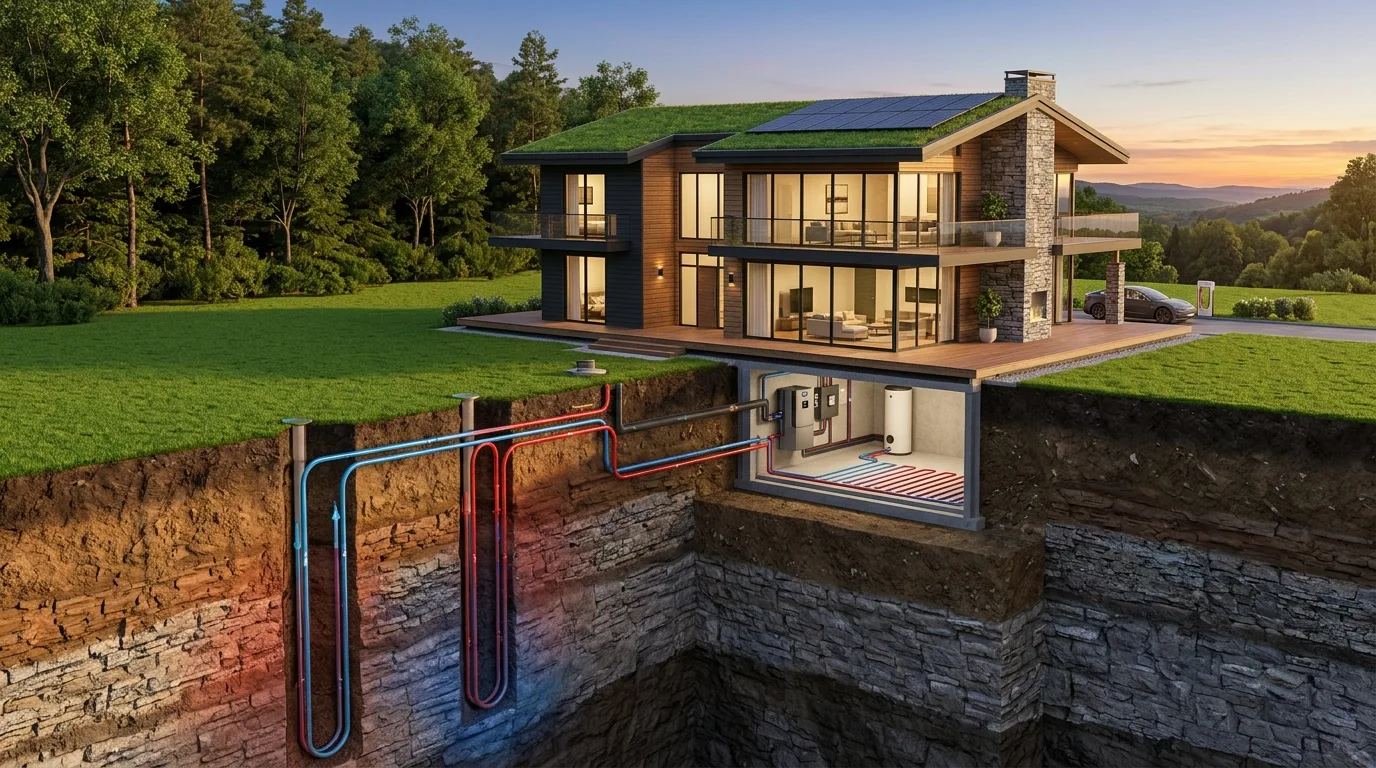
For individual homeowners, the most relevant application is the Ground-Source Heat Pump (GSHP)—often called a geoexchange system. Rather than drawing high-temperature volcanic steam from miles underground, residential heat pumps make use of the shallow thermal mass of the earth as a seasonal heat source during winter and a heat sink during summer.
Yet, ground-source heat pumps are not equally viable for every property. Site-specific factors—including local rock and soil conditions, drilling accessibility, upfront installation rates, and annual energy demands—decide whether the investment makes practical sense.
This guide clarifies the fundamental differences between geothermal power generation and home heat pumps, provides a detailed worked financial example, and examines the real-world geological, financial, and environmental trade-offs involved.
1. Geothermal Energy Is Not Uniform Everywhere
A common misconception is that geothermal energy can be tapped identically in any backyard. In reality, geothermal resources are divided into distinct categories based on depth, temperature (enthalpy), and geological formations:
High-Temperature Deep Geothermal (Geographically Restricted)
High-temperature deep geothermal reservoirs suitable for commercial electricity generation are typically found near tectonic plate boundaries, volcanic hotspots, or active seismic rift zones (such as Iceland, parts of the Western United States, New Zealand, and the East African Rift). In these specialized locations, high-temperature hydrothermal fluids or superheated steam can be extracted from deep wells to drive electricity-generating turbines. Most regions of the world lack high-temperature geothermal resources at economically accessible drilling depths. Details on global geothermal resource mapping can be explored through the International Geothermal Association (IGA).
Low-Temperature Shallow Ground Thermal Energy (Widespread, but Variable)
Near the surface, ground temperatures are influenced by solar heating, seasonal weather, soil moisture, vegetation, and local geology. With increasing depth, seasonal temperature variations generally become smaller. Ground-source heat pumps use these relatively stable temperatures to exchange heat with the ground, but the performance of a system still depends on local site conditions and long-term heat balance.
According to research and technical documentation from the U.S. Department of Energy (DOE) Geothermal Technologies Office and the U.S. Environmental Protection Agency (EPA) Underground Injection Control Program:
- At depths below several meters, seasonal atmospheric temperature swings diminish significantly.
- Undisturbed shallow ground temperature is not a single fixed number everywhere. Instead, it depends on geographic latitude, depth, local climate, surface cover, snow insulation, and soil moisture conditions.
- As a general thermal tendency, shallow ground temperatures correlate with the local Mean Annual Air Temperature (MAAT), modified by the earth's natural geothermal gradient and local surface conditions. For example, shallow ground temperatures are noticeably lower in sub-arctic regions, moderate in temperate zones, and warmer in subtropical areas.
- Furthermore, subsurface thermal properties vary widely. Formations with high moisture content or active groundwater movement transfer heat more effectively than dry sands or porous unsaturated rock, directly affecting the required borehole depth or loop surface area for a specific property.
2. Electricity Generation vs. Direct Heating vs. Heat Pumps
To avoid conflating industrial power plants with residential heating, the three primary uses of geothermal energy are compared below, supported by data from the U.S. Department of Energy (DOE) Geothermal Technologies Office:
| Application Category | Resource Profile & Temperature | Working Mechanism | Primary Real-World Utilization |
|---|---|---|---|
| Geothermal Power Plants (Electricity) | Deep hydrothermal reservoirs; high-temperature steam or pressurized brine | Superheated steam or pressurized hot brine expands through steam turbines connected to electrical generators. | Utility-scale power fed into national and regional electrical grids. |
| Direct-Use Geothermal Heating | Intermediate-depth thermal aquifers; naturally warm groundwater or springs | Naturally warm thermal water from artesian wells or hot springs is piped directly through heat exchangers without a heat pump. | Municipal district heating networks, commercial greenhouses, spas, and industrial food drying. |
| Ground-Source Heat Pumps (GSHP) | Shallow subsurface (horizontal trenches or vertical boreholes); ambient ground temperatures | Uses low-grade ground thermal storage via an electrically powered refrigeration heat pump cycle. | Individual residential and commercial space heating, cooling, and domestic water heating. |
Residential systems do not generate electricity; they consume electricity to drive compressors and circulation pumps. Under suitable operating conditions, a ground-source heat pump can deliver several units of heat for each unit of electricity consumed. Actual performance depends on the equipment, ground-loop temperature, distribution system, installation quality, and auxiliary electricity use.
3. How Ground-Source Heat Pumps Work
A residential ground-source heat pump does not generate heat by burning fuel; it mechanically transfers thermal energy between your home and the earth using a closed loop of buried high-density polyethylene (HDPE) pipe connected to an indoor refrigeration circuit:
Winter Heating Cycle
- A water-and-antifreeze fluid circulates through underground pipes, absorbing low-grade thermal energy from the earth (e.g., at 6°C to 12°C depending on local ground conditions).
- The warmed fluid enters the indoor heat pump unit.
- A refrigeration compressor pressurizes a chemical refrigerant, raising its temperature to 35°C–50°C.
- A heat exchanger transfers this heat into the home's indoor air ductwork or hydronic underfloor radiant loops.
- The cooled fluid returns underground to absorb more thermal energy from the surrounding soil.
Summer Cooling Cycle
- The heat pump extracts excess thermal energy from indoor air via the indoor evaporator coil.
- The heat is transferred into the circulating fluid loop.
- The warm fluid is pumped through the cooler subterranean pipes, where the earth absorbs the rejected heat.
- Cooled, dehumidified air is circulated throughout the living spaces.
- Because the ground in summer (typically 12°C–18°C) is significantly cooler than 35°C–40°C outdoor ambient air, rejecting heat into the earth requires less compressor work than an ordinary air conditioner, resulting in lower cooling electricity consumption.
4. Efficiency: Understanding the Coefficient of Performance (COP)
Heat pump efficiency is measured by the Coefficient of Performance (COP)—the ratio of useful heat energy delivered to electrical energy consumed:
- Electric Resistance Heaters: COP = 1.0 (1 kW of electricity produces exactly 1 kW of thermal heat; 100% efficiency).
- Air-Source Heat Pumps (ASHP): Operating COP varies significantly with outdoor temperature. Standardized rating specifications (such as AHRI 210/240 or cold-climate performance listings) report efficiency at specific outdoor test temperatures (e.g., 8.3°C / 47°F vs. −15°C / 5°F). In sub-zero winter conditions, efficiency declines as ambient air contains less available heat.
- Ground-Source Heat Pumps (GSHP): Laboratory-rated COPs reflect defined test protocols (such as AHRI/ISO 13256-1 water-to-air and brine-to-air standards) at specified entering fluid and distribution temperatures, as cataloged in the AHRI Certified Directory of Products and documented in technical publications from the U.S. Department of Energy (DOE) Geothermal Technologies Office and Natural Resources Canada (NRCan). These rated numbers should not be confused with annual seasonal performance.
| Heating Technology | Illustrative Operating Efficiency / COP | Relative Electricity Draw to Deliver 4 kW Heat | Operating Conditions & Testing Caveats |
|---|---|---|---|
| Electric Baseboard / Space Heater | COP 1.0 (100%) | 4,000 Watts | Direct electric resistance element converting electrical energy entirely into thermal heat. |
| Cold-Climate Air-Source Heat Pump (ASHP) | Illustrative Seasonal COP ~2.8 | ~1,430 Watts | Seasonal average under typical temperate winter conditions; performance varies with regional climate and outdoor temperatures. |
| Ground-Source Heat Pump (GSHP) | Illustrative Seasonal COP ~3.8 | ~1,050 Watts | Achieved under favorable conditions: moderate entering fluid temperatures and low-temperature heat distribution (such as underfloor radiant loops). |
Important Clarification on Operating Conditions (Rated COP vs. Seasonal Reality): A rated COP is not a guaranteed seasonal performance for every home. In practice, efficiency is strongly governed by system design:
- Low-Temperature Hydronic Underfloor Heating (e.g., 30°C–35°C supply): Delivers higher seasonal performance because the compressor operates across a smaller temperature lift between the ground and the heating emitters.
- High-Temperature Radiators or Forced Air (e.g., 50°C+ supply): Forces the compressor to pump against higher condensing pressures, which reduces real-world seasonal efficiency.
- Pumping Energy Impact: If circulation pumps must overcome high hydraulic resistance in long or undersized ground pipes, auxiliary pumping electrical consumption reduces overall system seasonal efficiency.
Understanding COP and Seasonal Performance
The coefficient of performance (COP) measures the heat delivered by a heat pump relative to the electricity it consumes under specified operating conditions. For example, a COP of 4 means the system delivers four units of heat for every unit of electricity used under those conditions.
Actual performance varies with the heat pump model, entering water or ground-loop temperature, heating-system design, outdoor conditions, and installation quality. A rated COP is not the same as seasonal performance. Seasonal COP (SCOP) reflects performance over a longer operating period, although the calculation method and system boundaries should be stated when comparing different products.
In the worked example below, the SCOP values of 3.8 for a ground-source heat pump and 2.8 for an air-source heat pump are illustrative assumptions, not guaranteed results. Actual performance should be estimated using product-specific ratings and conditions relevant to the property.
5. Ground Loop Configurations and Drilling Realities
The subterranean heat exchanger is the most capital-intensive component of a geothermal system. Loop configuration depends on available land area, topography, and local geology:
1. Horizontal Closed Loops
Pipes are laid in trenches 1.5 to 2.5 meters (5 to 8 feet) deep.
- Land Requirements: Requires a substantial area of open, unpaved land, depending on the building's calculated heating load, pipe layout, and soil thermal characteristics.
- Pros: Generally lower installation cost than vertical drilling where excavation equipment is readily available.
- Cons: Disrupts extensive lawn and landscape areas; surface cannot be paved, built over, or planted with deep-rooted trees. Soil temperatures at shallow depths are partially influenced by seasonal weather extremes.
2. Vertical Borehole Loops
Drilling rigs bore vertical holes typically 50 to 150 meters (150 to 500 feet) deep per borehole, spaced 4.5 to 6 meters (15 to 20 feet) apart to minimize thermal interference in accordance with IGSHPA Design and Installation Standards (CSA/ANSI/IGSHPA C448 Series). For an average residential home, the total required drilling length across the loop field (commonly 400 to 800+ linear feet, or ~120 to 240+ meters, depending on building heating and cooling loads) is distributed across multiple boreholes (e.g., two 300-foot boreholes) rather than a single deep well. A U-shaped continuous HDPE pipe loop is inserted into each borehole, which is then backfilled with thermally enhanced bentonite grout.
- Land Requirements: Minimal surface footprint; suitable for urban or suburban lots and retrofits with small yards.
- Pros: At greater depths, seasonal ground-temperature variations are generally smaller than near the surface. However, ground temperatures are not perfectly constant everywhere and can vary with local geology, groundwater movement, and long-term heat extraction or rejection.
- Cons: Capital-intensive; borehole drilling often accounts for a major portion of total initial system cost.
3. Surface Water (Pond / Lake) Loops
Coiled HDPE pipes (slinky coils) are submerged and anchored at the bottom of a nearby body of water at least 2.5 to 3 meters deep.
- Pros: Lower excavation cost and effective heat transfer.
- Cons: Requires a sufficiently deep, non-freezing body of water adjacent to the home with verified legal water usage rights.
6. Geological Suitability, Drilling Costs, and Site Constraints
Before committing to a geothermal heat pump, homeowners must evaluate several site-specific physical and geological constraints:
1. Drilling Cost Economics: Geographic Context, System Size, and Limitations
Vertical ground-loop drilling can be a substantial upfront expense in a residential geothermal heat pump project. However, the final cost depends on local geology, borehole depth, drilling access, contractor availability, and the scope of work included in the quotation.
Benchmark context and geographic limitations
In the United States and Canada, vertical ground-loop drilling costs can vary considerably between projects. Any per-foot or per-meter figure should be treated as a location-specific estimate rather than a universal industry price. Before using a numerical benchmark, confirm that a current, credible source supports the quoted amount and specifies whether it includes drilling only, borehole grouting, ground-loop installation, or additional work.
Costs in other countries, including the United Kingdom, Germany, and India, may differ because of labor rates, drilling equipment availability, geological conditions, contractor expertise, and local permitting requirements. North American estimates should not be applied directly to projects in these markets.
System size and borehole requirements
A residential ground-source heat pump is typically sized between 3 to 5 tons (approx. 10.5 to 17.5 kW) of heating or cooling capacity, depending on the building's calculated loads and local climate. One ton of refrigeration is equivalent to approximately 3.517 kW of thermal capacity.
As an engineering sizing rule of thumb outlined in DOE Geothermal Heat Pump Technical Guidance and IGSHPA Standards, closed-loop vertical systems typically require roughly 150 to 200 linear feet of drilling per ton of heat pump capacity (approx. 45 to 60 meters per ton), though this varies depending on ground thermal conductivity and annual heating-to-cooling ratios. This required drilling length represents the total cumulative drilled depth across the entire loop field, which is subdivided into individual vertical boreholes conforming to the 50–150 meter (150–500 ft) individual borehole depth guideline (for example, a 3.5-ton system requiring ~600 linear feet of drilling is typically configured as two 300-foot vertical boreholes). A qualified designer should calculate the final borehole count and depth using site-specific conditions.
What a drilling quotation should include
When comparing contractor estimates, check whether the quotation covers:
- Drilling and any temporary casing required by ground conditions.
- Borehole grouting and installation of ground-loop piping.
- Manifolds, trenching, connections, and pressure testing, where applicable.
- Site access, equipment mobilization, permits, and restoration work.
- The heat pump unit, indoor distribution system, and other mechanical equipment, if included in the total project price.
Separating these items helps homeowners compare quotations fairly and avoid treating a drilling-only estimate as the total installed system cost.
Practical takeaway: Obtain itemized quotations from qualified local contractors before estimating project cost or payback. For empirical benchmark data on vertical drilling cost breakdowns ($15–$35+ per foot depending on geological formations) and ground heat exchanger economics, refer to the national study by Oak Ridge National Laboratory (ORNL) and DOE: GeoVision Analysis on Geothermal Heat Pumps (ORNL/TM-2019/502).
2. Geological and Soil Conductivity
The heat transfer rate between the loop pipe and the ground depends directly on the thermal conductivity of the geological formation:
- High-Conductivity Formations: Formations with higher thermal conductivity (such as water-saturated sands, dense limestone, or solid granites) transfer heat more readily than dry, unsaturated gravels or porous volcanic formations, allowing shorter total borehole lengths for a given heating load.
- Low-Conductivity Formations: Dry, porous soils or fractured unsaturated bedrock conduct heat more slowly, requiring substantially longer pipe runs to achieve the same capacity.
- Site-Specific Verification: For accurate loop sizing, larger or complex projects often perform a Thermal Response Test (TRT) on an exploratory borehole to measure in-situ effective ground thermal conductivity.
- Drilling Complications: Loose, collapsing gravel or sandy formations require temporary steel casings during drilling, increasing labor and material costs. Extremely hard bedrock requires specialized drilling rigs that command higher rates.
3. Site Access Constraints
Drilling rigs and heavy support equipment require adequate access width, clearance from overhead utility lines, and consideration for surface loading on driveways or landscaping. Residential lots with narrow side gates, mature trees, or steep terrain may restrict drilling equipment access.
7. Environmental Conditions and Operational Risks: When Do Problems Arise?
Ground-source heat pumps can reduce operational greenhouse gas emissions compared with some conventional heating systems. The actual reduction depends on the electricity-generation mix, system efficiency, and the heating technology being replaced. They also carry specific environmental and mechanical considerations:
1. Ground-Loop Temperature Decline and Freezing Risks
Ground-loop temperatures can decline over time when annual heat extraction exceeds the heat replenished in the surrounding ground, or when the loop field is inadequately sized for the building's heating and cooling loads. The extent of the effect depends on local geology, groundwater movement, borehole spacing, loop design, and the balance between seasonal heating and cooling demand.
Low ground temperatures do not automatically mean that a system has failed. However, excessive temperature decline can reduce heat pump performance and may increase the risk of freezing in parts of the loop under unsuitable operating conditions.
Risk reduction requires appropriate ground-loop sizing, suitable circulating-fluid freeze protection, and design calculations that account for long-term ground temperatures. Thermal-response testing may also be appropriate for larger or more complex projects. No single borehole length, spacing measurement, or heating-to-cooling ratio is suitable for every property.
2. Antifreeze and Loop Fluid Management
- When Does It Occur? Underground piping is manufactured from high-density polyethylene (HDPE). Leaks are rare when joints are thermally butt-fused or electrofused according to standard engineering practices. However, leaks can occur if uncertified mechanical joints are buried underground, if backfill contains sharp uncompacted rocks, or if ground subsidence strains the pipe headers.
- Fluid Composition: Closed loops circulate water mixed with an antifreeze solution (typically inhibited propylene glycol, ethanol, or other approved heat transfer formulations specified by equipment manufacturers and local regulations). Standards for approved circulating fluids, maximum allowable glycol concentrations, and fluid disposal protocols are set out in the IGSHPA Design and Installation Standards (CSA/ANSI/IGSHPA C448 Series). While propylene glycol solutions generally have lower aquatic toxicity than alcohol-based formulations, fluid handling and environmental considerations vary by design and local regulations.
- Regulatory Framework: Groundwater protection rules vary significantly by jurisdiction. In the United States, while open-loop systems return water directly into underground aquifers and are regulated under EPA Underground Injection Control (UIC) Class V Regulations, closed-loop systems do not discharge fluid into the subsurface but are typically regulated by state, provincial, or local environmental and well-construction authorities regarding approved circulating fluids, grouting specifications, and setback distances from potable drinking water wells. Homeowners should verify applicable local regulations with qualified installers.
3. Aquifer Protection and Grouting Integrity
- When Does It Occur? When vertical boreholes penetrate through multiple underground aquifer layers separated by impermeable clay or shale aquitards.
- Risk Factor: If the borehole is improperly sealed or backfilled with poor-quality grout, the borehole can act as a vertical conduit, allowing surface runoff or saline upper groundwater to migrate into deeper drinking water aquifers.
- Mitigation: Professional contractors pump high-solids bentonite or cementitious thermal grout under pressure from the bottom of the borehole to the surface (tremie pipe method) to ensure a continuous impermeable seal.
8. Hypothetical Worked Example: Cost and Operational Comparison (Not an Empirical Field Test)
To understand how the economics of geothermal heating compare against other common systems, consider the following hypothetical illustrative engineering model.
Important Note on Methodology: The figures below represent a hypothetical calculation based on standardized engineering assumptions, not an empirical field measurement of a specific monitored property. Actual real-world electricity consumption and heating bills vary significantly based on building envelope airtightness (air changes per hour), ductwork insulation, occupant thermostat habits, local winter weather severity, and specific utility tariff structures.
Explicit Model Assumptions:
- Dwelling Profile: 2,200 sq. ft. (approx. 205 m²) single-family detached home with standard building envelope insulation (compliant with modern energy codes such as IECC 2021).
- Climate Location: Cold-temperate zone (assumed ~5,500 Heating Degree Days on a 65°F / 18°C base, typical of regions like the U.S. Midwest, Central Europe, or Northern Japan).
- Annual Heating Thermal Demand: 15,000 kWh of delivered thermal heat (approx. 51 million BTU) required to maintain comfortable indoor temperatures throughout the heating season.
- Electricity Tariff Assumption: A flat residential electricity rate of $0.16 per kWh (approx. ₹13.20/kWh equivalent), assumed constant without time-of-use or peak demand penalties.
- Ground-Source Heat Pump (GSHP) System Assumptions:
- 3.5-ton (approx. 12 kW thermal capacity) unit connected to a vertical closed-loop field with a total drilled length of approximately 600 linear feet across the loop field (~183 meters total, configured as two 300-foot / ~91-meter vertical boreholes, thermally grouted with bentonite). This directly matches the Section 5 benchmark of 50–150 meters (150–500 ft) per borehole and adheres to the industry sizing benchmark of ~170 linear feet of drilling per ton of capacity.
- Low-temperature hydronic underfloor radiant distribution (35°C supply water), enabling an assumed Seasonal Coefficient of Performance (SCOP) of 3.8.
- Annual electricity consumed: 15,000 kWh ÷ 3.8 = 3,947.37 kWh/year.
- Annual heating electricity cost: 3,947.37 kWh × $0.16/kWh = $631.58/year.
- Capital Installed Cost Baseline: $34,000 gross (illustrative model assumption, consistent with cost ranges documented in Oak Ridge National Laboratory (ORNL/TM-2019/502) and DOE Geothermal Technologies Guidance; $18,000 indoor heat pump unit, circulation pumps & indoor hydronic connection + $16,000 vertical loop borehole drilling & piping). Baseline Net Cost (no incentive assumed): $34,000.
- Cold-Climate Air-Source Heat Pump (ASHP) System Assumptions:
- 3.5-ton variable-speed inverter cold-climate split system rated under cold-climate performance standards (such as NEEP / AHRI 210/240).
- Ducted forced-air distribution, operating with an assumed Seasonal COP (SCOP) of 2.8 under local seasonal conditions.
- Annual electricity consumed: 15,000 kWh ÷ 2.8 = 5,357.14 kWh/year.
- Annual heating electricity cost: 5,357.14 kWh × $0.16/kWh = $857.14/year.
- Capital Installed Cost Baseline: $16,000 gross (illustrative model assumption, not a verified market price; no ground loop, drilling, or excavation required). Baseline Net Cost (no incentive assumed): $16,000.
- Electric Resistance Baseboard Baseline:
- Direct electric conversion operating at a fixed COP of 1.0 (100% efficiency).
- Annual electricity consumed: 15,000 kWh ÷ 1.0 = 15,000 kWh/year.
- Annual heating electricity cost: 15,000 kWh × $0.16/kWh = $2,400.00/year.
- Capital Installed Cost Baseline: $6,000 gross (illustrative model assumption; Net Cost: $6,000).
Tax Incentives and Geographic Limitations
Tax incentives can significantly affect the economics of a ground-source heat pump, but eligibility depends on the country, installation date, applicable legislation, and system requirements. Incentives used in historical examples should not be treated as currently available benefits.
For this illustrative comparison, the baseline calculations use gross installation costs without assuming that a tax credit or rebate will be available. Homeowners should verify current incentives with the relevant government agency before making an investment decision.
| Performance & Cost Metric | Electric Resistance Baseboards | Cold-Climate Air-Source Heat Pump (ASHP) | Ground-Source Geothermal Heat Pump (GSHP) |
|---|---|---|---|
| Seasonal Operating Efficiency | COP 1.0 (100% efficient) | Seasonal COP 2.8 (280% efficient) | Seasonal COP 3.8 (380% efficient) |
| Annual Electricity Consumed | 15,000 kWh | 5,357.14 kWh (15,000 ÷ 2.8) | 3,947.37 kWh (15,000 ÷ 3.8) |
| Annual Heating Bill (@ $0.16/kWh) | $2,400.00 / year | $857.14 / year | $631.58 / year |
| Turnkey Installed Cost (Hypothetical Baseline) | $6,000 (illustrative baseline) | $16,000 (illustrative baseline) | $34,000 (illustrative baseline, incl. drilling) |
| Incremental Cost vs. $6,000 Resistance Baseline | Baseline ($0 extra) | $10,000 extra ($16,000 − $6,000) | $28,000 extra ($34,000 − $6,000) |
| Baseline Net Installed Cost (No Incentives Assumed) | $6,000 | $16,000 | $34,000 |
Comparative Analysis and Economic Reality Check:
Financial return on a geothermal installation follows the standard energy payback formula:
Geothermal vs. Electric Resistance Baseboards:
- Annual Operating Savings: $2,400.00 − $631.58 = $1,768.42 per year.
- Net Upfront Cost Difference: $34,000 − $6,000 = $28,000 extra for geothermal.
- Simple Payback Period: $28,000 ÷ $1,768.42/year = ~15.8 years.
- Under favorable conditions and over an extended operating life, a geothermal heat pump may offer lower lifetime costs than electric resistance heating, though the upfront capital commitment remains substantial.
Geothermal vs. Modern Cold-Climate Air-Source Heat Pump (ASHP):
- Annual Operating Savings: $857.14 − $631.58 = $225.56 per year.
- Net Upfront Cost Difference: $34,000 − $16,000 = $18,000 extra for geothermal.
- Simple Payback Period: $18,000 ÷ $225.56/year = ~79.8 years.
Critical Financial Caveats: What "Simple Payback" Omits
A simple payback calculation provides an intuitive benchmark, but homeowners should recognize the variables omitted by this metric. Please note: these payback figures reflect only the hypothetical model assumptions, not a guaranteed household payback.
- Equipment Lifespan and Replacement Cycles: According to technical guidance from the U.S. Department of Energy (DOE) Geothermal Technologies Office and Natural Resources Canada (NRCan), indoor heat pump components typically have an estimated design life of approximately 20 to 25 years, while the buried HDPE ground loop is engineered to last 50+ years. For air-source heat pumps, outdoor condenser units exposed to weather have an estimated service life around 15 years. Note that expected service life differs from manufacturer warranty periods (which are typically 5 to 10 years). These life-expectancy estimates should not be treated as a guarantee for every installation. Over a multi-decade horizon, an air-source system may require unit replacement sooner than a geothermal ground loop, though future equipment costs, inflation, and financing rates remain project-specific variables.
- Maintenance & Servicing Differentials: ASHP units require routine outdoor coil cleaning, snow clearing, and periodic fan motor maintenance. GSHP systems require periodic closed-loop pressure monitoring, circulating pump checks, and antifreeze condition testing every few years.
- Future Electricity Tariff Escalation: If electricity tariffs rise over time, the annual operating savings of GSHP over ASHP increase proportionally (e.g., if rates rise to $0.24/kWh, annual savings rise from $225.56 to $338.34 per year), moderately shortening the simple payback period.
- Financing and Discount Rates: If the installation is financed through a loan at 6% to 8% APR, the annual interest costs on the $18,000 capital premium can easily exceed the annual operating savings, meaning a positive cash flow is never reached without substantial government grants.
- Summary Verdict: A ground-source heat pump may be more attractive for homes with high annual heating demand, expensive conventional heating, suitable ground conditions, or access to favorable installation incentives. However, no single annual heating-demand threshold determines the best option. Compare local installed quotations, expected seasonal performance, maintenance, financing, and equipment replacement costs before deciding.
9. Decision Framework: Is a Geothermal Heat Pump Right for You?
| Decision Factor | Ground-Source Heat Pump (GSHP) Is Favored | Air-Source Heat Pump (ASHP) Is More Practical |
|---|---|---|
| Climate & Heating Severity | GSHP may be advantageous in climates with prolonged cold periods, but the best choice depends on local design temperatures, equipment performance, energy prices, and installed cost. | Climates with moderate winter heating loads, or where air-source equipment provides sufficient heating capacity without excessive auxiliary heating. |
| Property Lot Size & Access | Sufficient unpaved land for horizontal loops or clear access for vertical drilling equipment. | Compact urban lot, terraced home, or established landscaped yard with limited access. |
| Project Scope | New construction where excavation machinery is already on-site. | Existing home retrofit where extensive excavation would destroy driveways or gardens. |
| Baseline Fuel Being Replaced | Expensive heating oil, propane, or electric resistance baseboards. | Low-cost natural gas or existing ducted heat pumps. |
| Homeowner Residency Horizon | Long-term ownership (15 to 25+ years) to recoup upfront capital costs. | Planning to sell or relocate within 5 to 10 years. |
| Local Contractor Availability | Established local drillers certified by [IGSHPA](https://igshpa.org/) or regional trade bodies. | Limited local geothermal contractors; abundant HVAC split-system installers. |
Authoritative Technical Guidelines & Direct Resources
- International Ground Source Heat Pump Association (IGSHPA): CSA/ANSI/IGSHPA C448 Series: Design and Installation of Ground-Source Heat Pump Systems
- U.S. Environmental Protection Agency (EPA): Underground Injection Control (UIC) Class V Injection Wells Regulations & Technical Guidance
- U.S. Department of Energy (DOE): Geothermal Technologies Office: Geothermal Heating and Cooling Technologies Guide
- Oak Ridge National Laboratory (ORNL) & DOE OSTI: GeoVision Analysis Supporting Task Force Report: Thermal Applications—Geothermal Heat Pumps (ORNL/TM-2019/502) (indexed on OSTI #1529367)
- Air-Conditioning, Heating, and Refrigeration Institute (AHRI): AHRI Certified Directory of Products & Performance Standards (ISO 13256-1 Standards)
- Natural Resources Canada (NRCan): Comprehensive Guide to Heating and Cooling with a Heat Pump
- U.S. Department of Energy (DOE): Geothermal Basics: Resources, Enthalpy & Systems Overview
- International Geothermal Association (IGA): Global Geothermal Energy Resources & Technical Documentation