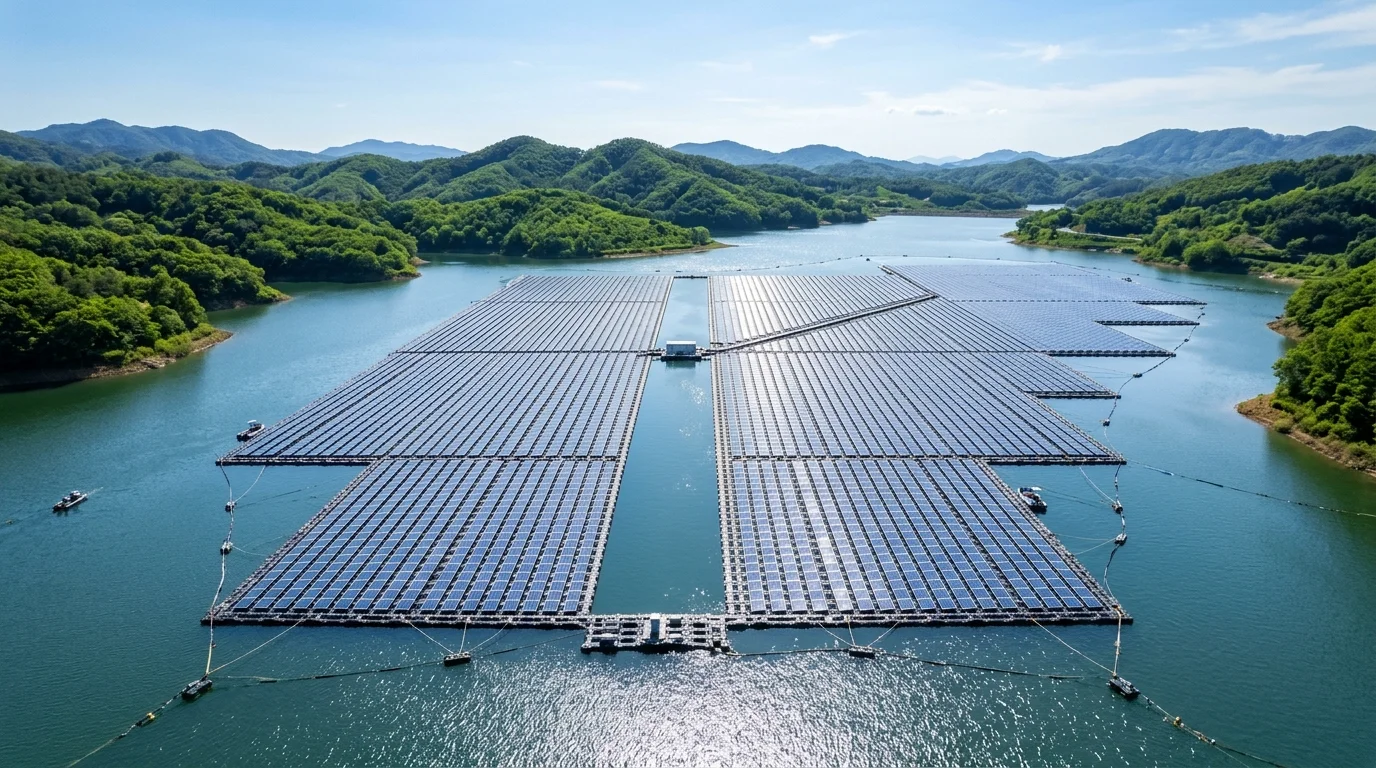
As utility-scale solar deployment accelerates globally to meet decarbonization targets, energy planners face an increasingly urgent spatial dilemma: land competition. Traditional ground-mounted photovoltaic (PV) power plants require substantial contiguous acreage—typically 3 to 5 acres per megawatt (MW) of installed DC capacity. In densely populated nations, mountainous topographies, and fertile agricultural belts, dedicating hundreds of square kilometers of flat land exclusively to solar panels directly clashes with food production, commercial forestry, wildlife corridors, and urban expansion.
Enter Floating Photovoltaics (FPV)—often called "Floatovoltaics". By mounting solar photovoltaic arrays on floating buoyant platforms anchored across man-made water bodies such as hydroelectric reservoirs, irrigation basins, water treatment lagoons, and abandoned mining lakes, floating solar turns underutilized aquatic surfaces into clean power generation hubs.
Beyond saving valuable arable land, floating solar panels interact directly with the host water body. Water-cooled microclimates can help temper operating cell temperatures, while partial surface coverage can curtail evaporative water losses from sheltered reservoirs. However, deploying high-voltage direct current (DC) electrical equipment on moving water introduces formidable engineering challenges: wind- and wave-induced hydrodynamic loads, complex mooring dynamics across seasonal water-level swings, corrosion, electrical insulation demands, and nuanced ecological considerations for aquatic ecosystems.
In this comprehensive technical guide, we examine the structural mechanics, electrical design, economic realities, environmental trade-offs, and practical operational parameters governing utility-scale floating solar installations worldwide.
1. What Are Floating Solar Panels?
A floating solar photovoltaic (FPV) system is an engineered solar power plant installed on a body of water rather than on building rooftops or terrestrial soil. The photovoltaic modules are secured to buoyant modular rafts (pontoons) held in precise spatial orientation by a network of flexible mooring lines and seabed or shoreline anchors.
| Design Dimension | Ground-Mounted Solar | Rooftop Solar | Floating Photovoltaics (FPV) |
|---|---|---|---|
| Primary Host Medium | Terrestrial land (agricultural, barren, brownfield) | Structural roofs (commercial, industrial, residential) | Water bodies (reservoirs, irrigation ponds, quarry lakes) |
| Civil Foundation Type | Driven steel piles, concrete footings, or ground screws | Ballasted mounts, clamps, or roof penetrations | Mooring lines with bottom deadweights or bank anchors |
| Land Footprint | High (~3–5 acres per MW DC) | Zero dedicated ground land | Avoids most panel-field land requirements, but shoreline access, electrical infrastructure and anchoring may still require land. |
| Operating Microclimate | Hot ambient air; high thermal heat derating | Elevated roof surface heat; restricted airflow | Cooling water microclimate; tempered operating cell temperature |
| Mechanical Stress Factors | Static deadweight, terrestrial wind shear, seismic loads | Building structural load capacity, wind uplift | Combined wave kinematics, hydrodynamic drift, fluctuating water depth |
| Electrical Insulation & Equipment Demands | Standard outdoor IP65/IP66 enclosure ratings | Standard building electrical codes and fire setbacks | Equipment enclosure ratings, cable suitability, connectors, bonding, and insulation requirements must be selected according to actual exposure conditions, manufacturer specifications, and applicable electrical codes (EN 50618 compliance alone does not establish suitability for continuous underwater submersion) |
Prime Deployment Environments
Floating solar arrays are predominantly deployed on man-made, sheltered inland freshwater bodies:
- Hydroelectric Dam Reservoirs: A common deployment setting for FPV. Combining solar panels with existing hydro reservoirs allows direct sharing of transmission lines, substation transformers, and grid interconnection switchyards while enabling diurnal energy balancing.
- Agricultural Irrigation Ponds & Raw Water Basins: Farm cooperatives and municipal irrigation districts install FPV to generate local pumping power while conserving stored irrigation water by abating surface evaporation across covered portions.
- Industrial Retention Basins & Quarry Lakes: Flooded sand and gravel pits, mining voids, and factory wastewater retention ponds possess existing road access and commercial electrical connections, transforming degraded industrial property into revenue-generating solar assets.
- Wastewater Treatment Facilities: Settling basins provide sheltered water surfaces adjacent to municipal power loads, avoiding land acquisition and transmission line extension expenses.
Where Floating Solar May Be Unsuitable
These environments may present substantial constraints for conventional floating PV systems. Suitability should be determined through site-specific engineering, ecological and regulatory assessments; the examples below are not universal exclusions:
- High-Velocity Rivers & Whitewater Waterways: Rapid river currents and floating seasonal debris (such as uprooted trees) generate immense hydrodynamic drag that tears mooring lines and ruptures floating platforms.
- Pristine Natural Lakes & Fragile Wetlands: Natural lakes harboring protected aquatic flora, sensitive waterfowl migratory routes, or commercial recreation should be preserved. Industrial FPV installations alter sunlight penetration and thermal stratification, which can disrupt undisturbed natural ecosystems.
- Open-Ocean & Extreme Marine Environments: Unprotected deep-sea offshore waters experience 10-to-15-meter storm swell waves, intense saltwater corrosion, barnacle biofouling, and severe mechanical fatigue. Offshore marine floating solar remains an early-stage experimental R&D domain, fundamentally distinct from proven inland reservoir technology.
- Ephemeral Reservoirs Prone to Complete Drying: Water bodies that completely desiccate during seasonal droughts leave floating platforms stranded on uneven, rocky bottoms, twisting aluminum racking and fracturing fragile silicon solar cells.
- Severe Ice-Packing Sub-Arctic Waters: Deep freezing lakes subject to massive shifting ice sheets exert crushing lateral pressure on modular plastic pontoons, demanding specialized cold-climate engineering or structural ice-deflection barriers.
2. How Does a Floating Solar System Work?
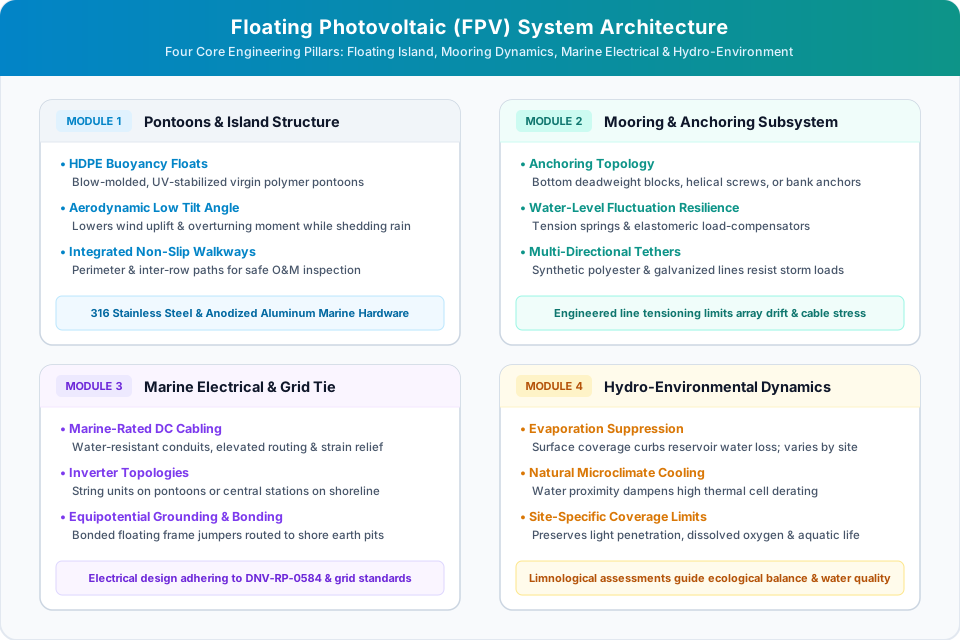
A floating photovoltaic plant comprises four tightly integrated engineering subsystems: the floating island assembly, the mooring and anchoring grid, the marine electrical balance of system (BOS), and the interconnection infrastructure. As established in foundational technical guidelines from the World Bank / ESMAP Floating Solar Handbook and DNV-RP-0584, these subsystems must be engineered holistically to absorb dynamic wave kinematics and seasonal water-level swings over multi-decade operating lifecycles.
1. Solar PV Modules and Structural Racking
The solar modules used in FPV systems are structurally similar to standard terrestrial silicon panels, but require specific material enhancements to withstand perpetual moisture:
- Glass-Glass (Dual-Glass) Considerations: Many floating solar designs evaluate or specify dual-glass modules to enhance moisture resistance and mitigate potential-induced degradation (PID). However, module selection depends on design criteria, manufacturer warranties, and project requirements; edge-seal integrity and junction-box sealing remain important engineering considerations.
- Corrosion-Resistant Frames & Hardware: Module frames and racking components should be selected based on site atmospheric corrosivity, commonly specifying anodized aluminum with appropriate coating thickness or suitable grades of stainless steel to mitigate ambient moisture and localized pitting.
- Aerodynamic Tilt Optimization (Site-Specific): While terrestrial solar racking is often tilted between 20° and 35° depending on latitude to maximize annual irradiance, floating solar arrays typically adopt shallower angles (frequently 5° to 15° for inland systems). Steeper tilt angles act as aerodynamic sails during storm gusts, exerting substantial uplift and overturning rotational torque across buoyant floats. A shallower tilt reduces wind drag and mooring tension while still enabling adequate precipitation runoff and soiling wash-off. The exact tilt angle is determined through site-specific computational wind engineering and aerodynamic load modeling.
2. Floating Modular Pontoons (Floats)
The buoyancy platform is composed of hundreds or thousands of interlocking, hollow High-Density Polyethylene (HDPE) floats produced via specialized blow-molding:
- Main Floats: Engineered with pre-formed structural mounting bosses that support the solar module frame at the designed tilt angle.
- Secondary (Walkway) Floats: Interlock between module rows to form continuous, anti-slip maintenance pathways. These allow operations and maintenance (O&M) personnel to walk safely across the floating island without boats for visual inspection, module washing, and electrical troubleshooting.
- UV and Environmental Stabilization: Pontoons are manufactured from virgin HDPE polymer compounds blended with carbon black and chemical hindered-amine light stabilizers (HALS) to mitigate polymer photo-oxidation and environmental stress cracking (ESC). However, long-term field durability and actual operational lifespan depend on resin purity, additive homogeneity, mechanical wave fatigue, climatic exposure, and rigorous testing under technical standards such as DNV-RP-0584.
3. Mooring Lines and Anchoring Systems
Unlike terrestrial solar arrays bolted permanently into concrete foundations, a floating solar island is in perpetual motion. It must float freely with rising and falling water levels while maintaining strict spatial coordinates against horizontal wind and wave loads:
- Bottom Deadweight Anchors: Reinforced concrete blocks (gravity deadweights) placed directly onto the reservoir bed by specialized cranes or barges.
- Helical Screw Anchors: Mechanically screwed into the reservoir floor sediment, offering high holding-power-to-weight ratios in soft clay or sandy beds with minimal physical footprint.
- Shoreline (Bank) Anchors: Heavy concrete deadmen or rock anchors embedded directly into the dry embankment or reservoir shoreline, commonly deployed on narrow irrigation ponds or quarry lakes where water depths make underwater diving difficult.
- Mooring Lines & Tensioning Management: The floating array connects to the anchors via high-strength synthetic ropes (polyester, nylon, or ultra-high-molecular-weight polyethylene) and marine-grade stainless chains. In reservoirs with significant water-level variations, mooring designs incorporate suitable tensioning solutions—such as elastomeric load-compensators, submerged clump weights, or shore-based winches—tailored to local bathymetric and hydrological profiles to accommodate water fluctuations and manage line tension.
4. Marine Electrical Balance of System (BOS)
Generating high-voltage electrical energy in direct proximity to water requires rigorous electrical insulation:
- Marine-Rated Flexible DC Cabling: While string cabling is commonly manufactured to EN 50618 (H1Z2Z2-K) standards for general outdoor photovoltaic use, compliance with EN 50618 alone does not certify a cable for continuous long-term underwater submersion. For any cable exposed to immersion, engineers should verify the manufacturer's explicit suitability for the intended water-exposure conditions, together with applicable cable standards and installation requirements. Enclosure protection classifications, such as IP ratings, should not be treated as proof that a cable itself is suitable for continuous submersion. In addition, projects should utilize dedicated watertight flexible conduits and ensure all junction boxes, connectors, and cable loops remain elevated well above splash zones and standing water.
- Inverter Architecture: Inverter placement is an architectural choice determined by system scale, site layout, and maintenance logistics: some projects position string inverters on dedicated floating platforms with environmental enclosures, while others route DC circuits across cable bridges to shoreline central inverters and step-up transformers.
- Flexible Interconnection Umbilicals: Where floating cables bridge from the moving floating platform to the fixed shoreline substation, heavy-duty flexible umbilical loops accommodate seasonal elevation changes and horizontal tidal shifts without mechanical strain.
3. Types of Floating Solar Installations
Depending on the operational host site, floating solar installations fall into four distinct architectural configurations:
- Standalone FPV Plants: Dedicated utility-scale arrays engineered on artificial freshwater bodies like agricultural basins, municipal reservoirs, or flooded quarry lakes.
- Hydro-Solar Hybrid Systems: Floating arrays co-located directly on hydroelectric dam reservoirs to share existing grid interconnections and enable complementary power dispatch.
- Industrial & Wastewater Pond Installations: Compact on-site installations deployed on factory wastewater lagoons, cooling ponds, or treatment basins to power local loads directly.
- Nearshore Marine & Offshore Systems: Experimental marine-grade installations deployed in sheltered sea bays, engineered to resist saltwater corrosion and severe oceanic swell.
1. Standalone Floating Solar Farms
Constructed on dedicated artificial water bodies (such as agricultural reservoirs, drinking water reservoirs, or flooded gravel quarries), standalone FPV plants function identically to independent terrestrial solar farms. Generated electricity may be exported to the grid or supplied to local loads, depending on the project configuration.
2. Hydropower Hybrid FPV Systems
The most technologically compelling deployment model unites floating solar with existing hydroelectric dams:
- Shared Grid Interconnection: Hydroelectric dams already possess high-voltage grid substations, transmission towers, and access roads. Installing floating solar directly on the dam reservoir eliminates the need to acquire land and construct new transmission corridors.
- Operational Complementarity: When reservoir conditions and operating rules permit, hydropower generation can be adjusted to complement daytime solar production. This may improve operational flexibility, but it does not guarantee full output during evening or nighttime hours.
- Seasonal Balancing: In many monsoon and tropical climates, seasonal dry periods coincide with high solar irradiance and reduced river inflows. The floating solar plant sustains electricity output when reservoir hydroelectric capacity drops, helping stabilize the regional grid.
3. Industrial and Agricultural Pond Systems
Compact floating solar arrays (typically 100 kW to 5 MW) installed on municipal wastewater treatment lagoons, factory process cooling basins, and agricultural irrigation dams:
- Offsets expensive on-site retail electricity tariffs for municipal aeration pumps and industrial compressors.
- Utilizes non-commercial, disturbed industrial water that may have limited competing uses, depending on the site.
4. Sheltered Inland Waters vs. Offshore Concepts
It is vital to distinguish between commercial inland floating solar and offshore marine concepts:
- Inland Reservoir FPV (Commercial & Mature): Deployed on lakes, reservoirs, and ponds where significant wave heights rarely exceed 0.5 to 1.0 meters. A 2026 comprehensive review in Nature Reviews Clean Technology reported more than 9.6 GWp of floating PV capacity installed globally by 2024. Deployment figures continue to change, so the reference year should always be stated.
- Nearshore & Offshore Marine Concepts: Open marine environments present distinct technical challenges including salt-fog corrosion, tidal currents, severe marine biofouling, and complex wave dynamics. Importantly, current industry design guidance such as DNV-RP-0584 primarily covers sheltered inland waters and limited sheltered nearshore conditions; harsher, exposed open-sea offshore conditions remain outside its current scope and are subject to ongoing experimental pilot research.
4. Key Benefits of Floating Solar Panels
Floatovoltaics offers an array of verified operational and environmental advantages over traditional ground-mounted solar farms. However, the extent of each benefit depends heavily on local climate, water chemistry, and engineering design.
| Benefit Category | Engineering Mechanism | Typical Real-World Impact |
|---|---|---|
| Land Conservation | Eliminates ground clearing, grading, and civil earthworks | Saves ~3 to 5 acres of agricultural or forest land per MW DC |
| Water Evaporation Suppression | Physical shading blocks direct sunlight and dampens wind shear | Reduces evaporation from covered areas; actual savings depend on coverage, climate, and reservoir characteristics |
| Thermal Efficiency Boost | Underlying water microclimate mitigates extreme cell operating temperatures | Reduces thermal derating losses; empirical gains vary by local winds, ambient heat, and terrestrial baseline |
| Algae Growth Mitigation | Attenuates photosynthetically active radiation (PAR) in water column | Can suppress light-dependent algal proliferation under favorable limnological conditions |
| Transmission Infrastructure Reuse | Connects to existing hydroelectric substation switchyards | Substantially reduces interconnection costs by utilizing existing dam substation infrastructure and transmission lines where co-located |
1. Land Conservation and Siting Ease
In densely populated regions such as India, Japan, South Korea, Taiwan, and Western Europe, land acquisition represents one of the largest financial and legal hurdles for solar development. Terrestrial solar often forces difficult compromises—displacing food crops, requiring tree clearing that releases stored carbon, or triggering contentious eminent domain battles. Floating solar leverages artificial water bodies that serve single utility purposes, which can reduce land-acquisition requirements, although shoreline access and local permits may still be necessary.
2. Suppression of Water Evaporation
In arid and semi-arid climates, agricultural and potable water reservoirs lose substantial volumes of stored capacity to open-water evaporation. By covering targeted water surfaces with modular floats and photovoltaic panels, FPV intercepts direct solar radiation and dampens wind shear across the water-air interface.
Floating solar may reduce evaporation from covered portions of a water body. However, as underscored in the World Bank / ESMAP Floating Solar Handbook, the magnitude of this effect depends on local conditions, and it should be estimated using suitable hydrological studies rather than assumed from surface coverage alone.
3. Cooling and Energy-Yield Effects
Floating solar panels may operate at lower temperatures than comparable land-based systems under some conditions. Lower module temperatures can improve instantaneous PV efficiency, but the effect on annual electricity generation depends on wind exposure, ambient temperature, array design, module spacing, and the reference system used for comparison. Cooling benefits should therefore be evaluated using site-specific measurements or validated energy-yield models rather than assuming a fixed percentage increase.
As discussed in global research reviews by Nature Reviews Clean Technology (2026) and IEA PVPS Task 13 (2025), while instantaneous cell temperatures above water can be lower than unventilated ground arrays during peak summer insolation, long-term annual energy yield is influenced by seasonal water temperatures, underneath ventilation, humidity, and the specific terrestrial baseline selected for evaluation.
5. Costs and Economic Considerations
While floating solar offers attractive land-saving advantages and potential microclimate cooling benefits, its specialized structural, mooring, and marine installation requirements result in a distinct capital expenditure (CapEx) premium compared to conventional terrestrial solar farms.
Capital Expenditure (CapEx) Breakdown
Building on water demands specialized materials, marine logistics, and corrosion engineering:
- Buoyancy & Racking Systems: Blow-molded HDPE pontoons, connecting pins, and marine-grade stainless hardware represent a significantly higher proportion of racking CapEx compared to standard driven-steel ground-mount piles.
- Mooring & Anchoring Engineering: Bathymetric lakebed sonar surveys, geotechnical bottom soil sampling, engineered deadweight blocks, and specialized marine installation craft represent substantial site-specific civil expenses.
- Marine Electrical Hardware: High-grade water-resistant cabling, watertight junction enclosures, flexible shoreline transition loops, and floating inverter platforms add to equipment budgets.
| Project Component | Ground-Mounted Solar Profile | Floating Photovoltaics (FPV) Profile | Primary Cost Variance Drivers |
|---|---|---|---|
| Solar PV Modules | Standard framed monofacial / bifacial panels | Modules selected for floating PV may include dual-glass designs or other moisture-resistant configurations, depending on the project design, environmental exposure, manufacturer warranties and reliability requirements. | Evaluation of moisture ingress resistance and encapsulation reliability per site conditions |
| Mounting / Buoyancy Racking | Driven steel piles, ground screws, or concrete ballasts | Interlocking HDPE pontoons, structural pins, and walkways | Higher equipment expense for specialized polymers, UV stabilizers, and corrosion-resistant hardware |
| Civil Works & Anchoring | Site clearing, terrain grading, access roads, and perimeter fencing | Bathymetric surveys, bottom deadweights, bank anchors, and dynamic tethers | FPV avoids earthworks and grading, but requires lakebed surveys, specialized watercraft, and mooring engineering |
| Land vs. Water Surface Access | High land purchase or long-term lease costs in populated regions | Water surface lease or concessional utility reservoir access | Water-surface rights often involve lower direct lease expenditures than arable terrestrial land |
| Capital Expenditure & LCOE Profile | Established mature commercial CapEx benchmark | Reported global median CapEx: ~$1.25/Wp (Nature Reviews Clean Technology, 2026) | LCOE for floating solar generally remains higher than land-based PV due to specialized floatation and mooring requirements |
*Cost Benchmarking Context: A comprehensive 2026 review in Nature Reviews Clean Technology reported a global median capital expenditure of approximately $1.25/Wp for utility-scale floating PV. The review notes that because of floatation hardware, anchoring systems, and marine installation logistics, the Levelized Cost of Electricity (LCOE) for floating PV is generally higher than for land-based solar. Turnkey capital costs vary widely depending on the host country, project size, water depth, bathymetry, and local component availability.
Levelized Cost of Electricity (LCOE) Realities
Because of higher upfront capital requirements and marine maintenance demands, the Levelized Cost of Electricity (LCOE) for floating solar generally remains higher than that of standard utility-scale land-based PV. However, projects can achieve financial viability and competitive life-cycle economics under specific site conditions:
- Land Value Offsets: In densely populated or highly fertile agricultural areas where acquiring terrestrial land is cost-prohibitive, water surface leasing rates can be substantially lower, offsetting a portion of the racking premium.
- Hydropower Co-Location Synergies: When deployed on hydroelectric dam reservoirs, utilizing existing high-voltage substations, transformers, and transmission corridors dramatically reduces grid connection costs.
- Microclimate Energy Output: In hot climates where water cooling mitigates midday thermal losses, increased kilowatt-hour generation helps amortize capital costs over the project lifecycle.
- Site Cost Drivers: Project economics are strongly dictated by physical site conditions—shallow, sheltered industrial basins with nearby grid ties yield significantly lower LCOE than deep, exposed reservoirs requiring long underwater transmission links and heavy storm mooring.
6. Environmental Impacts on Water and Aquatic Ecosystems
Deploying an industrial installation across a living water body creates an altered biological habitat. The environmental footprint of floating solar is not universally positive or negative; it represents a nuanced ecological trade-off that demands rigorous site-specific environmental impact assessments (EIA).
Understanding this ecological balance involves evaluating both positive benefits and potential over-coverage risks:
- Potential Ecological Influences: Shading from floating arrays can attenuate solar radiation and potentially reduce the proliferation of light-dependent algae under certain conditions. In some water bodies, surface shading may also moderate summer surface water temperatures and reduce wind-induced turbulence, which can influence sediment dynamics. However, actual ecological outcomes vary widely depending on depth, water residence time, and trophic status, and comprehensive long-term studies across diverse water bodies are still needed (Nature Reviews Clean Technology, 2026; IEA PVPS Task 13, 2025).
- Ecological Risks of Excessive Coverage: Covering an excessive fraction of a water body can lead to light starvation that impacts native Submerged Aquatic Vegetation (SAV), constrains natural air-water oxygen reaeration, and risks inducing deep hypolimnetic dissolved oxygen depletion (anoxia) in vulnerable, stratified reservoirs.
1. Sunlight Attenuation and Algae Suppression
Algae and cyanobacteria require sunlight (specifically Photosynthetically Active Radiation, or PAR) and warm water temperatures to proliferate. In nutrient-rich reservoirs suffering from agricultural runoff (eutrophication), shading from floating solar arrays can attenuate light penetration, potentially limiting the photosynthetic growth rate of phytoplankton.
However, peer-reviewed limnological reviews (such as 2024–2026 ecological research syntheses) indicate that shading alone does not guarantee improved water quality. The real-world impact on cyanobacteria and blue-green algae depends heavily on nutrient concentrations (dissolved phosphorus and nitrogen), water residence time, thermal stratification, and the specific dominant phytoplankton species present. In some water bodies, partial shading may shift phytoplankton community structures without necessarily preventing all bloom events.
2. Dissolved Oxygen (DO) and Thermal Stratification Risks
While moderate shading can help regulate water temperatures and reduce evaporation, excessive or poorly planned surface coverage introduces site-specific ecological risks that depend on reservoir depth, trophic state, and mixing dynamics:
- Light Attenuation for Native Aquatic Vegetation: Submerged Aquatic Vegetation (SAV) forms the trophic baseline of natural freshwater ecosystems, generating dissolved oxygen through photosynthesis and sheltering juvenile fish. If an array excessively starves the photic zone of light, native aquatic plants can decline, altering local biological balances.
- Atmospheric Oxygen Diffusion: Open water absorbs atmospheric oxygen across its surface through wind ripples and wave turbulence. Densely packed floating arrays physically shield the water-air interface, which can constrain natural reaeration if surface coverage is disproportionate.
- Deep Thermal Stratification & Anoxia Risks: In deep, seasonally stratified reservoirs, the epilimnion (warm surface layer) and hypolimnion (cold deep layer) do not mix readily in summer. If extensive surface shading suppresses upper-layer thermal convection while blocking light from oxygen-generating algae, deeper benthic layers can experience aggravated dissolved oxygen depletion (hypolimnetic anoxia) in vulnerable, nutrient-rich water bodies.
3. Site-Specific Surface Coverage
There is no universally suitable surface-coverage percentage for floating solar. Even artificial or industrial water bodies require assessment of water quality, oxygen exchange, mixing, existing biological activity, and operational requirements. Coverage limits should be established through site-specific environmental studies and applicable regulatory requirements, rather than applying a fixed percentage across different reservoirs and ponds.
4. Fish and Waterfowl Behavior
Empirical research demonstrates nuanced, species-specific responses to floating arrays:
- Aquatic Habitat Alterations: Underwater HDPE pontoons, mooring lines, and anchor chains can develop periphyton and biofilm, offering localized shelter and artificial structure for certain fish species. However, as noted in recent ecological literature (including IEA PVPS Task 13 (2025) and Nature Reviews Clean Technology (2026)), changes in light and temperature can alter natural species assemblages, favoring shade-tolerant organisms over native visual predators.
- Waterfowl Considerations: Bird activity can contribute to module soiling, while large arrays may alter open-water habitat and foraging areas. Any bird-deterrent measures should be selected according to site-specific ecological assessments and applicable wildlife requirements.
7. Engineering, Safety and Maintenance Challenges
Operating high-voltage electrical infrastructure afloat on an inland lake or industrial reservoir requires strict adherence to specialized marine and civil engineering safety protocols, detailed in technical standards such as DNV-RP-0584.
1. Hydrodynamic Fatigue and Wind Uplift
Terrestrial solar arrays experience straightforward static loads and predictable wind shear. A floating solar array experiences complex dynamic multi-axis kinematic stresses:
- Wind-Induced Drag & Uplift: High winds rushing across an open reservoir create enormous lateral drag and vertical aerodynamic suction on modules. If racking clips or module clamps suffer structural fatigue, panels can be sheared from the pontoons.
- Wave Cyclic Fatigue: Surface waves generate continuous cyclic flexing (pitch, roll, yaw) across the inter-pontoon connection pins. Engineering designs must utilize flexible hinge joints capable of absorbing millions of wave flexing cycles without plastic shearing or stress cracking.
2. Managing Water-Level Fluctuations
Hydroelectric and monsoon-driven storage reservoirs can experience notable seasonal elevation swings (sometimes exceeding 10 to 15 meters in documented deep-dam projects), whereas shallow industrial or quarry basins experience much smaller water-level shifts. Mooring systems must be custom-engineered to site bathymetry:
- Fixed-length lines would either snap during high-water crests or become slack during drought drawdown, allowing the array to drift into embankments.
- Engineers deploy submerged clump weights, elastomeric load-compensators, or shore-based tensioning winches designed to accommodate documented historical flood and drawdown baselines.
3. Corrosion, Moisture Ingress and Electrical Safety
Moisture and high-voltage DC electricity demand rigorous engineering isolation:
- Corrosion Resistance: Fasteners, brackets, and structural clips are typically selected from suitable grades of stainless steel or treated aluminum matched to site salinity and environmental conditions, with non-conductive isolating bushings where dissimilar metals meet to prevent galvanic corrosion.
- Equipotential Bonding & Grounding: On water, a solid earth reference does not exist at the pontoon level. Qualified electrical engineers design a continuous equipotential bonding network connecting all module frames, combiner boxes, and inverter chassis via corrosion-resistant jumpers. This network connects through heavy-duty, marine-rated conductors routed along the shoreline umbilical bridge to dedicated terrestrial grounding grids and earth termination pits compliant with applicable electrical codes.
- Lightning Protection: Open water bodies represent exposed environments susceptible to direct and indirect lightning strikes during convective storms. Lightning protection systems (LPS) must be engineered site-specifically in accordance with recognized international codes such as IEC 62305. Rather than generic turnkey installations, professional electrical designers evaluate risk categories, air terminal placement, surge protection devices (SPDs), and coordinated grounding conductors back to terrestrial grounding fields.
4. Operation, Maintenance (O&M) and Cleaning Logistics
Maintaining a floating solar plant requires specialized procedures and maritime safety protocols:
- Worker Safety: O&M procedures require site-specific safety plans tailored to evaluated water hazards and applicable occupational health regulations. Measures such as certified Personal Flotation Devices (PFDs / life jackets), fall-protection protocols along walkways, water-safety training, and standby rescue arrangements should be implemented according to the project's risk assessment and local regulatory requirements.
- Panel Cleaning on Water: While floating arrays experience less dust deposition than terrestrial desert installations, bird droppings, pollen, and airborne algae mist accumulate on module surfaces. Cleaning is performed using specialized small electric cleaning boats or lightweight autonomous robotic brush crawlers that utilize filtered reservoir water without chemical additives to avoid water pollution.
8. Floating Solar vs. Ground-Mounted Solar: Comprehensive Comparison
The decision to deploy floating solar versus conventional ground-mounted solar involves balancing land availability, structural capital expense, power generation efficiency, and environmental sensitivities.
| Evaluation Parameter | Floating Solar (FPV) | Ground-Mounted Solar | Engineering Trade-Off Analysis |
|---|---|---|---|
| Land Footprint | Avoids most panel-field land requirements, but shoreline access, electrical infrastructure and anchoring may still require land. | 3 to 5 acres per MW DC | FPV decisively wins in dense, agricultural, or mountainous regions. |
| Initial Capital Cost (CapEx) | Higher CapEx (Reported median ~$1.25/Wp) | Lowest industry benchmark CapEx | Ground-mount is cheaper upfront due to standard steel piles; FPV incurs mooring and marine racking premiums. |
| Electrical Energy Yield | Tempered thermal derating (Water cooling) | Standard baseline terrestrial yield | Water evaporative microclimate helps mitigate midday cell heat; net annual yield gains vary by climate and baseline. |
| Water Conservation | Suppresses evaporation over covered area | Zero evaporation benefit | Can reduce evaporative water loss from covered portions of reservoirs; actual volume depends on coverage, depth, and weather. |
| Installation & Civil Works | Complex marine anchoring & mooring | Standard pile driving & grading | FPV requires bathymetric surveys, marine installation craft, and specialized pontoon assembly. |
| O&M and Accessibility | Boat access, water safety, PFD gear | Simple vehicle access | Ground-mount allows simple truck and tractor access; FPV demands marine safety gear. |
| Hydropower Co-Location | Direct grid & dispatch synergy | Rarely adjacent to dam water | Where reservoir operating rules, water availability and grid conditions permit, hydropower may complement variable daytime solar generation. |
| Environmental Sensitivity | Alters water shading, light & mixing | Vegetation clearing & soil disturbance | Both require EIA: ground-mount affects soil and vegetation; FPV affects aquatic limnology and habitats. |
Frequently Asked Questions (FAQ)
Does floating solar make reservoir water toxic or contaminate drinking supplies?
Materials used in installations on drinking-water reservoirs should be assessed against the applicable drinking-water contact requirements and local regulations. The suitability of the complete system should be evaluated separately, and water quality should be monitored where required. Relevant testing frameworks evaluate whether base polymers, UV stabilizers, and additives leach harmful organic compounds or heavy metals under continuous exposure. In addition, site developers should establish baseline limnological testing before installation and maintain continuous monitoring of dissolved oxygen, pH, turbidity, and chemical indicators throughout project operation.
Can floating solar survive freezing temperatures and winter ice?
Floating solar arrays can operate in cold climates, but freezing water and shifting ice sheets present severe structural challenges that require project-specific cold-climate civil engineering. Ice expansion exerts crushing lateral pressures against floats, while shifting wind-driven ice floes can drag or snap mooring tethers. In cold regions subject to seasonal freeze-thaw cycles, engineering strategies should be evaluated using relevant ice-loading requirements and project-specific engineering assessments; design measures may include reinforced pontoon geometry, de-tensioning mooring protocols, seasonal water drawdown planning, or choosing deep sites with sufficient circulation. Sites prone to severe pack-ice require detailed hydrodynamic and geotechnical ice-loading analyses.
How are floating solar panels cleaned if they are in the middle of a lake?
Cleaning procedures depend on water quality, module manufacturer instructions, environmental regulations, and array layout:
- Walkway Access with Water-Fed Poles: Technicians traversing walkway pontoons may use telescopic water-fed poles fitted with soft brushes. Where permissible and water quality allows, filtered on-site water or brought-in demineralized water is used without chemical detergents to protect the aquatic environment.
- Robotic Cleaning Equipment: Some installations may use robotic cleaning equipment where the array design and pontoon surface permit, helping remove dust, pollen, and bird soiling while minimizing manual foot traffic across the floating platform.
Can a private homeowner or farmer install floating solar on a farm pond?
While technically feasible, installing floating solar on a private farm pond or agricultural irrigation basin requires careful pre-feasibility planning. A property owner must evaluate pond ownership and water-use rights, local civil and electrical zoning permits, and utility interconnection rules. From an engineering standpoint, small farm-scale arrays require secure bank-anchoring to withstand high winds, certified water-submersible electrical cabling, elevated junction boxes, and safe O&M access walkways. For many agricultural properties, standard ground-mounted or rooftop barn arrays remain simpler and more cost-effective unless land availability is strictly constrained or on-site water surface shading is an explicit goal.
Authoritative Standards and Technical References
For engineering standards, environmental guidelines, and regulatory design manuals governing floating photovoltaic power plants, consult the following authoritative resources:
- World Bank Group & ESMAP: Where Sun Meets Water: Floating Solar Handbook for Practitioners — Comprehensive international reference manual covering FPV bathymetry, pontoon design criteria, mooring physics, environmental impact mitigation, and financial modeling.
- International Energy Agency (IEA PVPS): Photovoltaic Power Systems Programme — Task 13: Floating PV Plants Review (2025) — Authoritative global research tracking empirical operational data, module reliability on water bodies, degradation mechanisms, and thermal cooling microclimate models.
- Nature Reviews Clean Technology (2026): Design and Implementation of Floating Photovoltaics — Peer-reviewed comprehensive review examining global deployment trends, median CapEx benchmarks (~$1.25/Wp), cooling performance uncertainties, and aquatic ecosystem interactions.
- DNV (Det Norske Veritas): DNV-RP-0584: Design, Development and Operation of Floating Solar Photovoltaic Systems — Global industry technical standard defining engineering safety baselines for floatation structural integrity, wave hydrodynamic loading, electrical safety, mooring station-keeping, and decommissioning.
- International Electrotechnical Commission (IEC): IEC TS 63209-1:2021: Photovoltaic Modules — Extended-Stress Testing, Part 1 — Provides supplementary test methods for evaluating longer-term module reliability under selected stress conditions. It should not be treated as a standalone certification of suitability for floating-solar installations.
- Grid Interconnection Standards & Codes: IEEE Std 1547 (governing distributed energy resource interconnection in North America) alongside applicable national and international grid codes (such as the Central Electricity Authority Technical Standards for Connectivity in India, and IEC 61727 globally) for power quality, voltage stability, and automated islanding protection.
Critical Evidence & Engineering Disclaimer:
Siting a floating solar photovoltaic plant requires site-specific bathymetric lakebed profiling, historical wind and wave hydrodynamic analysis, geotechnical anchor pull-out testing, and comprehensive limnological water quality assessments. There is no single universal surface-coverage percentage applicable to all reservoirs; permissible coverage must be determined through environmental impact assessments that balance water utility requirements, biological oxygen exchange, sunlight penetration, and aquatic biodiversity. Always engage certified marine civil engineers, electrical technicians, and environmental limnologists before undertaking commercial water-borne renewable energy installations.