When investing in rooftop solar, choosing the wrong system configuration is one of the most expensive mistakes a homeowner can make. Many homeowners install a standard on-grid system expecting it to power their home during electrical blackouts—only to discover that on-grid solar systems shut down automatically the moment the utility grid fails.
To select the right system for your property, you must understand how On-Grid (Grid-Tied), Off-Grid (Standalone), and Hybrid systems function, why standard inverters shut off during outages, and how battery storage, backup power, and net-metering serve completely distinct engineering roles.
Technical Comparison Matrix
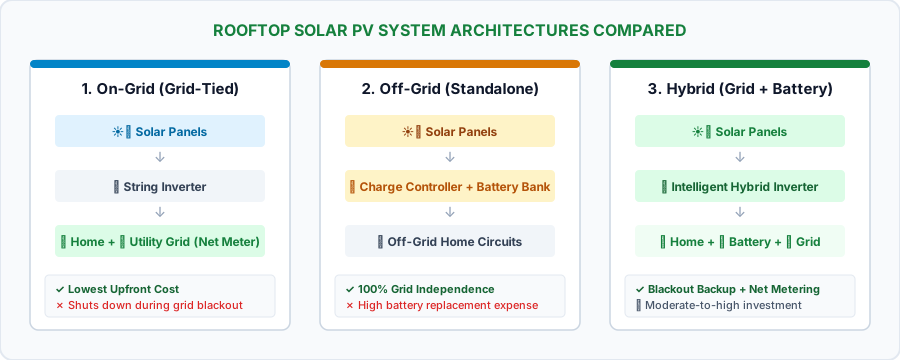
| Core Parameter | On-Grid (Grid-Tied) | Off-Grid (Standalone) | Hybrid (Solar + Storage) |
|---|---|---|---|
| Battery Storage | No physical batteries (relies on utility net-metering grid connection) | Mandatory battery bank (sized based on daily load and required autonomy) | Integrated battery bank (typically LiFePO4 or lead-carbon) |
| Utility Grid Connection | Direct bidirectional connection | Completely disconnected (no physical grid tie) | Connected with automatic grid isolation transfer switch |
| Net-Metering Support | Yes (surplus daytime solar exported to grid) | No (cannot export; surplus is curtailed once full) | Yes (exports surplus after home loads and battery are satisfied) |
| Operation During Grid Outages | Shuts off automatically (anti-islanding trip times per applicable grid code) | Continuous power (draws from battery and active solar) | Backup power for designated circuits (transfer time is model-dependent; check manufacturer specifications) |
| Relative Capital Cost | Lowest capital expenditure (panels + inverter only) | High upfront and lifecycle cost (batteries + charge controllers) | Moderate to High (hybrid inverter + storage capacity) |
| Illustrative Payback Window | Variable (~3 to 5 years under favorable tariffs and subsidies; highly site-dependent) | Longest (extended significantly by capital battery replacements) | Variable (~6 to 9+ years; depends on battery cost, tariffs, and storage sizing) |
| Government Subsidy Eligibility | Subject to program guidelines (e.g., PM Surya Ghar for eligible residential grid-connected systems) | Generally ineligible under standard grid-connected rooftop schemes | Subject to DISCOM & portal rules (central assistance typically targets grid-connected PV components; storage rules vary) |
| Maintenance Complexity | Minimal (periodic panel cleaning and annual inverter check) | High (battery state of charge, equalization, replacement cycles) | Moderate (battery management system / BMS monitoring) |
1. On-Grid Solar Systems (Grid-Tied)
On-grid solar is the most widespread rooftop configuration worldwide for urban and suburban residential properties connected to a dependable electrical utility network.
In an on-grid architecture, the energy flow forms a synchronized, bidirectional loop between your rooftop, your home's electrical panel, and the public utility grid:
- DC to AC Conversion: The rooftop array generates direct current (DC), which flows into the grid-tied inverter. The inverter instantaneously converts this into alternating current (AC) matched precisely to your utility's voltage and line frequency.
- Immediate In-Home Priority: This generated AC electricity flows straight into your main distribution panel, where active household loads consume it first before any outside grid power is drawn.
- Bi-Directional Net-Metering: When solar production exceeds immediate domestic consumption, the surplus automatically routes out through your bidirectional meter into the public grid, accumulating export credits. Conversely, when household demand exceeds solar generation (or after dark), power flows inward from the utility grid seamlessly.
How an On-Grid System Works:
- Photovoltaic Generation: Rooftop solar panels convert sunlight into direct current (DC) electricity.
- Synchronized Inversion: A grid-tied string inverter converts DC to alternating current (AC) synchronized precisely with the utility grid's voltage (230V single-phase or 415V three-phase) and frequency (50 Hz or 60 Hz).
- Self-Consumption First: Power generated is consumed immediately by household appliances currently in operation.
- Surplus Export via Net-Metering: When solar production exceeds immediate domestic demand, surplus energy flows through a bidirectional meter into the utility grid, generating energy credits.
- Nighttime Grid Import: After sunset or during overcast weather, the home draws electricity seamlessly from the utility grid.
Advantages & Trade-Offs:
- Financial Return: Eliminating battery storage keeps initial equipment and installation costs lower than storage-backed configurations. Payback depends on the installed system cost, local electricity tariff, annual solar generation, household self-consumption, export-credit rules, and applicable subsidies. Calculate it using local quotations and current utility rules rather than relying on a universal payback period.
- Major Limitation: It provides zero blackout protection. When the grid goes down, your home loses power even if the sun is shining brightly overhead.
2. Why Grid-Tied Inverters Must Shut Down During Power Cuts
The single most common disappointment among first-time solar buyers is discovering that their on-grid solar system ceases producing electricity during a utility blackout. This behavior is neither a product defect nor an equipment failure—it is a mandatory life-safety mechanism.
The Physics of Anti-Islanding Protection
When a utility power outage occurs, a section of the electrical distribution network becomes disconnected from the central substation. If rooftop solar inverters continued feeding power into this isolated section (called an "island"), serious hazards arise:
The Electrical Backfeed Hazard: When a utility line goes down, emergency utility crews arrive under the assumption that the severed distribution line is completely de-energized ("dead"). If decentralized rooftop solar inverters continued pumping electricity outward into that isolated neighborhood circuit, it would create an energized "island." Repair lineworkers touching downed cables would face lethal, high-voltage electrocution. Certified anti-islanding protection acts as an automated safety firewall, immediately disconnecting the inverter within milliseconds of detecting grid failure.
- Lineworker Electrocution Hazard: Utility repair crews responding to downed power lines or substation trips work under the assumption that an isolated distribution line is de-energized ("dead"). If decentralized solar inverters continued backfeeding current onto the line, repair technicians face fatal electrocution hazards.
- Grid-Following vs. Grid-Forming Physics: Standard grid-tied inverters are grid-following devices. They do not generate their own voltage or frequency reference; they monitor the utility grid waveform and inject current in phase with that reference. When the grid fails, the inverter loses its stable reference and cannot maintain correct voltage or frequency for household appliances.
- Load-Generation Mismatch & Protection Tripping: Standard grid-tied inverters lack the autonomous grid-forming controls needed to dynamically balance sudden load changes across distribution phases during an uncontrolled islanding event. Without a stable utility grid sink, attempting to power unsegregated neighborhood loads leads to instantaneous severe overload, phase imbalance, or frequency deviations that trip internal protective relays to prevent equipment strain.
Mandatory Regulatory Standards:
Under international and national standards—including IEEE 1547, IEC 62116, and the Central Electricity Authority (CEA) Technical Standards for Connectivity of Distributed Generation Resources—all grid-tied inverters must incorporate certified Anti-Islanding Protection. The inverter must detect utility voltage or frequency collapse and disconnect quickly, with required detection and clearing times governed by the applicable grid connectivity standards and inverter certifications (often within fractions of a second to a few seconds, depending on the severity of the disturbance).
3. Off-Grid Solar Systems (Standalone)
Off-grid systems are engineered to operate with total physical and electrical independence from the utility power grid.
In a standalone off-grid architecture, power flows along an entirely self-contained electrical loop with zero connection to the public utility network:
- DC Charging Loop: Raw DC electricity generated by the rooftop solar array flows through a Maximum Power Point Tracking (MPPT) charge controller, which steps down voltage and delivers regulated direct current directly into a dedicated battery storage bank.
- Battery Reservoir: The battery bank serves as the primary energy reservoir and voltage buffer, soaking up solar surplus during peak daylight and releasing stored energy after sundown.
- Grid-Forming Inversion: A specialized off-grid inverter draws DC power from the battery bank, autonomously creates its own stable AC reference voltage and frequency, and powers domestic circuits independently 24 hours a day.
How an Off-Grid System Works:
- Solar Array & MPPT Charge Controller: Solar panels generate DC electricity, which passes through a Maximum Power Point Tracking (MPPT) charge controller to regulate voltage and safely charge a dedicated battery bank.
- Chemical Energy Storage: The battery bank (typically Lithium Iron Phosphate / LiFePO4 or Deep-Cycle Lead-Carbon) stores electrical energy chemically.
- Grid-Forming Inversion: An off-grid inverter draws DC power from the battery bank, creates its own stable AC reference voltage and frequency independently, and powers domestic circuits 24 hours a day.
- Auxiliary Generation: During prolonged rainy periods or multi-day winter storms, an auxiliary diesel/petrol generator or auto-start generator charges the batteries once the depth-of-discharge limit is reached.
Engineering Challenges & Critical Realities:
- Autonomy Sizing: The battery bank cannot be sized solely for overnight usage; designers commonly budget for multiple days of autonomy depending on localized cloudy-day weather patterns, critical load demands, and permissible depth of discharge (DoD). Actual capacity must be sized using site-specific load profiling and usable storage limits rather than a universal rule of thumb.
- Energy Curtailment (Wasted Solar): On a sunny day when the battery bank reaches 100% state of charge early, surplus solar power cannot be exported; unless secondary dump loads are present, excess generation is curtailed.
- Substantial Ongoing Replacement Expense: While modern deep-cycle lithium (such as LiFePO4) cells often specify multi-thousand cycle ratings under laboratory test conditions, actual field service life varies with ambient operating temperatures, average depth of discharge, charge rates, and manufacturer specifications. Battery storage remains a significant lifecycle expense requiring planned periodic capital replacement.
4. Hybrid Solar Systems: The Unified Solution
A hybrid solar system unites the economic advantages of grid-tied net-metering with the blackout resilience of on-site battery storage.
A hybrid inverter functions as an intelligent multi-port energy director that coordinates four distinct power pathways in real time:
- Photovoltaic DC Input: Direct DC electricity from rooftop panels flows straight into the inverter's MPPT charge stages to supply active household demand or charge local batteries.
- Bidirectional Storage Port: A dedicated DC interface charges and discharges the lithium battery bank based on programmed economic and reserve priorities.
- Grid Interconnection with Net-Metering: An integrated AC port connects to the main electrical panel and bidirectional utility meter, allowing clean export of surplus power to earn utility credits once the battery is topped up.
- Islanded Critical-Load Isolation: When an outage occurs, an internal high-speed static transfer switch (STS) physically isolates the home from the grid in milliseconds, forming a localized microgrid that safely powers dedicated critical circuits without risking hazardous grid backfeed.
How a Hybrid System Works:
- Self-Consumption Priority: During daylight hours, solar power supplies your home's active loads first.
- Battery Replenishment Second: Any surplus daytime solar power charges the local battery bank.
- Grid Export Third: Once the home loads are satisfied and the battery is 100% full, additional excess solar is exported to the grid via net-metering to earn financial credits.
- Evening Operation: At night, the hybrid inverter draws from the battery to power the home during expensive peak tariff hours (peak shaving). If the battery reaches its programmed minimum reserve (e.g., 20% state of charge), the home switches seamlessly to drawing grid electricity.
- Outage Backup Operation: A compatible hybrid inverter can supply designated backup circuits during a grid outage, provided the battery has sufficient charge and the system is configured for backup operation. Transfer time, supported loads, and whether solar continues operating during the outage depend on the inverter model and installation design. While certain premium models feature high-speed static transfer switches that transition rapidly enough for sensitive electronics, transfer times and surge handling capabilities are model-dependent; always verify manufacturer specifications and dedicate critical-load sub-panels accordingly.
5. Comprehensive Decision Framework: Which System Fits Your Home?
Use the following decision matrix to determine which solar configuration matches your property's location, grid reliability, budget, and power requirements:
| Decision Criteria | On-Grid (Grid-Tied) | Hybrid (Solar + Storage) | Off-Grid (Standalone) |
|---|---|---|---|
| Local Grid Reliability | Reliable grid (minimal outage areas; occasional brief interruptions tolerated) | Unreliable grid (areas experiencing frequent or prolonged recurring power cuts) | No grid access or prohibitively expensive grid extension |
| Primary Motivation | Maximizing electricity bill offset and ROI | Backup for selected essential loads, subject to system capacity and transfer time | 100% self-reliance and basic electrification |
| Upfront Budget | Lowest capital investment among solar types (PV panels and grid-tied inverter) | Higher upfront cost; the difference depends on battery capacity, chemistry, and installation requirements | Highest initial investment per usable kWh to ensure multi-day reliability |
| Critical Load Demands | Standard domestic loads; brief outages tolerated | Work-from-home, medical equipment, security, refrigeration | All household loads must be carefully managed and budgeted |
| Government Subsidy Considerations | Eligible for central assistance under PM Surya Ghar (subject to portal/DISCOM criteria) | Subject to DISCOM/portal rules; central assistance typically evaluates grid-tied solar capacity, while storage is generally self-funded | Generally excluded from standard residential grid-connected rooftop subsidy programs |
| Ideal Property Profile | Urban apartments, suburban row houses, commercial offices | Suburban villas, clinics, homes in areas with routine load shedding | Remote agricultural farmhouses, forest lodges, island dwellings |
Subsidy Verification Note: In India, central assistance under PM Surya Ghar is subject to the scheme's current eligibility and implementation requirements for residential grid-connected rooftop solar. Do not assume that off-grid systems or battery storage automatically qualify for the same assistance; verify the applicable rules before purchasing.
Practical Homeowner Scenarios:
- Scenario 1: Urban Homeowner with Stable Grid (e.g., Metro Cities)
Grid Outages: Rare, brief interruptions.
Recommendation: Install an On-Grid System. Adding battery storage significantly increases upfront capital expenditure without providing substantial lifestyle value where outages are negligible. An on-grid system with net-metering maximizes return on investment. The actual reduction in your electricity bill depends on household daytime self-consumption, net-metering settlement rules (such as net-billing vs. 1:1 energy banking credits), export tariffs, slab tiers, and non-bypassable fixed monthly charges. While a properly sized system can significantly offset the variable energy portion of an electric bill, overall savings vary with local utility rate structures. - Scenario 2: Suburban Residence with Routine Load Shedding
Grid Outages: Daily or weekly power cuts lasting 1 to 4 hours.
Recommendation: Install a Hybrid System. You get the financial benefit of net-metering on sunny days while maintaining dedicated battery backup for essential home circuits during outages, avoiding noisy or polluting fossil-fuel generator sets. - Scenario 3: Rural Farmhouse, Remote Workshop, or Cabin
Grid Outages: Grid is absent or extending the utility line costs more than local off-grid hardware.
Recommendation: Install an Off-Grid System. Invest in an appropriately sized deep-cycle battery bank based on rigorous load profiling, paired with an auxiliary generator for seasonal monsoon or winter troughs.
6. Authoritative Standards & Regulatory References
For statutory interconnection rules, inverter safety standards, and national rooftop solar subsidy frameworks, consult the following official authorities:
- CEA Technical Standards for Connectivity — Official statutory regulations governing technical standards, anti-islanding isolation criteria, operating frequency/voltage bands, and safety requirements for distributed generators connecting to the electricity distribution network.
- MNRE Official Portal — Statutory guidelines, approved models and manufacturers list (ALMM), and central financial assistance (subsidy) criteria under the PM Surya Ghar: Muft Bijli Yojana.
- IEEE Standards Association — The global benchmark establishing technical interconnection requirements, response to abnormal grid conditions, and anti-islanding test parameters.
- IEC Webstore — International compliance testing protocol verifying automatic disconnect operation of solar inverters within specified safety intervals.