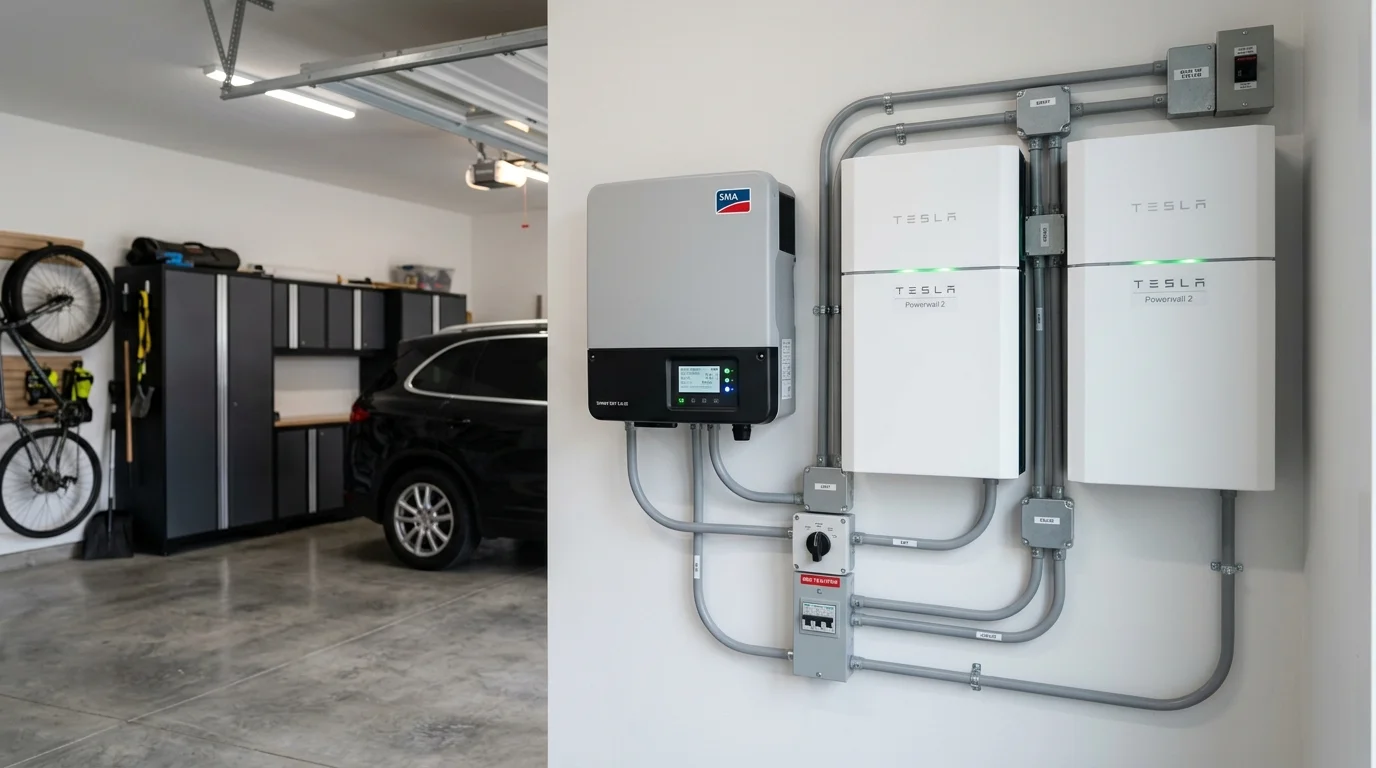
When investing in rooftop solar, every homeowner faces a pivotal engineering and financial crossroads: should you install a standard grid-tied system without batteries, or invest substantially more in a hybrid battery energy storage system (BESS)?
Solar marketing often portrays batteries as the ultimate symbol of total energy independence and permanent blackout immunity. However, batteries also substantially raise initial capital expenditure, experience chemical degradation over time, and can extend the financial payback period of your rooftop solar installation by several years.
In this guide, we break down the engineering, regulatory, and financial realities of Solar with Battery vs. Solar without Battery, grounded in technical guidelines from the Ministry of New and Renewable Energy (MNRE), the U.S. Department of Energy (DOE), and international electrical interconnection standards.
1. The Core Differences: Three Main Architectures
Understanding your options requires distinguishing between the three standard configurations used in residential solar installations:
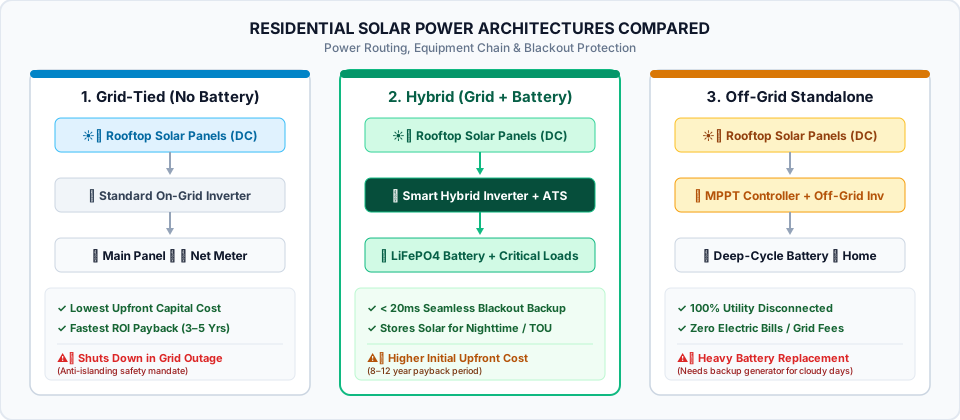
1. Grid-Tied System (Standard / No Battery)
- How It Operates: Solar photovoltaic (PV) modules convert sunlight into direct current (DC). In a string inverter configuration, series-connected module strings carry high-voltage DC to a central inverter near the service panel, which converts it to alternating current (AC). In a microinverter configuration, individual micro-inverters mounted under each panel convert DC to AC at the module level. Generated AC electricity immediately powers active household loads, and surplus electricity is exported through a bidirectional net meter to the utility grid.
- Key Advantage: Lowest upfront capital investment, high system efficiency because it avoids battery charge-discharge losses, zero battery maintenance, and the fastest return on investment (ROI).
- Core Limitation: Zero blackout resilience. Standard grid-tied inverters are "grid-following"—they require an external voltage and frequency reference from the utility grid to operate. When a grid outage occurs, the inverter is mandated by safety codes to shut down immediately ("anti-islanding") to prevent energizing downed power lines. Applicable compliance standards include international test procedures (IEEE 1547 and IEC 62116) as well as mandatory Indian regulations (Central Electricity Authority [CEA] Technical Standards for Connectivity of Distributed Generation Resources and Bureau of Indian Standards IS 16221 / IS 16169).
2. Hybrid System (Grid-Tied + Battery Storage)
- How It Operates: Combines rooftop solar with an energy storage system (typically Lithium Iron Phosphate — LiFePO4) managed by a multi-mode hybrid inverter. During normal grid operation, solar electricity powers household loads first, charges the battery bank second, and exports surplus power third.
- Outage Operation: When the utility grid fails, an automatic transfer switch (ATS) or internal islanding contactor physically disconnects the home from the utility grid. Transfer time varies substantially by inverter model and transfer equipment design—ranging from 10 to 50 milliseconds in UPS-grade electronic units to several seconds in external mechanical contactor-based ATS hardware (always consult manufacturer specifications). Once isolated, the hybrid inverter switches from "grid-following" to "grid-forming" mode, establishing an isolated local microgrid to keep critical circuits powered.
- Key Advantage: Resilient backup power during outages, protection against grid voltage fluctuations, and the ability to perform Time-of-Use (ToU) tariff arbitrage.
- Core Limitation: Significantly higher initial cost, chemical battery degradation over time, and 10% to 15% round-trip energy conversion losses.
3. Off-Grid System (Autonomous Stand-Alone)
- How It Operates: Entirely independent from the utility grid. Requires a large solar array, a heavy battery bank sized according to local weather variability, critical load profiles, and auxiliary backup generation (diesel or gas) to provide autonomy during prolonged monsoon or winter conditions. Power is managed through maximum power point tracking (MPPT) charge controllers and standalone inverters.
- Key Advantage: Complete self-sufficiency in remote geographic locations where grid extension is physically impossible or prohibitively expensive.
- Core Limitation: Highest capital cost per kilowatt-hour delivered, large space requirements, and complex battery maintenance.
2. Upfront Equipment and Turnkey Installation Cost Comparison
Energy storage remains the single most capital-intensive subsystem in a residential renewable energy project.
Indian Market Turnkey Cost Estimates (5 kW Residential System)
Illustrative Planning Estimates (as of Q1 2026; Not Independently Verified Market Averages or Formal Contractor Quotations)
Below is an illustrative planning comparison for a typical 5 kW residential rooftop solar installation in India (all values in INR, pre-subsidy). These figures provide rough order-of-magnitude ranges based on typical equipment specifications and standard rooftop mounting conditions. Actual turnkey quotations vary widely by installer, regional logistics, roof structural conditions, AC/DC cabling distances, module technology (e.g., TOPCon vs Mono PERC), electrical panel upgrades, and statutory DISCOM inspection fees:
| Component / Subsystem | 5 kW Grid-Tied (No Battery) | 5 kW Hybrid (+ 10 kWh LiFePO4 Battery) |
|---|---|---|
| Solar PV Modules (5 kW Mono PERC / TOPCon) | ₹1,50,000 – ₹1,80,000 | ₹1,50,000 – ₹1,80,000 |
| Power Conditioning Inverter | ₹40,000 – ₹55,000 (Grid-tied string) | ₹85,000 – ₹1,25,000 (Hybrid multi-mode) |
| Battery Storage Bank (10 kWh Usable LiFePO4) | None | ₹2,00,000 – ₹2,90,000 |
| Mounting Structure & Balance of System (BoS) | ₹35,000 – ₹50,000 | ₹40,000 – ₹60,000 |
| Critical Loads Subpanel & Automatic Transfer Switch | Not Required | ₹20,000 – ₹35,000 |
| Installation, Permitting, Testing & Net Metering | ₹30,000 – ₹45,000 | ₹45,000 – ₹65,000 |
| Total Turnkey Capital Investment (Pre-Subsidy) | ₹2,55,000 – ₹3,30,000 | ₹5,40,000 – ₹7,55,000 |
PM Surya Ghar: Muft Bijli Yojana Subsidy Context: Under current scheme guidelines notified by the Ministry of New and Renewable Energy (MNRE) and the Press Information Bureau (PIB), eligible individual residential consumers can claim Central Financial Assistance (CFA) calculated strictly on the rated capacity of grid-connected solar PV modules:
- ₹30,000 for residential rooftop systems up to 1 kW
- ₹60,000 for residential rooftop systems up to 2 kW
- Up to ₹78,000 for residential rooftop systems 3 kW and larger
International Market Perspective (U.S. Benchmarks)
In mature international markets like the United States, hardware costs, permitting overhead, and labor dynamics differ substantially:
- 5 kW Grid-Tied System: Typically costs $14,000 to $18,000 turnkey pre-incentive (reflecting a median installed pricing of ~$3.00–$3.80/W DC based on recent cohorts in the Lawrence Berkeley National Laboratory [LBNL] Tracking the Sun research dataset).
- 10 kWh Lithium Battery Add-On: An installed AC-coupled or DC-coupled residential battery system (such as Tesla Powerwall 3 or Enphase IQ 5P) adds approximately $8,500 to $13,000 installed pre-incentive (~$850–$1,300/kWh installed), bringing total hybrid system cost to $22,500 to $31,000.
- Federal Incentive Note (Verified as of October 2026): The U.S. residential clean energy tax credit under Section 25D was terminated for qualifying expenditures made after December 31, 2025. Do not assume that a residential solar or battery installation completed in 2026 qualifies for the former 30% credit. Always verify current IRS statutory guidance on Section 25D for any legislative revisions or applicable transition rules. The cost comparisons in this article use pre-incentive prices.
- Geographic Representation Note: As highlighted in LBNL's research, residential solar-plus-storage data in national datasets is heavily weighted toward California (driven by the transition to NEM 3.0 net billing). As a result, paired storage adoption rates and pricing dynamics in California may not be fully representative of states with different labor costs, permitting hurdles, or traditional net metering rules.
Reference Guide: For detailed equipment breakdowns and regional subsidy schemes, read our comprehensive Rooftop Solar Cost Breakdown Guide.
3. Financial Payback, ROI, and Tariff Structure Realities
The economic viability of adding a battery does not depend on solar irradiance alone—it is fundamentally governed by your local utility tariff structure, export compensation rules, and battery degradation economics:
Scenario A: Generous 1:1 Net Metering Available (Illustrative Case)
- Under traditional 1:1 net metering, the utility grid acts conceptually like an accounting "buffer" or virtual battery. Every kilowatt-hour exported during sunny afternoons offsets a kilowatt-hour consumed at night at full retail value (subject to DISCOM billing cycles and banking settlement rules).
- Payback Realities: Rather than a universal constant, actual grid-tied payback depends on several operational variables:
- Self-Consumption Ratio: How much solar energy powers daytime household loads directly vs. exported.
- Billing Rules: Full retail credit parity vs. reduced net billing buyback rates.
- Non-Avoidable Charges: Fixed monthly meter rents, demand charges, and statutory electricity duties.
- Seasonal Generation: Irradiance drops during monsoon/winter seasons.
- Worked Illustrative Calculation: Consider a 5 kW system generating ~600 kWh/month (~7,200 kWh/year) in a sunny Indian state offsetting retail power at an illustrative ₹7.50/kWh:
- If 50% (3,600 kWh) is self-consumed directly and 50% (3,600 kWh) is exported under 1:1 net metering, gross bill savings equal $7,200 \times ₹7.50 = \mathbf{₹54,000/\text{year}}$.
- Pre-Subsidy Payback: At ₹2,80,000 turnkey cost, simple payback is $\frac{₹2,80,000}{₹54,000} \approx \mathbf{5.2 \text{ years}}$.
- Post-Subsidy Payback: With a ₹78,000 PM Surya Ghar CFA (net cost ₹2,02,000), simple payback is $\frac{₹2,02,000}{₹54,000} \approx \mathbf{3.7 \text{ years}}$.
- Hybrid System Payback (With Battery): Extends significantly to 10 to 14+ years. Because a battery costs substantial capital without generating any new kilowatt-hours, it dilutes the overall financial yield of the solar panels. In this scenario, purchasing a battery is strictly an investment in power reliability and blackout insurance, rather than a financially driven return.
Scenario B: Time-of-Use (ToU) Tariffs or Low Net Billing Export Compensation
- In jurisdictions transitioning away from 1:1 net metering (such as California under NEM 3.0, or specific Indian state tariff structures enforcing net billing where surplus power is credited at an illustrative Average Power Purchase Cost [APPC] rate of ₹2.00–₹2.60/kWh while evening peak retail consumption costs ₹8.00–₹12.00/kWh in upper slabs):
- Daytime solar exported to the grid earns modest compensation.
- Evening electricity drawn from the grid carries high peak charges.
- In this environment, a battery performs tariff arbitrage: it stores daytime surplus solar and discharges during peak evening hours to avoid expensive grid purchases.
- Daily Usable Cycling: 8.0 kWh discharged during evening peak hours.
- Round-Trip Conversion Efficiency ($\eta_{\text{rte}}$): 90% (requiring $8.0 \div 0.90 \approx 8.89$ kWh of daytime solar charging).
- Illustrative Tariff Schedule: Peak retail grid tariff = ₹9.50/kWh; Daytime solar export credit = ₹2.50/kWh (Tariff spread = ₹7.00/kWh). Note: actual rates vary by state DISCOM order and consumer tariff slab.
- Active Annual Utilization: 320 equivalent full cycles per year (allowing for monsoon and low-solar periods).
- Incremental Capital Expenditure: ₹2,85,000 (lower bound) to ₹3,50,000 (typical planning midpoint) for hybrid inverter premium, 10 kWh battery, ATS subpanel, and extra BoS/labor.
Illustrative Financial Payback Calculation for Battery Storage
To evaluate whether a battery can pay for itself through tariff arbitrage alone, consider an illustrative planning scenario for an incremental 10 kWh battery subsystem (cycling 8 kWh usable energy daily):
- Illustrative Incremental-Cost Estimate Based on Component Assumptions Below:
- Inverter upgrade premium (string to hybrid multi-mode): Assumed at ₹45,000 to ₹70,000 premium based on typical residential hybrid units (e.g., GoodWe, Deye, Solis 5 kW hybrid series).
- Battery storage module: ₹2,00,000 to ₹2,90,000 for a 10 kWh usable LiFePO4 rack or wall-mounted battery bank.
- ATS & Critical Loads Subpanel: ₹20,000 to ₹35,000 for hardware and isolation contactors.
- Additional Balance of System (BoS) & Installation: ₹20,000 to ₹30,000 for heavy DC isolators, battery cabling, and labor differential.
- Total Indicative Incremental Outlay: Approximately ₹2,85,000 to ₹4,25,000 in India (typical planning midpoint $\approx \mathbf{₹3,50,000}$).
- In mature US markets, hardware, ATS, and installation for a 10 kWh battery add approximately $8,500 to $13,000 pre-incentive (planning midpoint $\approx \mathbf{$10,000}$).
- Daily Arbitrage Energy & Round-Trip Efficiency Accounting:
- The battery delivers 8.0 kWh of usable energy during peak evening hours.
- Accounting for an illustrative ~90% round-trip efficiency ($\eta_{\text{rte}}$), the battery requires approximately $8.0 \div 0.90 \approx \mathbf{8.89 \text{ kWh}}$ of daytime solar charging energy to deliver 8.0 kWh during peak evening hours.
- Net Annual Arbitrage Savings Calculation:
- India Illustrative Case:
- Avoided evening peak grid purchase: $8.0 \text{ kWh} \times ₹9.50/\text{kWh} = ₹76.00$.
- Foregone daytime export revenue (opportunity cost of charging): $8.89 \text{ kWh} \times ₹2.50/\text{kWh} = ₹22.22$.
- Net daily arbitrage savings: $₹76.00 - ₹22.22 = \mathbf{₹53.78/\text{day}}$.
- Over 320 active cycling days per year: $$\text{Annual Net Arbitrage Savings} = ₹53.78 \times 320 = \mathbf{₹17,209.60/\text{year}}$$ (Note: This calculation assumes all charging energy would otherwise have been eligible for full export credit; in practice, standby parasitic draw, BMS power consumption, and household self-consumption alter actual realized savings).
- US Illustrative Case (e.g., California NEM 3.0 Pre-Incentive):
- Avoided peak grid purchase: $8.0 \text{ kWh} \times $0.35/\text{kWh} = $2.80$.
- Foregone daytime export credit: $8.89 \text{ kWh} \times $0.07/\text{kWh} = $0.62$.
- Net daily savings: $$2.80 - $0.62 = $2.18/\text{day}$.
- Over 320 active days: $320 \times $2.18 = \mathbf{$697.60/\text{year}} \approx \mathbf{$698/\text{year}}$.
- India Illustrative Case:
- Simple Capital Payback (Before Degradation, Maintenance & Replacement):
- India Scenario:
- At the midpoint incremental capital outlay of ~₹3,50,000: $$\text{Simple Capital Payback} = \frac{₹3,50,000}{₹17,209.60} \approx \mathbf{20.3 \text{ years}}$$
- At the lower-bound incremental capex of ~₹2,85,000: $$\text{Simple Capital Payback} = \frac{₹2,85,000}{₹17,209.60} \approx \mathbf{16.6 \text{ years}}$$ (Note: This is an illustrative simple capital payback calculation. It does not account for battery degradation, ongoing maintenance, financing costs, or mid-life equipment replacement).
- US Scenario (Pre-Incentive Benchmark):
- Using pre-incentive turnkey installed costs ($10,000 midpoint for a 10 kWh battery system) and annual net arbitrage savings of ~$698: $$\text{Simple Capital Payback} = \frac{$10,000}{$697.60} \approx \mathbf{14.3 \text{ years}}$$
- India Scenario:
- The Impact of Degradation & Replacement (NREL Methodology):
- Battery capacity can decline over time due to calendar aging and cycling. The rate varies by chemistry, operating temperature, depth of discharge, usage patterns, and battery model. Use the manufacturer's published degradation data and warranty terms for project-specific estimates.
- As modeled in the National Renewable Energy Laboratory (NREL) System Advisor Model (SAM), battery degradation consists of both calendar aging (driven by resting cell temperature and state of charge) and cycle aging (driven by depth of discharge, C-rate, and cumulative energy throughput).
- Over a 10-year operational period, usable capacity often declines toward the manufacturer's warranted threshold (specified in model datasheets, such as BYD Battery-Box Premium, Tesla Powerwall, or Enphase IQ 5P warranty schedules), progressively eroding annual bill arbitrage savings.
- Economic Conclusion: Under these illustrative assumptions, arbitrage savings alone do not recover the battery's incremental cost within a typical 10-year warranty period. Actual economics depend on local tariffs, incentives, utilization, and replacement costs. Therefore, a residential battery should be evaluated primarily as an investment in uninterrupted power security and lifestyle resilience, rather than a financial profit engine.
Solar Panel vs. Battery Warranties: Key Differences Explained
Homeowners often confuse laboratory cycle life testing with legal manufacturer warranty terms:
- Solar PV Modules:
- Workmanship / Product Warranty (Typically 10 to 15 Years): Covers mechanical structural defects, frame separation, junction box failures, and defective bypass diodes.
- Linear Power Performance Warranty (Typically 25 to 30 Years): The manufacturer's performance warranty typically specifies that the module's power output will not degrade faster than ~1%–2% in year 1 and ~0.35%–0.55% per year thereafter (varying across TOPCon, HJT, and Mono PERC architectures), ensuring at least 80% to 85% of rated nameplate capacity remains at year 25 or 30.
- Battery Energy Storage Systems:
- Laboratory Cycle Life vs. Manufacturer Warranty: In standardized laboratory tests under benign conditions (constant 25°C, gentle 0.2C rate, 80% DoD), LFP cells often demonstrate 4,000 to 6,000 cycles before reaching 70% capacity. However, this is not an unconditional contractual warranty.
- Actual Warranty Structures (Typically 10 Years OR Throughput Limit): Commercial battery warranties typically cover 10 years (or up to 15 years for select units like Enphase IQ Battery 5P) or a specific cumulative energy throughput limit, whichever occurs first, guaranteeing a specified retained capacity (commonly 60%–70% depending on the model). Tesla Powerwall 2, for example, warrants 10 years with unlimited cycles for solar self-consumption. Specific throughput, cycle limits, and operating temperature exclusions vary substantially—always review the manufacturer's formal warranty document.
4. Blackout Resilience: The Crucial Anti-Islanding Reality
One of the most persistent misconceptions among homeowners considering rooftop solar is:
"If the utility grid suffers a blackout on a bright sunny afternoon, my solar panels will continue powering my appliances."
Without an island-capable hybrid system and an automated transfer switch, this is completely false.
Why Standard Grid-Tied Inverters Must Shut Down
Standard grid-tied solar inverters are engineered as grid-following devices. They do not possess independent internal voltage or frequency generators; instead, they lock onto the external AC waveform of the utility grid and inject solar power synchronously at that exact voltage and frequency.
When a grid outage occurs:
- The inverter detects the loss of grid voltage and frequency reference within milliseconds.
- It immediately terminates power output to comply with mandatory anti-islanding safety standards (IEEE 1547, UL 1741, IEC 62116, and in India, the Central Electricity Authority [CEA] Technical Standards for Connectivity of Distributed Generation Resources Regulations and Bureau of Indian Standards IS 16221 / IS 16169).
- The Safety Rationale: If solar inverters continued injecting electricity into an inactive distribution grid ("unintentional islanding"), they would energize local power lines that utility line technicians assume are dead. This creates an immediate risk of fatal electrocution for utility repair crews working to restore downed lines, and risks catastrophic equipment damage if the utility grid recloses out-of-phase.
How a Hybrid Battery System Enables Blackout Operation
A hybrid battery system overcomes this limitation through specialized hardware:
- Automatic Transfer Switch (ATS) / Islanding Contactor: Upon sensing grid loss, the ATS physically and galvanically severs the home's connection to the utility grid. Transfer time varies by inverter model and system design—ranging from 10 to 50 milliseconds for seamless UPS-grade units to several seconds for mechanical contactor-based ATS hardware (always verify manufacturer specifications).
- Grid-Forming Mode: Once isolated, the hybrid inverter switches into "grid-forming" mode. It uses energy from the battery bank to establish its own stable reference waveform (e.g., 230V at 50 Hz in India/Europe, or 120/240V at 60 Hz in North America).
- Outage Solar Generation Capabilities: Crucially, not every hybrid inverter can automatically power critical loads directly from solar panels during an outage. As documented by the U.S. Department of Energy (DOE), maintaining solar power during a grid failure requires an island-capable hybrid or storage-ready multi-mode inverter paired with adequate battery capacity and an automatic isolation device to stabilize voltage and frequency. Without sufficient battery buffering, transient solar fluctuations from passing clouds would immediately collapse an isolated microgrid.
- Critical Loads Subpanel: Non-essential heavy loads (such as electric vehicle chargers, central HVAC, or electric water heaters) are disconnected, while essential circuits (refrigeration, lighting, Wi-Fi, laptops, medical equipment, and ceiling fans) remain powered continuously.
5. Battery Lifespan, Chemistry & Operational Efficiency
If you determine that energy storage is necessary for your household resilience, choosing the correct battery chemistry and understanding operational parameters is critical:
| Engineering Metric | Lithium Iron Phosphate (LiFePO4 / LFP) | Nickel Manganese Cobalt (NMC) | Deep-Cycle Lead-Acid (Tubular / AGM) |
|---|---|---|---|
| Usable Depth of Discharge (DoD) | 90% – 95% | 80% – 90% | 50% maximum (rapidly degrades if discharged deeper) |
| Indicative Cycle Life in Lab Conditions (to 70% Retained Capacity) | 4,000 – 6,000 cycles (at 25°C, 0.2C rate; model-dependent, e.g. Pylontech US3000C / BYD LVS) | 2,000 – 3,000 cycles (at 25°C, 0.2C rate; model-dependent, e.g. LG RESU10H) | 500 – 1,200 cycles (at 50% DoD; maintenance-dependent, e.g. Trojan L16RE) |
| Indicative Calendar Lifespan | 10 to 15 years (illustrative estimate; subject to operating temperature & usage) | 8 to 12 years (illustrative estimate; subject to operating temperature & usage) | 3 to 5 years (illustrative estimate; subject to regular maintenance) |
| Typical Manufacturer Warranty Terms | 10 to 15 years or specified MWh throughput (model-dependent; e.g. Enphase IQ 5P, BYD LVS; ~60%–70% capacity retention) | 10 years or specified MWh throughput (model-dependent; e.g. Tesla Powerwall 2) | 1 to 3 years (limited warranty; strict maintenance compliance required) |
| Round-Trip Efficiency (RTE) | 92% – 96% | 90% – 94% | 75% – 85% |
| Thermal Stability & Safety Profile | Generally better thermal stability than many NMC chemistries, but proper BMS protection, installation, ventilation/clearance, and manufacturer safety requirements remain essential | Higher energy density; requires active thermal management and BMS monitoring | Emits hydrogen gas during overcharge; requires adequate room ventilation |
| Maintenance Requirements | Zero manual maintenance; managed by internal BMS | Zero manual maintenance; managed by internal BMS | Periodic terminal inspection, torque checks, and electrolyte topping (tubular) |
Lifespan as a Condition-Dependent Estimate (Not a Fixed Guarantee)
Battery cycle life and calendar longevity cannot be treated as unconditional guarantees. As documented in NREL battery reliability research, actual degradation depends heavily on four operating variables:
- Operating Temperature: Lithium cells operate optimally between 15°C and 25°C. Sustained exposure to high ambient temperatures (above 35°C / 95°F, common in hot summers) accelerates solid electrolyte interphase (SEI) growth and electrolyte degradation. Charging below 0°C without internal cell heaters causes permanent lithium plating and capacity loss.
- Depth of Discharge (DoD): Discharging a battery to 80% DoD every day delivers significantly more lifetime throughput than routinely draining it to 100%.
- Charge and Discharge Rate (C-Rate): Rapid continuous discharging (>0.5C or 1C) generates internal ohmic heating, which degrades cell longevity faster than moderate regimes (0.2C to 0.3C).
- Manufacturer Warranty Structures: Reputable manufacturers warrant lithium batteries for 10 to 15 years OR a specified energy throughput limit, whichever comes first, guaranteeing approximately 60%–70% retained capacity at end-of-warranty. Always consult the specific manufacturer's product datasheet and warranty schedule.
6. How to Size a Home Solar Battery: Exact Engineering Formulas
To avoid under-sizing (which leads to premature battery shutdown during an outage) or over-sizing (which inflates capital costs unnecessarily), engineers use the following step-by-step formula:
Step 1: Calculate Daily Critical Energy Consumption (Watt-hours)
Identify only the critical appliances required during a blackout and their expected operating hours:
$$\text{Daily Critical Energy Requirement } (E_{\text{critical}}) = \sum \left[ \text{Power Rating } (P_i \text{ in Watts}) \times \text{Run Time } (t_i \text{ in Hours}) \right]$$
Step 2: Account for Inverter AC-to-DC Conversion Losses
Because inverters have an operational efficiency ($\eta_{\text{inv}}$) typically between 92% and 96%, the battery must supply more DC energy than the AC appliances consume:
$$E_{\text{usable, required}} \text{ (Wh)} = \frac{E_{\text{critical}}}{\eta_{\text{inv}}}$$
Step 3: Account for Usable Depth of Discharge (DoD) to Size Nominal Capacity
A battery should never be discharged beyond its safe depth-of-discharge limit. To calculate the raw Nominal (Nameplate) Battery Capacity required from bare cells or nominal battery blocks:
$$C_{\text{nominal}} \text{ (kWh)} = \frac{E_{\text{usable, required}} \text{ (kWh)}}{\text{DoD}}$$
Crucial Engineering Distinction (Nominal vs. Marketed Usable Capacity): As documented in NREL's System Advisor Model (SAM) documentation, there is a fundamental difference between nominal cell capacity and usable battery capacity:
- Raw Nominal Capacity ($C_{\text{nominal}}$): The total chemical energy stored in the cells at 100% state of charge. This is the value derived by dividing $E_{\text{usable, required}}$ by the allowable DoD (e.g. 90% for LFP or 50% for lead-acid).
- Manufacturer-Marketed Usable Capacity: Many modern packaged residential batteries (such as Tesla Powerwall 3 [13.5 kWh usable] or Enphase IQ 5P [5.0 kWh usable]) are marketed directly by their usable energy rating, with internal BMS depth-of-discharge buffers already factored in by the manufacturer. If selecting a battery based on published usable capacity, match $E_{\text{usable, required}}$ directly to the datasheet's usable rating (plus an aging buffer) — do not divide by DoD a second time.
Technical Note on Round-Trip Efficiency ($\eta_{\text{rte}}$): Round-trip efficiency represents total energy losses incurred across the full charge-discharge cycle (internal resistance, electrochemical conversion, and BMS parasitic draw). While $\eta_{\text{rte}}$ does not reduce the usable capacity delivered during discharge from an already-charged battery, it determines the additional solar energy required to recharge the battery: $$E_{\text{solar, charging required}} = \frac{E_{\text{usable, required}}}{\eta_{\text{rte}}}$$
Step 4: Convert to Ampere-Hours (Ah) for DC Voltage Systems
For battery banks configured at a standard nominal DC bus voltage ($V_{\text{nominal}}$), convert nominal capacity from kilowatt-hours to Watt-hours (by multiplying by 1,000) before dividing by system nominal voltage:
$$\text{Capacity } (\text{Ah}) = \frac{C_{\text{nominal}} \text{ (kWh)} \times 1,000}{V_{\text{nominal}} \text{ (V)}} = \frac{C_{\text{nominal}} \text{ in Watt-hours}}{V_{\text{nominal}} \text{ in Volts}}$$
Engineering Voltage Clarification: Note that nominal battery voltage dictates actual stored energy:
- A 51.2V / 100Ah module (standard 16S LiFePO4 configuration: $16 \times 3.2\text{V}$) provides $51.2\text{V} \times 100\text{Ah} = \mathbf{5.12 \text{ kWh}}$ nominal capacity.
- A 48.0V / 100Ah module (standard 15S LiFePO4 configuration: $15 \times 3.2\text{V}$, or nominal 48V telecom/lead-acid equivalent) provides $48.0\text{V} \times 100\text{Ah} = \mathbf{4.80 \text{ kWh}}$ nominal capacity. Sizing calculations must always use the battery's specific nominal voltage and manufacturer rating.
Worked Engineering Example: Household Outage Sizing
Suppose a homeowner needs emergency blackout backup for a 12-hour overnight outage covering the following critical loads:
- Refrigerator: 150 W average running power (operating on a 50% compressor duty cycle = 6 hours total run time) $\rightarrow 150 \text{ W} \times 6 \text{ h} = 900 \text{ Wh}$
- LED Lighting: 8 bulbs @ 12 W each for 6 hours $\rightarrow 96 \text{ W} \times 6 \text{ h} = 576 \text{ Wh}$
- Ceiling Fans: 3 energy-efficient BLDC fans @ 30 W each for 10 hours $\rightarrow 90 \text{ W} \times 10 \text{ h} = 900 \text{ Wh}$
- Wi-Fi Router & Modem: 25 W for 12 hours $\rightarrow 25 \text{ W} \times 12 \text{ h} = 300 \text{ Wh}$
- Laptops & Phone Charging: 150 W combined for 5 hours $\rightarrow 150 \text{ W} \times 5 \text{ h} = 750 \text{ Wh}$
- Television: 100 W for 3 hours $\rightarrow 100 \text{ W} \times 3 \text{ h} = 300 \text{ Wh}$
- Total Daily Critical AC Energy ($E_{\text{critical}}$): $900 + 576 + 900 + 300 + 750 + 300 = \mathbf{3,726 \text{ Wh}} \approx \mathbf{3.73 \text{ kWh}}$
- Inverter Efficiency Adjustment ($\eta_{\text{inv}} = 0.94$): $$E_{\text{usable, required}} = \frac{3,726}{0.94} \approx 3,964 \text{ Wh} \approx \mathbf{3.96 \text{ kWh}}$$
Sizing Option A: Lithium Iron Phosphate (LiFePO4)
- Usable Depth of Discharge ($\text{DoD}$) = 90% (0.90)
- Required Nominal Capacity: $$C_{\text{nominal}} = \frac{3.96 \text{ kWh}}{0.90} \approx \mathbf{4.40 \text{ kWh}} = 4,400 \text{ Wh}$$
- Ampere-Hour Conversion:
- For a 51.2V nominal bus (16S): $\frac{4,400 \text{ Wh}}{51.2 \text{ V}} \approx \mathbf{85.9 \text{ Ah}}$. A standard 51.2V / 100Ah (5.12 kWh) module satisfies the requirement with a ~16% reserve buffer.
- For a 48.0V nominal bus (15S): $\frac{4,400 \text{ Wh}}{48.0 \text{ V}} \approx \mathbf{91.7 \text{ Ah}}$. A standard 48.0V / 100Ah (4.80 kWh) module satisfies the requirement with a ~9% reserve buffer.
- Selection Recommendation: A standard 51.2V / 100Ah (5.12 kWh) LiFePO4 rack or wall-mounted battery module is an ideal engineering match, providing headroom for battery aging, sub-optimal ambient temperatures, and transient surge peaks.
Sizing Option B: Deep-Cycle Lead-Acid (Tubular / AGM)
- Usable Depth of Discharge ($\text{DoD}$) = 50% (0.50)
- Required Nominal Capacity: $$C_{\text{nominal}} = \frac{3.96 \text{ kWh}}{0.50} \approx \mathbf{7.93 \text{ kWh}} = 7,930 \text{ Wh}$$
- Standard Commercial Sizing: A typical bank of four 12V 200Ah deep-cycle batteries connected in series yields a nominal capacity of $48\text{ V} \times 200\text{ Ah} = \mathbf{9.60\text{ kWh}}$. At 50% usable DoD, this bank provides $4.80\text{ kWh}$ of usable DC energy, safely meeting the 3.96 kWh requirement while offering reserve capacity for battery degradation and Peukert's effect under heavy discharge rates.
Outage Appliance Compatibility Checklist
Before deciding on an energy storage system, use this checklist to understand what a standard residential hybrid inverter (typically 5 kW continuous output paired with a 5–10 kWh battery) can and cannot run during a blackout:
| Load Category | Appliances Included | Can Run on 5 kW Hybrid Backup? | Engineering Guidance |
|---|---|---|---|
| Essential Loads | LED Lights, Wi-Fi router, laptops, phone chargers, medical CPAP/oxygen devices | Yes (Continuous) | Very low draw (100–350W total); runs for 15–24+ hours on a 5–10 kWh battery. |
| Comfort & Food Preservation | BLDC ceiling fans, residential refrigerator/freezer, TV | Yes (Continuous) | Refrigerator compressor cycles intermittently; ensure refrigerator start surge does not exceed inverter peak surge rating. |
| Motor & Water Pumping | 0.5 HP to 1.0 HP domestic water pump, submersible borewell pump | Yes (Intermittent Only) | Pumps draw 3× to 5× starting surge current (Locked Rotor Amps). Check that the hybrid inverter's short-duration surge rating (typically 1.5×–2× continuous rating for 5–10 seconds) accommodates the pump starting surge. |
| High-Power Heating & Cooling | 1.5-ton inverter air conditioner, electric water geyser, room space heaters | Restricted / Not Recommended | Continuous running power of a 1.5-ton inverter AC typically ranges between 1,000W and 1,800W depending on compressor modulation, room insulation, and ambient temperature. Running an AC on a 10 kWh battery alongside other household baseloads will rapidly deplete the battery's usable energy (typically in 4 to 7 hours). Therefore, air conditioners and heavy heating geysers (2,000W+) should generally remain on the non-backup main panel unless backed by a large multi-module storage bank (15–30+ kWh) and smart load-shedding relays. |
| Heavy High-Draw Equipment | Electric vehicle (EV) Level 2 chargers, induction cooktops (simultaneous burners) | No | EV chargers draw 7,000W+; immediately trips a 5 kW hybrid inverter. Must remain isolated on the utility grid panel. |
7. Real-World Case Studies: Which Setup Makes Sense for You?
To see how these principles apply in practice, consider two common household scenarios:
Case Study 1: Urban Metro Home with a Reliable Grid (e.g., Ahmedabad / Bengaluru)
- Local Grid Environment: The neighborhood experiences fewer than 10 to 15 hours of cumulative grid outages per year. The local utility offers reliable 1:1 net metering.
- Household Energy Profile: High daytime consumption with ACs and household appliances; peak evening consumption is moderate.
- Optimal Choice: Standard Grid-Tied Solar (No Battery).
- Engineering & Financial Rationale: Under stated planning assumptions for a standard 3 kW+ system costing an illustrative ~₹2.8 lakh pre-subsidy and eligible for the top-tier residential Central Financial Assistance (CFA) ceiling of ₹78,000 under current PM Surya Ghar: Muft Bijli Yojana Operational Guidelines, the net capital outlay is approximately ₹2.02 lakh. Note that individual system pricing, structural add-ons (such as elevated superstructures), and subsidy approvals vary by state DISCOM and installer. This setup offsets monthly electricity bills by ₹3,500–₹4,500, achieving capital payback in 3.5 to 4.5 years. Adding a battery would cost an extra ₹3.5 lakh without delivering additional kilowatt-hours, extending the payback period beyond 14 years for negligible blackout protection.
Case Study 2: Suburban / Semi-Rural Home with Frequent Grid Outages
- Local Grid Environment: The home experiences 2 to 4 hours of unpredictable power cuts several days a week, voltage fluctuations, and monsoon line tripping.
- Household Energy Profile: Remote-work professionals, home refrigeration requirements, and critical medical devices.
- Optimal Choice: Hybrid Solar System with 5.12 kWh to 10 kWh Battery.
- Engineering & Financial Rationale: While the capital payback stretches to 14 to 20+ years, the primary investment justification is uninterrupted power security, voltage stabilization, and lifestyle resilience. Essential circuits remain live seamlessly during blackouts, and the battery provides daily peace of mind that a standard grid-tied inverter cannot deliver.
8. Decision Matrix & Summary
- Choose Grid-Tied (No Battery): If your grid is highly reliable (outages under 10 to 15 hours/year), your utility offers equitable 1:1 net metering, and your primary goal is maximizing financial ROI with the fastest capital payback (3.5–5.5 years).
- Choose Hybrid (With Battery): If your local grid experiences frequent blackouts or voltage instability, you have critical power needs, face steep evening peak Time-of-Use tariffs, and prioritize blackout resilience over purely financial yield.
Choose a Grid-Tied System (No Battery) If:
- Your neighborhood experiences fewer than 10 to 15 hours of cumulative grid outages per year.
- Your local utility offers favorable 1:1 net metering or equitable billing credits.
- Your primary objective is maximizing financial return and achieving the fastest possible capital payback (3.5 to 5.5 years under favorable net metering conditions).
- Your upfront budget is constrained, and you want the highest solar generation capacity per rupee spent.
- Strategic Recommendation: If your budget is limited today but you anticipate future storage needs, consider installing a "Battery-Ready" hybrid inverter now. However, note that adding batteries later requires verifying battery DC bus voltage compatibility (low-voltage 48V vs. high-voltage 200V–500V architectures), matching BMS communication protocols (CAN / RS485), updating inverter firmware, and complying with prevailing electrical codes.
Choose a Hybrid System (With Battery) If:
- You experience frequent, unpredictable grid outages or voltage instability that disrupts daily life and remote work.
- You operate essential medical equipment, residential security systems, cold storage, or water pumps that cannot tolerate power interruptions.
- Your utility enforces steep Time-of-Use (ToU) peak evening tariffs or pays very low avoided-cost buyback rates for daytime solar exports.
- You value energy security, peace of mind, and blackout resilience above raw financial ROI.
9. Conclusion: Finding the Right Balance
Ultimately, deciding whether to install a solar battery does not hinge on how much sunshine hits your roof—it depends on the intersection of three decisive local factors: your utility grid's reliability, your DISCOM's net metering and export credit regulations, and your household budget.
For homes connected to stable urban grids with equitable 1:1 net metering, a standard grid-tied solar installation remains the gold standard for financial return. It requires the lowest upfront investment, operates at peak thermodynamic efficiency without chemical conversion losses, and achieves capital payback within 3.5 to 5.5 years.
Conversely, for households subject to frequent blackouts, unstable grid voltages, or punitively low solar export buyback rates under net billing or Time-of-Use tariffs, a hybrid solar-plus-storage system delivers indispensable energy security. While a battery bank significantly increases initial capital expenditure and will likely not pay for itself strictly through electricity bill savings within its warranty lifespan, the value of continuous refrigeration, seamless remote work, and uninterrupted medical power often far outweighs pure monetary return.
Authoritative Standards & References
For statutory guidelines, interconnection safety codes, and energy storage benchmarks, consult the following official authorities:
- Ministry of New and Renewable Energy (MNRE) — Government of India nodal ministry publishing guidelines for rooftop solar systems, PM Surya Ghar Muft Bijli Yojana operational guidelines, and DISCOM technical standards.
- Press Information Bureau (PIB) — Cabinet Approves PM-Surya Ghar — Official release outlining financial allocations, CFA subsidy ceilings, and eligibility criteria.
- National Portal for Rooftop Solar — PM Surya Ghar — Official Government of India portal for residential rooftop solar applications, subsidy disbursal rules, and empanelled vendors.
- U.S. Internal Revenue Service (IRS) — Residential Clean Energy Credit (Section 25D) — Official IRS statutory guidance on residential clean energy tax credit parameters and expiration dates.
- U.S. Department of Energy (DOE) — Home Energy Storage Systems — Official educational resource detailing battery storage economics, chemistries, and backup configurations.
- Lawrence Berkeley National Laboratory (LBNL) — Tracking the Sun — Long-term empirical research report on installed prices and technical trends for distributed solar and residential solar-plus-storage systems in the United States.
- IEEE Standards Association — IEEE 1547 — Standard for Interconnection and Interoperability of Distributed Energy Resources with Associated Electric Power Systems Interfaces (Anti-Islanding Rules).
- National Renewable Energy Laboratory (NREL) — U.S. national laboratory publishing empirical research on lithium battery cycling degradation, round-trip efficiency, and levelized cost of storage (LCOS).
- NREL System Advisor Model (SAM) — Techno-economic software model for detailed photovoltaic and battery storage performance and degradation analysis.
Related Guides & Deep Dives
- On-Grid vs Off-Grid vs Hybrid Solar Systems: Complete Comparison — Comprehensive breakdown of technical hardware, wiring diagrams, and balance-of-system components.
- Net Metering Explained: How Rooftop Solar Credits Work — Guide to bidirectional meters, credit rollover, and DISCOM surplus settlement.
- How to Calculate Electricity Cost of Any Appliance — Step-by-step formulas to measure household power consumption before sizing solar.
- How Much Does Rooftop Solar Cost for a Home? — Complete capital expenditure estimates, equipment warranties, and subsidy rules.
Frequently Asked Questions
Can I install solar panels now and add a battery later?
Yes. If you install a hybrid (battery-ready) inverter initially, adding a battery bank later is possible, provided the battery matches the inverter's voltage architecture (low-voltage 48V vs high-voltage 200V–500V), supports the required BMS communication protocols (CAN or RS485), and compatible firmware is loaded. If you already have a standard string inverter installed, you can still add batteries later by using an AC-coupled battery system (which includes its own dedicated bidirectional battery inverter), although this configuration introduces an additional AC-DC conversion efficiency penalty.
How big of a battery do I need to power a house overnight?
An average energy-conscious household consumes 6 to 12 kWh between sunset and sunrise. A 5 kWh to 10 kWh usable lithium battery can comfortably run LED lights, ceiling fans, refrigeration, Wi-Fi, and entertainment systems overnight. However, running central air conditioners or electric water heaters continuously requires 15 kWh to 30 kWh of storage or dedicated smart load management.
Will adding a solar battery completely eliminate my electricity bill?
No. Even with a solar battery, grid-connected customers remain subject to mandatory fixed monthly connection charges, meter rents, and statutory electricity taxes. Variable energy consumption charges can fall substantially in well-sized, suitable systems, but actual bill savings depend heavily on household self-consumption patterns, utility tariff slabs, export compensation rules, and seasonal solar irradiance.