Have you ever wondered how much it actually costs to run your microwave, your refrigerator, or an extra space heater for a month? While utility bills show only the total units of electricity consumed across the entire home, calculating the exact operating cost of an individual appliance requires just a simple mathematical equation.
Knowing your appliances' individual running costs empowers you to eliminate unnecessary energy waste, identify aging or defective equipment, and make smart buying decisions when shopping for energy-efficient replacements.
In this guide, we walk through the exact step-by-step process: finding the appliance's electrical rating, factoring in duty cycles for intermittent loads, applying the standard kWh formula, and interpreting utility tariff structures.
The Standard Three-Step Calculation Formula
To calculate how much an electrical appliance costs to operate over any given period, follow these three steps:
Step 1: Find the Power Rating in Watts (W)
Check the nameplate or rating sticker on the appliance. If the rating is given in kilowatts (kW), multiply by 1,000 to convert to watts (e.g., $1.5\text{ kW} \times 1,000 = 1,500\text{ W}$).
If the label provides only Volts (V) and Amperes (A), the theoretical active electrical power in single-phase AC circuits is calculated using:
Engineering Note on Power Factor: For pure resistive heating elements (room heaters, water geysers, electric irons), Power Factor ≈ 1.0. For motorized or inductive equipment (fans, compressor pumps), Power Factor typically ranges between 0.75 and 0.85 under load. Note that nameplate Volts and Amps often denote maximum design limits rather than actual running draw. Checking the manufacturer's active wattage rating or testing with a digital wattmeter provides a significantly more accurate baseline.
Step 2: Convert Operating Duration into Kilowatt-Hours (kWh)
Electricity meters measure energy consumption in kilowatt-hours (kWh)—commonly referred to on utility bills as "units." Multiply the power rating by the number of hours operated, then divide by 1,000:
Step 3: Multiply by Your Utility Tariff Rate (Marginal Energy Charge)
Check your latest electricity bill to determine your active per-unit tariff rate (cost per kWh). Then calculate the direct marginal energy cost:
Note on Tariff Rates: Throughout this guide, we utilize an illustrative benchmark rate of ₹7.50 per kWh. This represents a typical middle-tier domestic slab rate in urban India. Actual tariffs vary across state electricity distribution companies (DISCOMs), seasonal fuel surcharges, and progressive consumption tiers.
Worked Example: 1,500W Oil-Filled Room Heater
Suppose you operate an electric oil-filled room heater rated at 1,500 Watts (1.5 kW) for 6 hours every evening, and your electricity tariff's marginal slab rate is an illustrative ₹7.50 per unit:
- Daily Energy Consumption: $$\text{Daily kWh} = \frac{1,500\text{ W} \times 6\text{ hours}}{1,000} = \mathbf{9.0\text{ kWh/day}}$$
- Monthly Energy Consumption (30-Day Billing Cycle): $$\text{Monthly kWh} = 9.0\text{ kWh/day} \times 30\text{ days} = \mathbf{270.0\text{ kWh/month}}$$
- Monthly Marginal Running Cost: $$\text{Monthly Cost} = 270\text{ kWh} \times \text{₹}7.50/\text{kWh} = \mathbf{\text{₹}2,025.00}\text{ per month}$$
Crucial Context on Thermostats & Operating Reality: This ₹2,025.00 calculation represents continuous 1,500 W operation—accurate for cold, uninsulated rooms where the heating element remains energized without interruption for all 6 hours. However, most modern oil-filled and radiant space heaters include adjustable bimetallic thermostats. Once the ambient room reaches your desired temperature, the thermostat automatically cycles the element off periodically (e.g., operating at a 60% to 75% effective duty cycle). Under thermostat regulation, actual consumption may drop to 5.4–6.8 kWh/day (₹1,215–₹1,530/month). Conversely, in leaky, drafty rooms or if the thermostat is dialed to maximum, power draw stays continuous at the full 9.0 kWh/day.
The "Duty Cycle" Nuance: Continuous vs Intermittent Loads
The standard formula assumes an appliance draws its maximum rated power continuously. While this holds true for simple resistive loads (like an electric kettle or basic space heater without active temperature regulation), many household appliances operate on an intermittent duty cycle:
- Refrigerators: Although plugged in 24 hours a day, the compressor typically cycles on for only 25% to 35% of the total time in a standard room under moderate conditions. A refrigerator labeled 180W does not consume
180W × 24h = 4.32 kWh/day. Its real consumption is closer to180W × (24h × 0.30) = 1.30 kWh/day. - Air Conditioners: An inverter AC modulates its compressor speed rather than running on a binary on/off switch. Once it cools the room to the setpoint, power draw throttles down from 1,400W to a steady cruise of 300W to 500W.
- Steam Irons & Water Geysers: Internal bimetallic thermostats cut power automatically once target water or plate temperatures are reached, meaning the heating element draws full current for only a fraction of the time the device is switched on.
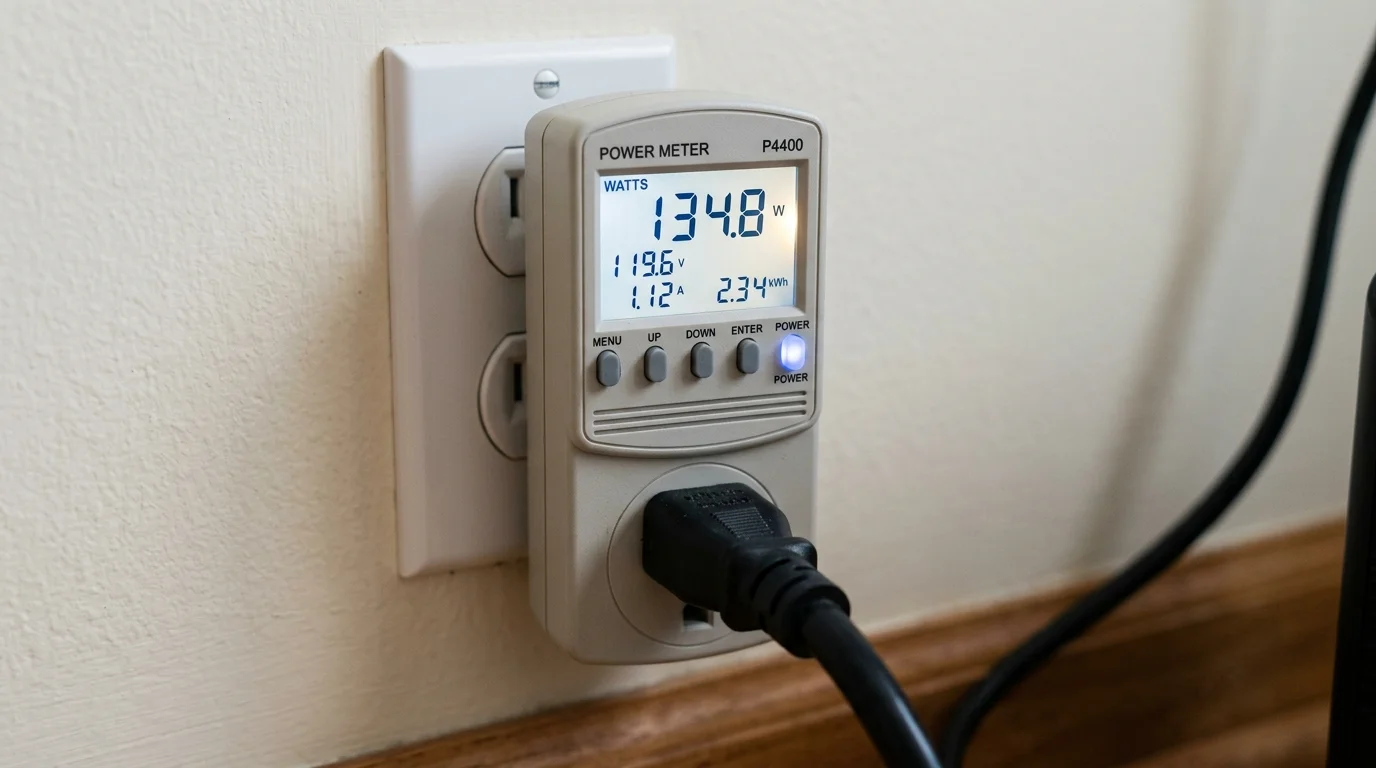
For cyclic appliances equipped with standard wall plugs (refrigerators, desktop computers, washing machines), measuring real consumption with a digital plug-in energy monitor between the socket and appliance plug for 24 to 48 hours provides accurate real-world data.
Essential Electrical Safety Checklist for Plug-in Monitors:
- Voltage & Frequency Rating: Verify that the monitor is explicitly rated for Indian single-phase mains supply (230V AC ±10%, 50 Hz).
- Current Rating & Plug Type: Match the monitor to the appliance load—use a 6A rated monitor (Type D plug) for electronics, computers, and refrigerators. For plug-connected heating or motorized appliances (such as portable 1.5 kW room heaters), use a heavy-duty 16A rated monitor (Type M plug). Never use a 6A-to-16A adapter to run heavy loads through a 6A monitor, as undersized internal contacts can overheat and present an electrical fire hazard.
- Protective Earthing: Verify that the monitor provides unbroken, low-resistance protective earth continuity between the wall earth socket and the appliance chassis to guard against electric shock.
- Safety Certification: Choose meters carrying formal certification marks (such as BIS / ISI marking under Indian Standards or CE / IEC 61010 electrical safety compliance). Avoid unbranded, non-certified meters with lightweight internal busbars.
Important Rule for Hardwired Appliances: Never attempt to force or wire a standard plug-in monitor into heavy appliances that are hardwired directly into the wall—including most split air conditioners, high-capacity storage geysers, or central submersible pumps wired via dedicated Miniature Circuit Breakers (MCBs) or isolators. Measuring consumption on hardwired circuits requires a DIN-rail energy meter or a non-invasive split-core current transformer (CT) clamp meter installed inside the distribution board. In accordance with Central Electricity Authority (CEA) safety regulations, this work must always be performed by a licensed, qualified electrician.
Benchmark Consumption & Running Cost Table
The table below lists realistic power ratings, typical daily operating hours, and monthly electricity costs for 10 common household appliances, calculated at an illustrative benchmark rate of ₹7.50 per kWh:
Disclaimer: All figures are illustrative engineering estimates. Individual appliance running costs reflect direct marginal energy consumption and exclude fixed meter charges, fuel adjustment surcharges, and statutory electricity taxes. Real-world consumption varies with ambient temperatures, user thermostat setpoints, and appliance energy efficiency.
| Appliance | Rated Wattage | Typical Daily Use | Effective Duty Cycle / Mode (Illustrative Only) | Monthly kWh | Est. Monthly Cost (@ ₹7.50/kWh) |
|---|---|---|---|---|---|
| Frost-Free Refrigerator (260L) | 150W – 180W | 24 hours | ~30% (cycling assumption) | 32 – 39 kWh | ₹240 – ₹293 |
| 1.5 Ton 5-Star Inverter AC (Sample Model) | 1,200W – 1,400W rated max | 8 hours | Modulated cruise (~750W–850W illustrative) | 180 – 204 kWh | ₹1,350 – ₹1,530 |
| Storage Water Geyser (25L) | 2,000W | 1.5 hours | ~80% (illustrative assumption: ~1.2h active heat) | 72 kWh (illustrative) | ₹540 |
| Submersible Water Pump (1 HP) | 750W | 1.0 hour | 100% (continuous) | 22.5 kWh | ₹169 |
| Ceiling Fan (Standard Induction) | 75W | 14 hours | 100% (continuous) | 31.5 kWh | ₹236 |
| Ceiling Fan (5-Star BLDC) | 28W | 14 hours | 100% (continuous) | 11.8 kWh | ₹88 |
| LED Television (55-inch 4K) | 85W – 110W | 5 hours | 100% (continuous) | 13 – 16.5 kWh | ₹98 – ₹124 |
| Laptop (Working / Browsing) | 45W – 65W | 8 hours | ~60% (battery charge/idle cycle assumption) | 6.5 – 9.4 kWh | ₹49 – ₹71 |
| Microwave Oven (Reheating) | 1,200W | 20 minutes (0.33h) | 100% (active cook) | 12.0 kWh | ₹90 |
| Automatic Washing Machine | 500W (cold cycle) | 1 hour (15 days/month) | ~50% (illustrative: motor spin only, cold wash) | 3.75 kWh (illustrative) | ₹28 |
Note on Duty Cycles, Geysers, Washing Machines & Standardized BEE Metrics: All duty cycles and consumption estimates listed in this table are illustrative engineering benchmarks to model typical household scenarios, not measured universal standards. Specifically:
- Storage Water Geyser (72 kWh/month): Assumes an illustrative scenario where a 2,000W element is actively energized for ~1.2 hours total (80% of a 1.5-hour morning window) to heat incoming cold water for sequential family baths. The 80% duty cycle is not a standardized laboratory metric; actual consumption depends heavily on ambient water inlet temperature, tank insulation, volume drawn, and thermostat cutoff points. Stationary storage geysers carry statutory BEE Star Labels certifying standing heat loss in kWh/24h/45°C.
- Washing Machine (3.75 kWh/month): Assumes an illustrative cold wash cycle (motor and drain pump only). If internal water-heating cycles (temperatures 40°C–60°C) are activated, the 1,500W–2,000W internal heating element dramatically raises consumption to 1.0–1.8 kWh per wash cycle. Real-world consumption depends on cycle program, load weight, and model efficiency as certified under BEE Star Label per-cycle standards.
- For all cyclic and complex appliances, direct measurement using a certified digital energy monitor or checking certified model data on the official BEE Star Label Verification Portal provides verified real-world consumption figures.
How Progressive Tariff Slabs Affect Incremental Consumption
Retail electricity tariffs in India are determined by State Electricity Regulatory Commissions (SERCs) and vary across distribution utilities (DISCOMs), with distinct slab structures, subsidy thresholds, and seasonal rules. Many utilities implement telescopic tiered tariffs, where the per-unit rate increases across successive consumption brackets.
Consider an illustrative telescopic domestic structure:
- 0 to 100 Units: Baseline / subsidized tier (e.g., ~₹3.50/unit)
- 101 to 300 Units: Intermediate tier (e.g., ~₹5.50/unit)
- 301 to 500 Units: Higher domestic tier (e.g., ~₹7.50/unit)
- Above 500 Units: Upper consumption tier (e.g., ~₹9.00+/unit)
Illustrative Marginal Impact Scenario:
When evaluating the financial impact of adding a new high-consumption device, calculating costs using your bill's "average cost per unit" can be misleading:
- Suppose a household already consumes 350 kWh per month from baseline appliances, placing its top consumption into the ₹7.50/unit bracket.
- If they introduce a high-power space heater adding an incremental 150 kWh, the newly added units span across the 351–500 kWh bracket (billed at ~₹7.50/unit) and the 501+ kWh bracket (billed at ~₹9.00/unit).
- In such a progressive structure, the extra 150 units cost significantly more than the household's prior average per-unit rate.
Practical Takeaway: Because tariff schedules, slab widths, and subsidy mechanisms differ widely between utilities (e.g., BSES in Delhi, MSEDCL in Maharashtra, or UGVCL/DGVCL in Gujarat), always check your utility's specific SERC-approved tariff order to identify your active marginal slab.
Appliance Running Cost vs. Total Electricity Bill: Key Differences
A vital engineering and accounting distinction is that an individual appliance's running cost is not equivalent to your total monthly electricity bill.
The standard formula Energy (kWh) × Rate computes only the direct marginal energy consumption cost. Your monthly utility invoice from your DISCOM comprises several distinct structural charges:
- Energy Charges (Variable): The cost of physical units (kWh) consumed, billed across progressive slab tiers. This is the only component directly calculated by appliance wattage formulas.
- Fixed / Demand Charges: A mandatory monthly base fee billed per kilowatt (kW) of sanctioned connected load. (Illustrative domestic range: ₹50 to ₹150 per kW/month; actual rates are defined by individual State Electricity Regulatory Commission tariff orders and vary from nominal flat fees in some states to tiered kW charges in others). Running an appliance within your existing sanctioned load limit does not increase this charge. However, if multiple high-load appliances operate simultaneously and trip your maximum demand indicator (MDI) beyond your sanctioned limit, the utility may impose demand penalties or require a sanctioned load enhancement.
- Fuel & Power Purchase Price Adjustment (FPPPA / FAC / PPAC): A variable energy surcharge per unit approved periodically by state regulators to pass through fluctuating power generation and fuel procurement costs. (Illustrative range: ~₹1.00 to ₹2.50+ per kWh depending on state DISCOM quarterly determinations), which applies to every additional unit consumed.
- Electricity Duty & Municipal Taxes: Statutory state government taxes and cess (illustratively 5% to 20% across different Indian states) calculated on energy charges and added to the billing total.
- Meter Rent & Regulatory Surcharges: Nominal administrative charges for meter calibration, distribution infrastructure, and pension trusts.
Takeaway: If a 1,500W heater incurs ₹2,025 in marginal energy costs, your total bill will increase by ₹2,025 plus the applicable per-unit FPPPA surcharge and percentage electricity duty on those 270 newly added units. Note that retail domestic tariffs, fixed charges, FPPPA, and electricity duty are determined by respective State Electricity Regulatory Commissions (SERCs) and individual DISCOM tariff orders, not by central bodies.
Interactive Appliance Cost Calculator
Instead of calculating complex numbers on paper, enter your appliance wattage, daily runtime, and local electricity rate directly into our interactive calculator:
Use our client-side Home Electricity Cost Calculator to quickly compute daily, monthly, and yearly costs with preloaded appliance presets.
Frequently Asked Questions (FAQ)
What is the difference between peak power and running power?
Motorized appliances require extra torque to overcome mechanical inertia upon startup. For direct-on-line (DOL) single-phase induction motors (such as those in older fixed-speed compressors, conventional water pumps, or standard induction fans), the initial inrush starting current (Locked Rotor Amperes) can momentarily reach 4 to 6 times the rated continuous running current. In contrast, inverter drives generally control motor acceleration and can reduce the high starting-current surge associated with direct-on-line motors; actual startup behaviour depends on the appliance design. Even for conventional induction motors with inrush current, the surge lasts for only a fraction of a second (tens to hundreds of milliseconds), meaning its contribution to total billable kilowatt-hours (kWh) on your electric meter is negligible.
Does an appliance with a higher wattage always cost more to run?
Not necessarily. Total cost depends on both wattage and operating duration. A 1,500W electric kettle running for 3 minutes uses only 0.075 kWh (approx. ₹0.56 at ₹7.50/unit), whereas a 75W ceiling fan running for 24 hours consumes 1.8 kWh (roughly 24 times more energy, costing ~₹13.50). Always calculate total energy (Wattage × Hours), not wattage alone.
Authoritative Standards & References
For statutory appliance energy standards, test codes, and retail tariff guidelines, consult the following official resources:
- Bureau of Energy Efficiency (BEE India) — Statutory regulatory authority under the Ministry of Power administering the Standards & Labeling (S&L) scheme for household appliances in India.
- BEE Star Label Verification Portal — National portal for verifying certified appliance energy consumption metrics, star tiers, and technical nameplate data.
- Central Electricity Authority (CEA) — National technical organization under the Ministry of Power regulating technical electrical safety, grid connectivity, and power distribution data.
- Forum of Regulators / Central Electricity Regulatory Commission (CERC) — Apex consultative body of central and state power regulators establishing multi-year tariff principles. Note: Binding retail domestic tariffs and DISCOM schedules are notified by respective State Electricity Regulatory Commissions (SERCs).
- International Electrotechnical Commission (IEC) — Global standards body establishing international appliance test procedures, including IEC 62301 (standby power measurement) and IEC 60335 (household appliance electrical safety).
Related Guides & Deep Dives
- How to Calculate Home Electricity Consumption in kWh — Foundations of electrical energy, power equations, and watt-hour conversions.
- How Much Electricity Does an Air Conditioner Use Per Hour? — Deep dive into 1.0T, 1.5T, and 2.0T inverter AC power consumption.
- How to Read a Residential Electricity Meter — Track your actual meter readings to verify appliance calculations.
- 25 Practical Ways to Reduce Electricity Bills at Home — Comprehensive checklist to lower overall household consumption.
Conclusion
Calculating the electricity cost of any home appliance comes down to three basic variables: rated wattage, operating hours adjusted for duty cycles, and your marginal utility tariff per unit. By identifying high-wattage, long-runtime devices in your home, you can focus your energy-saving efforts where they make the largest financial impact.