Understanding how to calculate your home electricity consumption in kilowatt-hours (kWh) is the single most effective step toward lowering your utility bill. Once you know the mathematical formula and where to find the power rating on your appliances, you can pinpoint exactly which devices drive up your monthly costs.
In this guide, we break down the calculation formula with real-world examples, provide a wattage reference table for common household appliances, and explain how utility billing slabs work.
Power vs. Energy: Understanding the Difference Between kW and kWh
A frequent point of confusion when reading electric bills is the distinction between kilowatts (kW) and kilowatt-hours (kWh). While they sound similar, they represent two fundamentally different physical quantities in electrical engineering:
+-----------------------------------+--------------------------------------+
|          POWER (kW)               |            ENERGY (kWh)              |
+-----------------------------------+--------------------------------------+
| Rate at which electricity is used | Total quantity of electricity used   |
| Instantaneous capacity / demand   | Cumulative consumption over time     |
| Analogy: Speedometer (km/h)       | Analogy: Odometer (Total km driven)  |
| Water Analogy: Water flow rate    | Water Analogy: Volume of water       |
|                (liters/minute)    |                in a tank (liters)    |
+-----------------------------------+--------------------------------------+
- Kilowatt (kW) = Electrical Power: One kilowatt equals 1,000 watts. It measures the instantaneous rate at which electrical energy is flowing into an appliance. For example, if you switch on a 2,000 W electric geyser, your home's instantaneous electrical demand immediately increases by 2.0 kW.
- Kilowatt-Hour (kWh) = Electrical Energy: This is the cumulative volume of electrical work performed when power is drawn over an elapsed duration of time. One kilowatt-hour is equivalent to 1,000 watts sustained continuously for one hour ($1\text{ kW} \times 1\text{ hour} = 1\text{ kWh} = 3.6\text{ Megajoules}$). This is the billable "unit" recorded by your utility meter.
How Different Appliances Yield the Same 1.0 kWh:
To see how power (kW) and operational duration (hours) interact, notice how vastly different devices consume the exact same 1.0 kWh unit:
- A 1,000 W (1.0 kW) room heater running for 1 hour: $1.0\text{ kW} \times 1.0\text{ hr} = \mathbf{1.0\text{ kWh}}$
- A 100 W (0.1 kW) bulb running for 10 hours: $0.1\text{ kW} \times 10.0\text{ hrs} = \mathbf{1.0\text{ kWh}}$
- A 2,000 W (2.0 kW) water heater running for 30 minutes (0.5 hour): $2.0\text{ kW} \times 0.5\text{ hr} = \mathbf{1.0\text{ kWh}}$
- A 25 W (0.025 kW) Wi-Fi router running for 40 hours: $0.025\text{ kW} \times 40.0\text{ hrs} = \mathbf{1.0\text{ kWh}}$
The Core Formula for Electricity Consumption
Utility electricity meters measure consumption in kilowatt-hours (kWh). To calculate the energy consumed by any domestic appliance, use the standard mathematical formula:
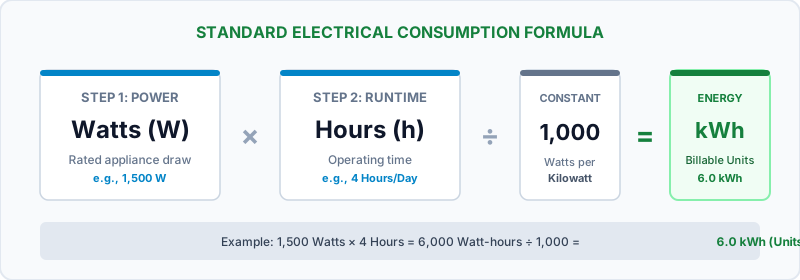
$$\text{Energy (kWh)} = \frac{\text{Power (Watts)} \times \text{Operating Time (Hours)}}{1,000}$$
To estimate the monetary running cost:
$$\text{Cost (₹)} = \text{Energy (kWh)} \times \text{Tariff Rate (₹/kWh)}$$
Step-by-Step Example: 100 W Appliance Running for 5 Hours
Suppose you operate a 100-watt appliance (such as an audio-video receiver, outdoor floodlight, or desktop workstation display) for 5 hours:
- Calculate total Watt-hours (Wh): $$100\text{ Watts} \times 5\text{ Hours} = 500\text{ Watt-hours (Wh)}$$
- Convert Watt-hours to Kilowatt-hours (kWh): $$\text{kWh} = \frac{500\text{ Wh}}{1,000} = \mathbf{0.5\text{ kWh (units)}}$$
- Calculate the estimated cost: Assuming an illustrative domestic tariff rate of ₹7.00 per unit (kWh): $$0.5\text{ kWh} \times \text{₹}7.00 = \mathbf{\text{₹}3.50\text{ for that 5-hour period}}$$
Comprehensive Worked Example: Multiple Appliances & Monthly Household Usage
In a typical home, multiple appliances operate concurrently for different numbers of hours each day. To determine your total monthly consumption and estimate your electricity bill, calculate the daily kWh for each device, sum them up, and multiply by 30 days.
30-Day Household Energy Consumption Audit:
| Appliance Description | Quantity | Power Rating (Watts) | Daily Runtime (Hours) | Daily Energy (kWh) | Monthly Energy (30 Days) |
|---|---|---|---|---|---|
| LED Light Bulbs | 6 | 9 W each | 6 hours | 0.324 kWh | 9.72 kWh |
| Ceiling Fans (Standard Induction) | 3 | 75 W each | 12 hours | 2.700 kWh | 81.00 kWh |
| Refrigerator (250L, 3-Star Inverter) | 1 | ~120 W nameplate (40% active cycle) | 24 hrs ($0.12\text{ kW} \times 24 \times 0.40$) | 1.152 kWh | 34.56 kWh |
| Smart LED Television (43-inch) | 1 | 65 W | 5 hours | 0.325 kWh | 9.75 kWh |
| Storage Water Geyser (Bathroom) | 1 | 2,000 W | 1.5 hours total heating | 3.000 kWh | 90.00 kWh |
| 1.5 Ton 5-Star Inverter Split AC | 1 | ~800 W avg cruising load (1,250 W rated) | 8 hours (setpoint: 24°C, moderate night) | 6.400 kWh | 192.00 kWh |
| Laptop / Computer Workstation | 1 | 90 W | 8 hours | 0.720 kWh | 21.60 kWh |
| Total Estimated Daily & Monthly Energy Consumption: | 14.621 kWh / day | 438.63 kWh / month | |||
Important Caveat on Refrigerator & AC Duty-Cycle Estimates:
- Refrigerator Duty-Cycle Approximation: The $0.12\text{ kW} \times 24\text{ hrs} \times 0.40 = 1.152\text{ kWh/day}$ calculation is a simplified illustrative example. In real-world operation, a refrigerator compressor's active runtime percentage is not fixed at 40%; it fluctuates based on ambient kitchen temperature, door-opening frequency, internal food loading, and whether the compressor is an inverter or fixed-speed motor. For an accurate, model-verified metric, consumers should refer to the tested annual energy consumption (kWh/year) printed on the unit's official BEE Star Label or measure it with a plug-in digital energy meter.
- Illustrative Air Conditioner Range: The 6.40 kWh/day figure assumes an inverter unit cruising at an illustrative average power draw of ~800 W during 8 nighttime hours. Because nameplate rated power (1,250 W – 1,450 W) represents standard laboratory test conditions, it does not directly dictate real-world hourly energy. Actual AC consumption varies continuously with outdoor weather, room thermal insulation, ceiling height, and dynamic compressor modulation.
Calculating the Monthly Bill Using Progressive Tariff Slabs:
Most electric utilities bill consumers on graduated consumption slabs. For this illustrative household consuming 438.63 kWh (units) in a 30-day month, here is how the tiered bill is computed:
- Slab 1 (First 100 units @ ₹3.50/unit): $$100\text{ kWh} \times \text{₹}3.50 = \mathbf{\text{₹}350.00}$$
- Slab 2 (Next 200 units, from 101 to 300 @ ₹6.00/unit): $$200\text{ kWh} \times \text{₹}6.00 = \mathbf{\text{₹}1,200.00}$$
- Slab 3 (Remaining 138.63 units, from 301 to 438.63 @ ₹8.00/unit): $$138.63\text{ kWh} \times \text{₹}8.00 = \mathbf{\text{₹}1,109.04}$$
- Total Illustrative Energy Charges for the Month: $$\text{₹}350.00 + \text{₹}1,200.00 + \text{₹}1,109.04 = \mathbf{\text{₹}2,659.04}$$
Illustrative Tariff Disclaimer: The slab thresholds and unit rates used here (₹3.50, ₹6.00, and ₹8.00 per unit) are purely hypothetical, rounded rates chosen to demonstrate the mathematical mechanics of progressive tiered billing. They do not represent the actual approved tariff schedule of any specific distribution utility (DISCOM). Real-world residential electricity bills vary significantly by state and utility, and include fixed monthly standing charges, meter rent, fuel price adjustments (FPPPA), and statutory state electricity duty.
Where to Find an Appliance's Wattage Rating
Before you can calculate energy usage, you need the appliance's power rating in watts (W) or kilowatts (kW). You can locate this in three places:
- The Nameplate / Specification Sticker: Located on the back, underside, or inside door frame of appliances like refrigerators, microwave ovens, and washing machines.
- Voltage and Current Ratings (With Power Factor Consideration): If the specification plate lists Volts (V) and Amperes (A) instead of Watts, be aware that multiplying Volts by Amps directly gives Apparent Power (Volt-Amperes or VA), which does not always equal billable Real Power (Watts) in alternating current (AC) circuits. To determine real power, you must account for the Power Factor ($\text{PF} = \cos \phi$):
$$\text{Real Power (Watts)} = \text{Voltage (V)} \times \text{Current (Amps)} \times \text{Power Factor}$$
- Resistive Loads ($\text{PF} \approx 1.0$): In electric kettles, water geysers, toasters, and incandescent lights, voltage and current are in phase, so $\text{Watts} \approx \text{Volts} \times \text{Amperes}$. For instance, a 230V heating element drawing 2 Amps consumes roughly $230 \times 2 \times 1.0 = \mathbf{460\text{ Watts}}$.
- Inductive Motor Loads ($\text{PF} \approx 0.70 - 0.85$): Conventional induction ceiling fans, non-inverter compressors, and pump motors experience a phase shift where current lags voltage. Multiplying $V \times I$ without power factor overstates billable active wattage. (Modern inverter appliances incorporate active Power Factor Correction [PFC] circuitry that elevates operational PF close to 0.95–0.98).
- Star Energy Labels (BEE / Energy Star): Certified labels display annual or seasonal energy consumption in kWh/year directly on refrigerators, ACs, and water heaters.
Appliance Consumption Reference Table
Different appliances operate continuously, intermittently, or on cyclic duty. Here is a realistic overview of standard appliances based on lab test averages and field measurements:
| Appliance | Rated Power (Watts) | Typical Daily Use | Daily Energy (kWh) | Monthly Energy (30 Days) |
|---|---|---|---|---|
| LED Light Bulb | 9 W | 6 hours | 0.054 kWh | 1.62 kWh |
| Ceiling Fan (Standard Induction) | 75 W | 12 hours | 0.90 kWh | 27.0 kWh |
| BLDC Energy-Saving Ceiling Fan | 28 W | 12 hours | 0.336 kWh | 10.08 kWh |
| Refrigerator (250L, 3-Star Inverter) | 120 W nameplate (Cycles on/off) | 24 hours (~40% compressor run) | 0.95 – 1.20 kWh | 28 – 36 kWh |
| 1.5 Ton 5-Star Inverter AC | 1,250 W – 1,450 W (Nameplate rated input) | 8 hours (set at 24°C) | 5.50 – 7.50 kWh (Illustrative range)* | 165 – 225 kWh (Illustrative range)* |
| Storage Water Heater (Geyser) | 2,000 W | 1 hour | 2.00 kWh | 60.0 kWh |
| Desktop PC (Workstation + Monitor) | 150 W | 8 hours | 1.20 kWh | 36.0 kWh |
| LED Television (43-inch) | 65 W | 5 hours | 0.325 kWh | 9.75 kWh |
| Microwave Oven | 1,200 W | 0.3 hours (18 mins) | 0.36 kWh | 10.8 kWh |
| Induction Cooktop | 1,600 W | 1.5 hours | 2.40 kWh | 72.0 kWh |
Editorial Note on Duty Cycles & Variable AC Loads:
- Thermostatic Cycles: Appliances with thermostats—such as refrigerators, air conditioners, and water geysers—do not draw their full rated wattage continuously. A 2,000W geyser only draws power while heating water; once the set temperature is reached, the thermostat turns off the heating element.
- Refrigerator Estimate Limitations: The daily consumption figure for refrigerators is a simplified illustrative estimate. A refrigerator's actual compressor duty cycle varies widely with door-opening frequency, kitchen ambient temperature, food loading, and gasket seal integrity. For verified model metrics, always check the tested annual kWh on the physical BEE Star Label or measure with a digital energy meter.
- AC Rated Input vs. Operational Energy Draw: An air conditioner's nameplate rating (1,250 W – 1,450 W) represents standardized full-load laboratory testing (IS 1391 / ISO 5151). This rated input does not directly translate into fixed energy consumption over an 8-hour period. The 5.50 to 7.50 kWh figure is an illustrative engineering estimate across generalized residential conditions; actual electricity use shifts continuously depending on real-time outdoor temperature, room thermal envelope, building orientation, and variable-speed compressor modulation. In the household worked example earlier, a moderate nighttime cruising average of 800 W (yielding 6.40 kWh/day) was used.
Continuous Loads vs Cyclic Loads
When calculating your home's total electricity usage, categorize appliances into two groups:
- Fixed / Resistive Loads: These consume their stated wattage steadily whenever switched on. Examples include incandescent bulbs, LED lamps, electric heaters, and toaster ovens. Calculating their consumption is straightforward using the formula above.
- Thermostatic / Cyclic Loads: Compressors in air conditioners and refrigerators turn on and off based on indoor temperature, ambient outdoor temperature, and thermal insulation. To get accurate figures for cyclic appliances, check their BEE Star Rating Label for the tested annual consumption figure (kWh/year), or use an inexpensive plug-in energy monitor.
Understanding Tiered Billing Slabs
Most electricity distribution companies (DISCOMs / utilities) bill residential consumers using a graduated tariff slab system. This means the cost per unit (kWh) increases as your total monthly consumption rises.
Here is an illustrative tiered tariff structure commonly used for educational demonstrations:
- 0 to 100 units: ₹3.50 per unit (Illustrative)
- 101 to 300 units: ₹6.00 per unit (Illustrative)
- 301 to 500 units: ₹8.00 per unit (Illustrative)
- Above 500 units: ₹10.50 per unit (Illustrative)
Because your highest-consuming appliances push your total consumption into more expensive higher slabs, reducing just 50 units of unnecessary usage can yield disproportionate savings on your bill.
Actionable Steps to Reduce High-kWh Consumption
- Target high-draw thermal loads: High-power thermal appliances—such as air conditioners in summer and water geysers in winter—can account for a substantial share of a home's seasonal electricity consumption, depending on local climate, household occupancy, and daily operational hours.
- Upgrade aging ceiling fans: Replacing 75W induction fans with 28W BLDC fans saves over 60% electricity per fan per year.
- Audit phantom (standby) power: Standby energy consumption varies widely by appliance model, age, and efficiency standards. However, many electronic devices—including televisions, set-top boxes, game consoles, and appliances with digital displays or remote standby receivers—continue to draw small amounts of electricity whenever plugged in. Switching off wall switches or using smart power strips eliminates this unnecessary background draw.
Official Sources & References
- Bureau of Energy Efficiency (BEE), Ministry of Power, Government of India: Appliance Standards & Labeling Programme (beeindia.gov.in)
- U.S. Department of Energy (DOE): Estimating Appliance and Home Electronic Energy Use (energy.gov)
- Central Electricity Authority (CEA): Technical Standards for Electrical Energy Metering (cea.nic.in)