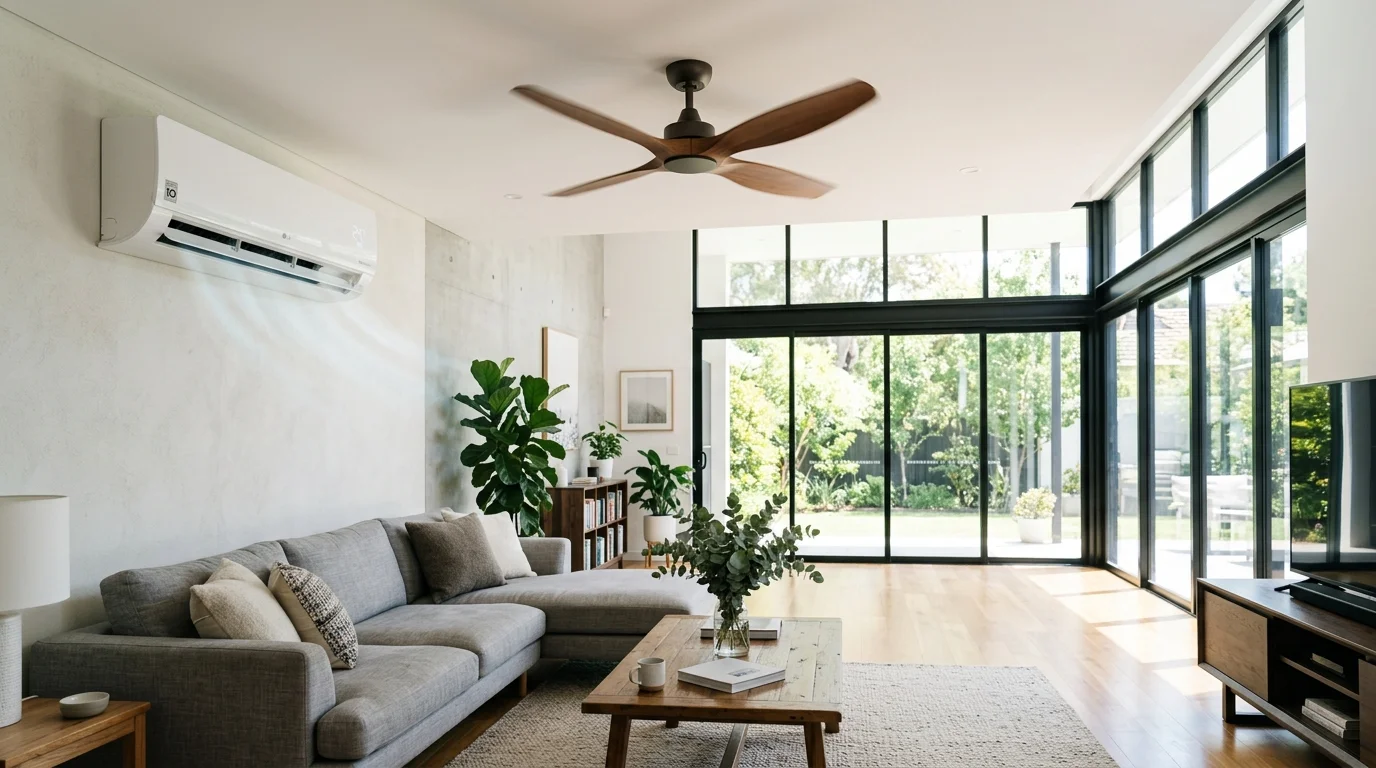
When summer temperatures climb, homeowners face an ongoing trade-off between electrical costs and thermal comfort. The choice between operating a ceiling fan versus turning on an air conditioner represents the single largest operational variable in a household's warm-weather utility bill.
While most people recognize that an air conditioner consumes far more power than a ceiling fan, the actual scale depends heavily on operating conditions: a 1.5-ton air conditioner can consume several times more power than a ceiling fan, but the exact multiple depends on the AC's cooling load, compressor modulation, and the fan's motor technology and speed setting (for instance, an AC drawing 1,000W to 1,500W can equal the power draw of roughly 13 to 20 legacy induction fans, or 35 to 50 low-speed BLDC fans).
However, fans and air conditioners perform fundamentally different thermodynamic jobs. In this guide, we break down the physics of sensible and latent cooling, compare hourly and monthly running costs across standard induction and modern BLDC motors, evaluate adaptive thermal comfort models, and outline an optimal hybrid cooling strategy that delivers maximum comfort at the lowest possible cost.
1. How Cooling Physics Differ: Air Movement vs Heat and Moisture Removal
To understand the energy disparity between these appliances, it is essential to examine their underlying thermodynamic processes:
Air Conditioners: Active Refrigeration & Enthalpy Reduction
An air conditioner is an active, closed-loop vapor-compression refrigeration machine. It utilizes a motorized compressor, chemical refrigerant, expansion valve, and two heat exchangers (evaporator and condenser coils) to perform two distinct physical tasks:
- Sensible Cooling: Directly extracting thermal heat energy from indoor air and rejecting it outdoors, thereby lowering the measurable dry-bulb room air temperature.
- Latent Cooling (Dehumidification): Condensing moisture vapor out of the air as liquid water over cold evaporator coils, significantly reducing indoor relative humidity.
Compressing refrigerant vapor into high-pressure liquid against high outdoor ambient temperatures requires substantial mechanical work—drawing 700 to 1,650 Watts of continuous or modulated electrical power for typical 1.0 to 1.5-ton domestic units under summer load.
Ceiling Fans: Convective & Evaporative Wind-Chill on Skin
A ceiling fan does not cool the air in the room. A ceiling fan does not remove heat, nor does it dehumidify the space. In fact, in a closed, empty room with a wall thermometer, running a fan will cause the air temperature to rise slightly over time due to the motor's internal electrical resistance and aerodynamic friction.
Instead, a ceiling fan cools human occupants, not rooms:
- By moving air across exposed human skin at velocities typically between 0.5 and 1.5 meters per second (m/s), the fan disrupts the insulating boundary layer of warm, moist air surrounding the body.
- This air motion accelerates convective heat transfer and promotes the evaporation of microscopic perspiration, carrying latent heat away from the skin.
- Under favorable conditions, elevated air velocity can reduce the perceived (operative) temperature by an estimated 2°C to 3°C, though actual comfort depends on ambient relative humidity, clothing insulation, air speed, and individual metabolic rates.
- Rotating lightweight aerodynamic blades requires only a small fractional-horsepower motor, drawing just 28 to 75 Watts.
2. Power Consumption & Running Cost Comparison
The table below contrasts rated wattage, daily kilowatt-hours, and monthly running costs across standard fan and air conditioner technologies.
Operating Assumptions:
- Evaluated under identical daily usage: 10 hours per day over a 30-day billing cycle (300 operating hours).
- Billed at an illustrative benchmark residential tariff of ₹7.50 per kWh (representative middle-tier domestic urban slab in India; actual retail rates vary by state SERC tariff orders and DISCOM schedules).
- Costs reflect direct marginal energy consumption and exclude fixed demand charges, fuel adjustment surcharges (FPPPA), and statutory electricity taxes.
- Note on AC Wattage: The AC average wattage figures (e.g., 750W for 1.0-ton, 1,050W for 1.5-ton) are illustrative operating averages for a closed, thermally insulated room (~120–150 sq. ft.) with outdoor ambient temperatures around 35°C–38°C and an indoor thermostat setpoint of 25°C. These are not universal figures for every 5-Star or 1.5-ton model; actual consumption varies significantly based on outdoor weather, room volume, solar heat gain, building insulation, and model-specific ISEER efficiency.
| Cooling Appliance | Typical Operating Wattage | Daily Energy (10 hrs) | Monthly Energy (300 hrs) | Est. Monthly Marginal Cost (@ ₹7.50/kWh) |
|---|---|---|---|---|
| 5-Star BLDC Ceiling Fan (1200 mm) | 28 Watts (Speed 5) | 0.28 kWh | 8.4 kWh | ₹63.00 |
| Standard Induction Ceiling Fan (Non-Star / Legacy) | 75 Watts (Speed 5) | 0.75 kWh | 22.5 kWh | ₹168.75 |
| 1.0 Ton 5-Star Inverter Split AC | 750 Watts avg (modulating) | 7.50 kWh | 225.0 kWh | ₹1,687.50 |
| 1.5 Ton 5-Star Inverter Split AC | 1,050 Watts avg (modulating) | 10.50 kWh | 315.0 kWh | ₹2,362.50 |
| 1.5 Ton Older Fixed-Speed (Non-Inverter) AC | 1,500 Watts avg (cycling) | 15.00 kWh | 450.0 kWh | ₹3,375.00 |
Key Mathematical Insight: In this baseline scenario, operating a 1.5-ton 5-star inverter AC costs approximately 14 times more than running a standard induction ceiling fan, and over 37 times more than a modern energy-efficient BLDC fan.
To calculate exact running costs for your home's unique hours and local DISCOM tariff rates, use our client-side Appliance Running Cost Calculator.
3. Ceiling Fan Efficiency: Induction vs. BLDC Technology and BEE Star Ratings
Ceiling fans in India are governed by the statutory Bureau of Energy Efficiency (BEE) Standards & Labeling scheme, which rates fans from 1-Star to 5-Star based on their Service Value (air delivery in cubic meters per minute divided by electrical power consumption in watts, $\text{m}^3/\text{min}/\text{W}$):
Traditional Single-Phase Induction Motors
Legacy ceiling fans rely on single-phase induction motors with copper or aluminum stator windings and a squirrel-cage rotor:
- At top speed, standard non-rated induction fans typically consume 70W to 80W (newer BEE 1-Star induction models consume around 50W–55W).
- When throttled to lower speeds using conventional resistance-type regulators, excess electrical power is dissipated as waste heat inside the switchbox.
- Even with modern electronic thyristor regulators, induction motor electrical efficiency drops at partial speeds due to slip losses.
Brushless DC (BLDC) Permanent Magnet Motors
Modern high-efficiency ceiling fans utilize Brushless DC (BLDC) motors driven by a built-in electronic commutator and switched-mode power supply (SMPS):
- Permanent Neodymium Magnets: The rotor uses high-energy permanent magnets, eliminating rotor copper losses and slip dissipation.
- True Speed Modulation: Speed control is achieved via Pulse-Width Modulation (PWM) from an onboard microprocessor. Power consumption drops dramatically at lower speeds:
- Speed 5 (Max): ~28W to 32W
- Speed 3 (Medium): ~14W to 18W
- Speed 1 (Low): ~6W to 8W
- Understanding BEE Star Ratings: BLDC technology can help improve ceiling-fan efficiency, but a BLDC motor does not automatically make a fan a 5-Star model. Star ratings depend on the applicable BEE rating schedule and the specific model's certified performance. Check the product's current BEE label and verify its rated wattage, air delivery, and service value directly on the BEE Star Label Verification Portal before comparing models.
- Economic Payback Potential: In a representative household replacing three legacy 75W induction fans with 28W BLDC models used for 10 hours daily, the combined reduction of ~141W saves approximately 42.3 kWh per month (roughly ₹317 per month at ₹7.50/kWh). However, actual payback periods vary: depending on the retail price premium of the specific BLDC model (which often ranges from ₹1,000 to ₹2,500+ per fan) and total annual operating hours, recovering the initial purchase difference can range from under two summer seasons to several years.
4. Temperature, Humidity & Adaptive Thermal Comfort
When deciding whether to turn on the air conditioner or rely strictly on ceiling fans, homeowners often look for fixed temperature cutoffs. However, in architectural engineering and thermal comfort science, comfort is dynamic and multidimensional.
Understanding the Physiological Limits of Air Movement
Thermal comfort models—including ASHRAE Standard 55 and the Indian Model for Adaptive Comfort (IMAC) developed by CEPT University and BEE—define comfort as a combined function of dry-bulb air temperature, mean radiant temperature, relative humidity, air speed, clothing insulation (clo), and metabolic rate:
- The Convective Gradient (Skin Temperature Boundary):
- Normal human skin surface temperature typically hovers around 34°C to 35°C.
- When room air temperature approaches or exceeds skin temperature, moving air may transfer sensible heat into the body rather than remove it. The overall effect depends on humidity, radiant heat, air speed, and the body's ability to lose heat through evaporation.
- The Humidity Factor: In humid conditions, sweat may evaporate less efficiently, reducing the body's evaporative cooling. Air movement can still improve comfort, but a ceiling fan alone may not provide enough relief during very hot and humid weather. The effect depends on temperature, humidity, air speed, and the individual.
Practical Operational Guidelines (Adaptive Guidance)
Rather than treating temperature thresholds as rigid scientific laws, use these practical operational guidelines:
- Moderate Warmth (Below ~30°C–32°C with Moderate Humidity): Ceiling fans are often entirely sufficient. A fan operating at medium-to-high speed provides adequate air velocity (0.8–1.2 m/s) to maintain comfortable perceived operative temperatures without needing air conditioning.
- Warm & Humid Conditions (32°C to 35°C with High Humidity): Ceiling fans alone may prove inadequate because sweat evaporation stalls. Air conditioning is particularly beneficial here for its latent dehumidification capacity, pulling moisture out of the air.
- Extreme Heat Waves (Above ~35°C): Air movement alone cannot reliably prevent heat strain during intense heat waves. Access to a cooler or actively cooled space—especially for vulnerable populations like the elderly, young children, or individuals with chronic health conditions—is critical to prevent heat-related illness.
5. The Optimal Hybrid Strategy: Pairing AC with Ceiling Fans
The most energy-efficient household cooling strategy is not an "either/or" dilemma—it is a coordinated hybrid approach.
The Low Setpoint Myth (Setting AC to 18°C)
Many homeowners mistakenly set their air conditioners to 18°C or 20°C, believing it cools the room faster. Selecting an excessively low setpoint does not increase an air conditioner's maximum cooling capacity or make cold air come out any faster. While modern inverter compressors dynamically adjust their operating frequency and displacement, setting a rock-bottom temperature simply prevents the system from throttling down into an efficient low-power cruising state, forcing it to consume peak power for extended hours in an attempt to reach an unnecessarily cold target.
Setpoint Adjustments and Energy Savings
Setting the AC to a moderately higher temperature can significantly reduce electricity consumption, depending on outdoor conditions, room insulation, humidity, and the AC's control system. According to the Bureau of Energy Efficiency (BEE): Raising AC setting by 1° can save 6% power, increasing the thermostat setpoint by 1°C can yield an estimated ~6% reduction in electricity consumption under standard test conditions. However, this is an indicative engineering estimate rather than a guaranteed uniform figure; actual savings vary from home to home based on building heat gain, outdoor ambient heat, room size, and appliance efficiency.
The Hybrid Synergy Rule:
Combine the sensible/latent cooling of an air conditioner with the skin-level wind-chill of a ceiling fan:
- Set your air conditioner thermostat to a comfortable 24°C to 26°C.
- Run your ceiling fan on low or medium speed (Speed 1 or 2 on a BLDC fan, drawing just 8W–14W) directly above the occupied area.
- The AC removes uncomfortable room humidity and lowers dry-bulb air temperature.
- The gentle air circulation from the ceiling fan lowers your perceived skin temperature by an estimated 2°C to 3°C, providing comfort comparable to a noticeably colder room.
- Using a ceiling fan may improve comfort at a higher setpoint, allowing the AC compressor to run at a lower output and reducing power draw compared to forcing the AC to maintain a chilly room on its own, though the exact percentage saved varies by household and climate.
6. Golden Operating Rule: Turn Fans Off When Leaving the Room
Because ceiling fans cool people and not rooms, leaving a ceiling fan running in an unoccupied room wastes 100% of the electricity it consumes.
A spinning fan in an empty room does not "keep the room cool" for when you return; in fact, the motor's copper losses and blade friction add minor heat to the sealed space. Always switch fans off when stepping out. Unlike air conditioners—which require 15 to 25 minutes of refrigeration pull-down time to remove thermal mass from walls and furniture—a ceiling fan delivers its full cooling benefit the exact millisecond you flip the switch.
Authoritative Standards & References
For statutory fan efficiency ratings, room air conditioner standards, and thermal comfort science, consult the following official publications:
- Bureau of Energy Efficiency (BEE India) — Statutory regulatory authority under the Ministry of Power administering the mandatory Standards & Labeling (S&L) scheme for ceiling fans and room air conditioners.
- BEE Star Label Verification Portal — Official national registry to verify certified annual energy consumption, service values (air delivery per watt), and star ratings for BLDC fans and inverter ACs.
- BEE SAATHEE Portal (AC Temperature & Energy Savings Guidance) — Official consumer guidance and technical advisory on thermostat setpoints and room air conditioner energy conservation.
- Bureau of Indian Standards (BIS) — National standards body governing IS 374: Electric Ceiling Type Fans and Regulators Specification.
- Indian Society of Heating, Refrigerating and Air Conditioning Engineers (ISHRAE) — Professional technical society publishing Indian standards on indoor environmental quality, ventilation, and residential air conditioning.
- ASHRAE Standard 55 — Thermal Environmental Conditions for Human Occupancy, establishing international models for elevated air speed and convective cooling envelopes.
Related Guides & Deep Dives
- How Much Electricity Does an Air Conditioner Use Per Hour? — In-depth breakdown of 1.0T, 1.5T, and 2.0T inverter AC power consumption.
- How to Reduce AC Electricity Consumption Without Sacrificing Comfort — Practical thermostat, maintenance, and insulation strategies.
- Inverter AC vs Non-Inverter AC: Energy Consumption & Running Costs — Compressor modulation mechanics and payback calculations.
- How to Calculate Home Electricity Consumption in kWh — Core electrical formulas, nameplate ratings, and unit conversions.
Conclusion
Ceiling fans are an indispensable, extraordinarily energy-efficient foundation for residential cooling. In our illustrative 10-hour daily baseline (@ ₹7.50/kWh), a 5-Star BLDC ceiling fan costs approximately ₹2.10 per day (approx. ₹63/month), whereas a 1.5-ton inverter AC averages around ₹79 per day (approx. ₹2,363/month). Under peak heat waves with heavier compressor loads or longer 14–16 hour runtimes, daily AC costs can easily rise to ₹100 to ₹120+ per day, underscoring the massive cost advantage of utilizing ceiling fans whenever ambient conditions permit. By using ceiling fans as your frontline cooling defense during moderate weather, recognizing the humidity and temperature boundaries where refrigeration is necessary, and combining a moderate AC setpoint with low-speed fan circulation during intense heat waves, you can achieve optimal indoor comfort while keeping your electricity bills firmly under control.