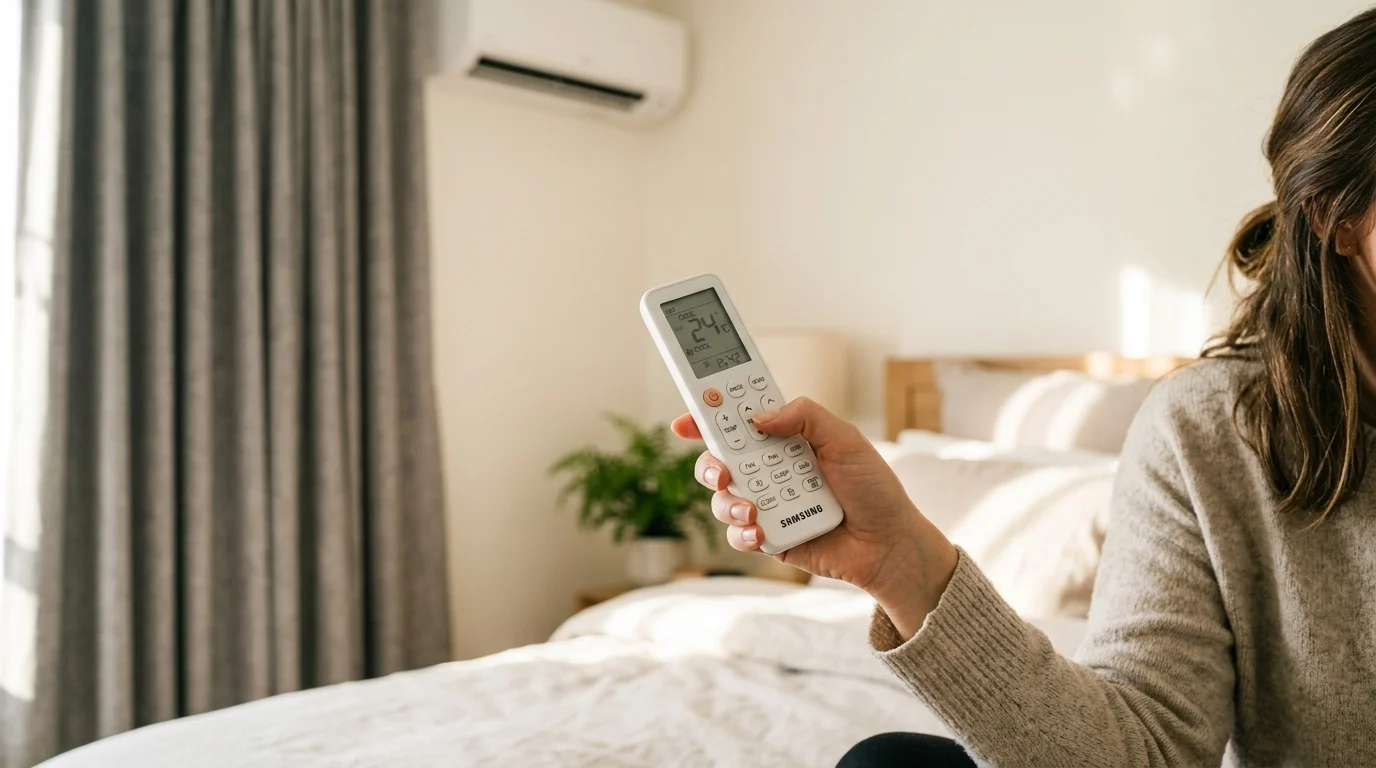
During hot weather, air conditioning can become a major contributor to household electricity use. Its share varies with the local climate, room insulation, AC efficiency, and daily operating hours. When utility bills spike, the common instinct is to switch the unit off completely and endure uncomfortable indoor heat.
However, reducing cooling power draw does not require sacrificing comfort. Human thermal comfort is governed by a combination of air temperature, relative humidity, air velocity across the skin, and radiant heat. By understanding basic heat transfer and appliance settings, you can help reduce air conditioner electricity consumption while maintaining comfortable indoor conditions.
Guidance from organizations such as the Bureau of Energy Efficiency (BEE) suggests that moving thermostat settings from colder levels (such as 20°C to 24°C) can potentially lower cooling energy use by around 24%, though actual household savings depend on weather, room insulation, and operating patterns.
Below are six practical engineering and behavioral adjustments that can help lower compressor workload without leaving living spaces stuffy.
1. Setting 24°C (75°F) as an Energy-Efficient Starting Baseline
Many people believe that setting an air conditioner's thermostat to 18°C (64°F) cools the room faster. In reality, a split air conditioner discharges cold air at roughly the same temperature (typically 10°C to 12°C across the cooling coil) regardless of whether the remote is set to 18°C or 24°C.
What the thermostat setpoint actually dictates is when the compressor is allowed to cycle off or throttle down:
Operating draw varies by technology and cooling load. In fixed-speed (non-inverter) units, the compressor cycles fully on or off. In modern inverter units, the compressor modulates speed based on demand:
- At very low setpoints (e.g., 18°C / 64°F): The compressor often runs at high capacity for extended periods attempting to reach a temperature that may be difficult to sustain against ambient summer heat entering walls and windows.
- At an efficient baseline (e.g., 24°C / 75°F): Once the room approaches the setpoint, an inverter compressor may reduce its rotational speed and power draw, depending on the room's cooling load and the unit's operating limits.
Important Context: BEE's estimate of approximately 6% savings per degree is an indicative engineering benchmark, not a guaranteed result for every household. Real-world electricity savings depend on outdoor weather, solar heat gain, building envelope insulation, and operating hours. Furthermore, 24°C is recommended as an energy-efficient starting baseline rather than an inflexible universal requirement. Personal thermal comfort depends on clothing, metabolic rate, indoor humidity, and room design; adjust in 1°C increments to determine your household's best balance.
Related Guide: See wattage benchmarks in How Much Electricity Does an Air Conditioner Use Per Hour?.
2. Pair Ceiling Fans with Air Conditioning (Air Movement and Evaporative Cooling)
Ceiling fans do not reduce room air temperature. Instead, air movement across human skin accelerates sweat evaporation, creating an evaporative and convective cooling sensation.
This gentle air movement helps occupants feel cooler than the actual thermometer reading, depending on ambient humidity, clothing, and individual comfort preferences. This physiological effect can make a higher thermostat setpoint feel comfortable:
- By pairing the air conditioner at a slightly higher setpoint (such as 25°C or 26°C) with a ceiling fan on low-to-medium speed, occupants can often maintain comfortable conditions while reducing compressor runtime.
- However, specific energy savings are not guaranteed: actual net benefit depends on the fan's electrical efficiency, operating hours, room heat gain, and turning fans off when the room is empty.
Accounting for Fan Power Consumption:
- A modern 5-star BLDC ceiling fan typically consumes 28 to 32 Watts (around 0.22 to 0.25 kWh over 8 hours).
- An older conventional induction fan consumes roughly 70 to 75 Watts (around 0.56 to 0.60 kWh over 8 hours).
- Because the compressor power avoided by setting a higher temperature baseline typically exceeds the electricity used by an energy-efficient fan, combining the two generally provides a net energy advantage.
Key Rule: Because fans cool people through air movement, not empty rooms, always turn ceiling fans off when vacating the space to prevent unnecessary power consumption.
3. Understand When to Use "Dry Mode" vs "Cool Mode"
Thermal discomfort during summer is often caused not just by temperature, but by high relative humidity (above 65% to 70%), which hinders natural perspiration evaporation.
Dry Mode operation varies by air conditioner model and manufacturer:
- Cool Mode: Primary mode designed to lower sensible air temperature. The indoor blower operates at chosen speeds while the compressor modulates or cycles to reach and maintain the setpoint.
- Dry Mode (Dehumidification): Prioritizes moisture removal. Depending on the manufacturer's control logic, the indoor fan speed is often reduced while the compressor runs to maximize water vapor condensation on chilled coil fins.
When to consider Dry Mode:
- Dry Mode can be helpful during monsoon spells, rainy days, or damp coastal evenings when outdoor temperatures are moderate (e.g., 28°C to 33°C) but indoor humidity feels sticky and clammy. In these situations, removing humidity improves comfort without necessarily chilling the room. Energy consumption in Dry Mode varies by model and depends on the manufacturer's compressor cycling algorithm.
When Cool Mode is more appropriate:
- In genuinely hot weather (such as high summer temperatures), sensible cooling is the main priority. Using Dry Mode when the room is excessively hot may restrict airflow and delay room cooling. Follow manufacturer guidance and use Cool Mode with appropriate fan circulation for hot days.
4. Use "Sleep Mode" Based on Your Model's Logic
Human metabolic rate drops during sleep, and ambient outdoor temperatures naturally cool between late night and early morning. Leaving an AC running at an excessively cold, fixed temperature all night can lead to waking up shivering under heavy blankets—a sign of avoidable energy consumption.
How Sleep Mode works: Sleep Mode behavior varies by model. Rather than following a single universal schedule, different manufacturers implement different control strategies—some gradually adjust setpoints overnight, others modulate fan speeds or cycle the compressor differently. Always check your manufacturer's manual to see how your specific unit manages temperature during sleep mode, and assess whether it delivers the comfort and energy efficiency you expect.
5. Block Solar Radiation & Infiltration
An air conditioner removes heat from an indoor space. The less heat enters the room from outside, the less work the compressor has to perform:
- Window Shading & Thermal Curtains: Solar radiation penetrating clear window glass adds significant heat load. Drawing light-colored, reflective blinds or thermal-lined curtains during sunny hours helps block radiant heat gain.
- Door Sweeps & Weatherstripping: Gaps beneath doors and unsealed window frames allow warm air from corridors or outdoors to infiltrate air-conditioned rooms. Inexpensive silicone door sweeps and foam strips help keep cool air inside.
6. Routine Maintenance: Follow Manufacturer Filter Guidance
A dirty filter can restrict airflow and reduce an air conditioner's cooling performance. Cleaning or replacing the filter according to the manufacturer's instructions helps maintain proper airflow and efficient operation. Guidance from the U.S. Department of Energy (DOE) highlights that routine filter maintenance is critical for system performance, though the actual energy benefit depends on how dirty the filter was and the system's operating conditions.
Clogged coils and restricted airflow can also cause uneven room cooling, frost buildup on indoor fins, and premature wear on blower motors.
Manufacturer Recommendations:
- Washable Mesh Pre-Filters: Major manufacturers recommend inspecting and cleaning reusable plastic mesh filters every 2 to 4 weeks during periods of regular use, particularly in dusty environments. Rinse gently with water, dry thoroughly in the shade, and snap back into place.
- Specialized Filters (PM2.5, Carbon, or Catechin): Check your user manual before cleaning. Delicate electrostatic or carbon filters are generally not water-washable and should be vacuumed or replaced according to manufacturer guidelines (typically every 3 to 6 months).
Qualitative Comparison: Operational Modes & Efficiency Impacts
Because real-world power draw depends on machine capacity, inverter tuning, ambient temperature, and room insulation, the table below provides a qualitative operational comparison of common AC practices:
| Operating Strategy | Compressor & System Behavior | Relative Energy Impact | Comfort Impact |
|---|---|---|---|
| Low Setpoint (18°C–20°C, Dirty Filter) | Compressor typically operates at or near full capacity for extended periods; restricted airflow can reduce heat transfer efficiency. | Generally higher consumption (increased risk of avoidable energy loss). | Excessive chill near the unit; potential room stuffiness due to restricted airflow. |
| Standard Baseline (22°C–23°C, Clean Filter) | Unobstructed airflow; compressor cycles or modulates normally to maintain setpoint. | Moderate consumption (baseline reference for clean operation). | Consistent, standard cooling comfort. |
| Optimized Baseline (24°C–25°C + Ceiling Fan) | The compressor may reduce output or cycle less frequently, depending on the AC type and cooling load; ceiling fan provides air movement. | Generally lower consumption compared to lower setpoint operation (BEE estimates an indicative ~6% potential savings per degree setpoint increase under comparable conditions). | Equal or superior comfort due to gentle convective cooling across the skin. |
| Nighttime Sleep Mode | May adjust the temperature or fan settings automatically, depending on the model. | Potentially lower consumption; actual savings depend on the model, room conditions, and settings. | May help maintain comfortable sleeping conditions and avoid excessive cooling. |
| Dry Mode in Monsoon (High Humidity, Moderate Temp) | Optimized fan speed to condense moisture on evaporator fins. | Variable (model-dependent; targets latent moisture load). | Substantially reduces clammy discomfort without over-chilling. |
How to Measure Your Actual AC Electricity Savings
Rather than relying on generic estimates, you can verify your household's actual electricity consumption using direct measurement:
- Smart Energy Monitors / Smart Plugs: Use a smart plug only if your AC's plug, rated current (typically 16A), and electrical requirements are fully compatible with the device and the AC manufacturer's instructions.
- Dedicated Sub-Meters for Hardwired Units: For hardwired or dedicated-circuit units, use a suitably rated digital DIN-rail energy meter installed on the circuit breaker panel by a qualified electrician.
- AC Companion Apps: Many modern Wi-Fi-enabled inverter air conditioners (such as models supported by Daikin Mobile Controller, LG ThinQ, Samsung SmartThings, or Panasonic Miraie) feature built-in energy-monitoring dashboards that log daily and monthly kWh directly from unit sensors.
- Benchmarking Test: To get meaningful comparisons, track energy use across two multi-day periods while keeping outdoor temperatures, daily operating hours, and room conditions as comparable as possible. Run your baseline settings for three representative days and record average kWh/day, then test an adjusted baseline (such as 24°C with gentle fan circulation) across three similar days. Comparing these verified numbers reveals your home's true real-world savings.
References & Official Guidance
For technical standards, manufacturer guidance, and energy-saving principles, consult:
- Bureau of Energy Efficiency (BEE) — Save More with AC@24° Guidance
- U.S. Department of Energy (DOE) — Energy Saver: Air Conditioning Basics
- U.S. Department of Energy (DOE) — Energy Saver: Maintaining Your Air Conditioner
- Samsung India — Understanding Modes and Settings in Air Conditioners
- American Society of Heating, Refrigerating and Air-Conditioning Engineers (ASHRAE) — Standard 55: Thermal Environmental Conditions for Human Occupancy
Conclusion
Reducing air conditioning costs does not mean enduring unbearable indoor heat. By setting a sensible 24°C baseline, taking advantage of gentle ceiling fan air movement, aligning modes with weather conditions, and maintaining clean filters according to manufacturer instructions, you can lower power bills while enjoying consistent indoor comfort.