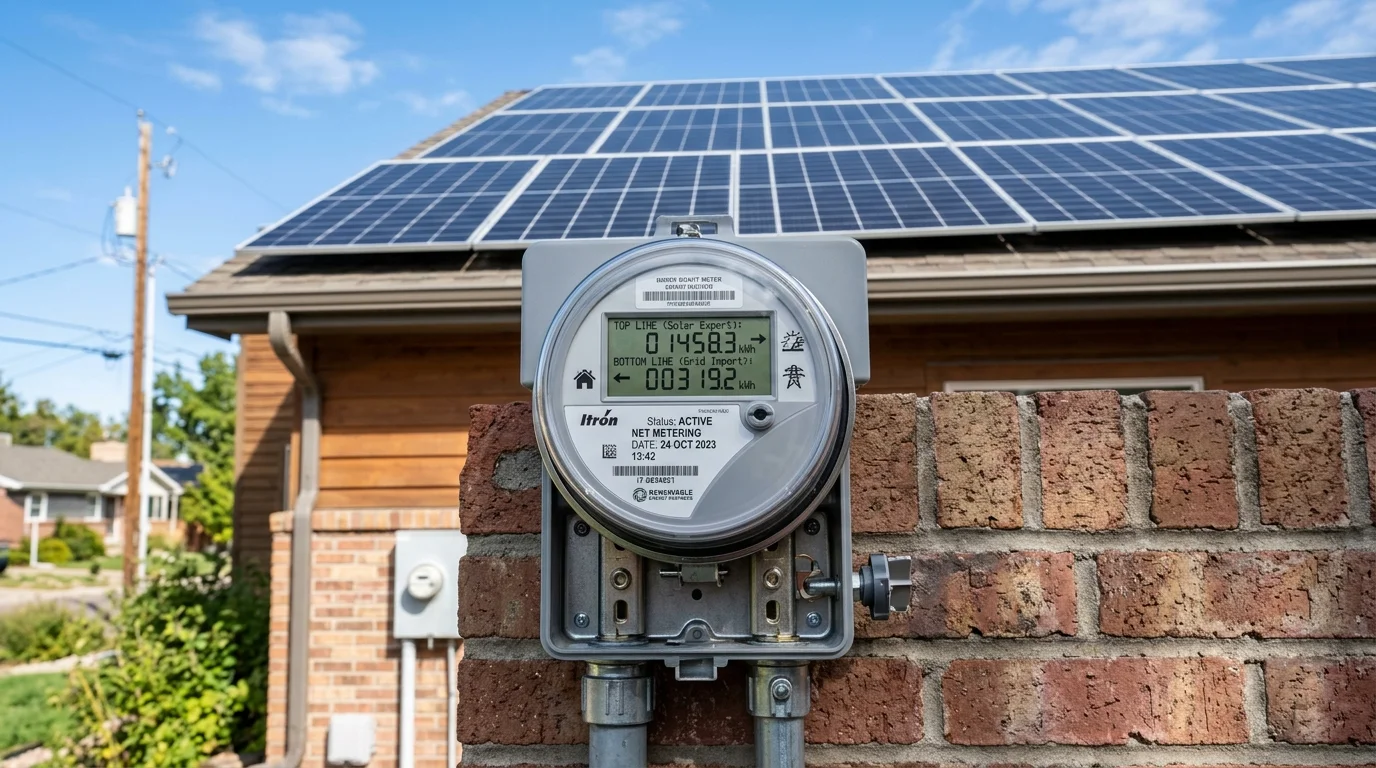
When homeowners install a grid-tied rooftop solar system, one of the most common operational realities is that solar photovoltaic (PV) panels generate the vast majority of their electricity during the middle of the day—typically between 10:00 AM and 3:00 PM. In many households, this peak solar production coincides with lower daily electrical demand, as family members are often away at work or school.
Without an on-site battery storage bank, what happens to this midday solar generation?
This is where Net Metering plays an essential role. Net metering is a regulated utility billing mechanism that tracks and credits solar system owners for the electricity they feed into the public distribution grid. By allowing instantaneous solar surplus to export into the grid and offsetting it against power drawn when the sun is down, net metering enables homeowners to maximize the value of their solar investment without necessarily purchasing a dedicated battery system.
In this guide, we break down how bidirectional meters operate, the mechanics of credit banking and settlement, the fundamental differences between Net Metering, Net Billing, and Gross Metering, the technical considerations for hybrid battery integration, and the statutory requirements enforced by distribution companies (DISCOMs).
1. How a Bidirectional Net Meter Operates
In a conventional non-solar home, the electric utility meter is unidirectional: it registers electrical energy flowing in a single direction from the local distribution grid into the household.
When a rooftop solar PV system is commissioned under an approved grid-connection agreement, the distribution utility replaces the unidirectional meter with a Bidirectional Net Meter (or reprograms an existing dual-register digital smart meter). This meter continuously logs energy flow in two independent registers:
- Import Register (Grid → Home): Records cumulative kilowatt-hours (kWh) drawn from the utility grid during nighttime hours, early mornings, rainy periods, or whenever household electrical demand exceeds instantaneous solar output.
- Export Register (Solar → Grid): Records cumulative kilowatt-hours (kWh) of surplus solar energy injected into the local utility distribution network whenever real-time solar generation exceeds total household consumption.
For example, if your home imports 450 kWh from the grid across a 30-day billing cycle and your rooftop solar panels export 380 kWh to the grid during daytime hours, your energy charges are assessed on only the net difference of 70 kWh.
Related Guide: Discover how household power usage dictates system size in our How Many Solar Panels Does a Home Need? Step-by-Step Sizing Guide.
2. What Happens When Solar Export Exceeds Import? (Energy Banking & Settlement)
During long, sunny summer months, a solar system frequently generates more electricity than the home consumes over the entire billing cycle:
- Illustrative Scenario: Your home imports 300 kWh from the grid during nighttime and cloudy periods, while your rooftop solar panels export 420 kWh during sunny hours.
- Net Calculation: 300 − 420 = −120 kWh (a net export surplus of 120 units).
Under a standard net metering framework, this surplus is treated through an Energy Banking Ledger:
- Zero Net Energy Charge: Because solar export exceeded grid import within the billing period, your net billed energy consumption is recorded as 0 kWh. (Note: Monthly fixed demand charges and statutory taxes may still apply under your applicable tariff category).
- Banked Energy Credits: The excess 120 kWh is credited to your utility energy banking ledger rather than lost. In subsequent billing cycles—when cloudy skies or shorter days reduce solar output—the utility draws upon these banked units to offset grid consumption before assessing energy charges.
- Surplus Settlement: At the conclusion of the regulatory settlement cycle defined by the state commission, any unutilized banked credits are reconciled by the DISCOM under applicable settlement rules.
A common misconception is that every surplus unit exported to the grid earns credits equal to the full retail electricity tariff. While exports offset imports unit-for-unit within the active billing cycle against energy charges, any unadjusted surplus units settled at the end of the settlement period are compensated based on the applicable State Electricity Regulatory Commission (SERC) regulations, consumer category, and connection agreement. These surplus purchase rates (such as the utility's Average Power Purchase Cost - APPC or a commission-notified feed-in rate) are typically lower than domestic retail tariffs. Furthermore, fixed demand charges and statutory duties are generally not offset by surplus energy credits.
State-Specific Banking Rules & Limitations:
Banking terms, rollover allowances, and settlement cycles are not uniform across India; they are established independently by each State Electricity Regulatory Commission (SERC):
- Settlement Cycles: The duration of the banking cycle (e.g., monthly, bi-monthly, or annual) is governed by state-specific regulations (for example, the GERC Net Metering and Distributed Renewable Energy Regulations and Amendments in Gujarat). Consumers should verify the settlement frequency specified in their connection agreement.
- Banking Charges: While residential rooftop solar connections under programs like PM Surya Ghar are generally exempt from banking fees in many states, open-access or commercial/industrial captive installations may be subject to state-notified banking charges.
- Time-of-Day (ToD) Conditions: In jurisdictions with peak and off-peak tariff schedules, energy generated during standard daytime hours may be subject to specific adjustment rules when offsetting peak-evening consumption.
3. Net Metering vs Net Billing vs Gross Metering
As rooftop solar adoption has expanded, regulatory commissions across various states and consumer categories have introduced alternative grid-interconnection billing frameworks. Understanding the technical and commercial differences between these three models is vital:
| Billing Mechanism | Energy Accounting & Settlement Flow | Commercial Considerations for Homeowner |
|---|---|---|
| Traditional Net Metering | Energy-Based Offset (kWh): Total exported units are subtracted 1:1 from total imported units within the billing cycle. Only net positive kWh is billed at retail tariff. Surplus kWh rolls over in the banking ledger subject to state rules. | May offer higher utility bill reduction for households by offsetting retail slab energy charges during the billing cycle. Final surplus compensation depends on state SERC orders. |
| Net Billing | Value-Based Financial Offset (₹ / $): 100% of grid imports are billed at regular retail slab tariffs. Separately, 100% of exported units are converted to a monetary credit at an approved feed-in tariff (FIT / APPC). The monetary credit is deducted from the gross rupee bill. | Financial return depends on the spread between the retail tariff and the approved feed-in rate. This structure provides a financial incentive to maximize direct self-consumption. |
| Gross Metering | Independent Dual-Meter System: Total solar energy generated is fed directly into the utility distribution network and purchased by the DISCOM at a fixed feed-in tariff. Total household power is drawn from the grid and billed normally at retail tariffs. | Generation and consumption are treated as separate commercial transactions. Return depends entirely on the contracted feed-in tariff versus standard retail rates. |
Regulatory Scope in India (Central Guidelines & State SERC Jurisdiction):
Under the statutory framework of the Electricity Act, 2003, electricity distribution, consumer classification, and retail tariff determination fall under the jurisdiction of individual State Electricity Regulatory Commissions (SERCs).
While the Ministry of Power issues policy guidelines—such as the Electricity (Rights of Consumers) Rules and subsequent amendments—the actual eligibility criteria, capacity caps (whether up to sanctioned load or specific kilowatt thresholds), and applicable billing arrangements are formally notified by each State Commission (such as GERC in Gujarat, MERC in Maharashtra, or UPERC in Uttar Pradesh). For instance, residential rooftop solar installations approved under the PM Surya Ghar: Muft Bijli Yojana generally operate under state net-metering provisions, whereas commercial and industrial consumers are often governed by net billing or gross metering schedules.
4. Reading a Sample Net Metered Utility Statement
A residential net-metered utility statement provides an itemized reconciliation ledger showing imported energy, exported generation, and remaining billing obligations.
The reconciliation table below is a hypothetical worked example designed to illustrate the arithmetic structure of a net-metered statement. The effective energy rate of ₹5.50/unit, fixed load charge of ₹75/kW, and statutory levies are sample figures for demonstration purposes and do not represent the actual rates of any specific DISCOM or consumer connection.
| Bill Parameter / Line Item | Registered Units (kWh) | Illustrative Tariff Basis | Calculated Amount |
|---|---|---|---|
| Grid Energy Import | 420 Units | Energy drawn from grid during off-sun periods | — |
| Solar Energy Export | 360 Units | Daytime surplus solar injected into grid | — |
| Net Billable Consumption | 60 Units | 420 Import − 360 Export = 60 Net Units | — |
| Base Energy Charges | 60 Units | Sample effective rate (~₹5.50 / unit, illustrative) | ₹330.00 |
| Fixed Sanctioned Load Charge | 3 kW Load | Sample capacity charge (₹75.00 / kW, illustrative) | ₹225.00 |
| Meter Rent, Duties & Statutory Levies | Monthly | Sample electricity duty and meter lease charges | ₹65.00 |
| Total Bill Payable | — | Energy (₹330) + Fixed (₹225) + Levies (₹65) | ₹620.00 |
Illustrative Scenario Comparison (Hypothetical Only): To illustrate how net metering reduces billing liability, consider this household's 420 units of total monthly consumption under a hypothetical non-solar scenario:
- Illustrative Non-Solar Calculation: If all 420 units were billed across representative domestic telescopic slabs (e.g., base energy charges of ~₹1,800 + fixed demand charges of ~₹225 + sample fuel surcharges of ~₹1,140 + electricity duties of ~₹270), the total payable amount would illustratively exceed ₹3,400.
- Net-Metered Calculation: Because 360 exported solar units offset 360 imported units 1:1 against energy charges, the household is billed only for the net 60 units plus fixed fees and levies, totaling ₹620.00.
- Important Disclaimer on Savings: This comparison is an illustrative exercise based on hypothetical slab assumptions. It does not represent guaranteed savings. Real-world bill reductions depend strictly on your DISCOM's active tariff schedule, consumption tiers, fuel adjustment surcharges, and local connection charges.
Related Deep Dive: For a complete line-by-line guide on decoding telescopic slabs and statutory taxes, see our article on How to Read an Electricity Bill: Units, Fixed Charges and Taxes.
5. Net Metering with Battery Storage (Hybrid Solar Regulations)
Many homeowners inquire whether they can combine battery storage with a grid-connected net-metered system. While hybrid solar systems (solar PV + battery inverter) provide energy security during power outages, specific regulatory and technical conditions govern their interconnection:
+------------------------------------------------------------------------+
|             HYBRID SOLAR + NET METERING POWER FLOW (SAMPLE)            |
+------------------------------------------------------------------------+
| 1. Solar Generation → Powers Immediate Home Loads                 |
| 2. Surplus Solar Generation → Charges Battery Storage             |
| 3. Excess Solar (Battery Charged) → Exported via Net Meter        |
| 4. Battery Storage → Discharges to Dedicated Backup Loads         |
| 5. Grid Power → Charges Battery / Supplies Supplemental Loads     |
+------------------------------------------------------------------------+
(Note: The diagram above illustrates a typical residential hybrid configuration where battery discharge is dedicated to internal captive/backup loads. Actual permissible power flow and export conditions depend on your approved interconnection agreement).
Regulatory Considerations for Battery Net Metering:
- Battery Export Permissions: Under most standard residential net metering approvals, battery discharge into the utility distribution grid may be restricted or prohibited to maintain grid stability and prevent potential tariff arbitrage (such as charging on off-peak grid tariffs and exporting back during other periods). Homeowners must confirm the permitted system configuration with their DISCOM.
- Inverter Configuration & Directional Control: Where battery export is restricted, hybrid inverters must be installed with certified power management controls (such as external current transformers and approved non-export / zero-export-to-grid settings for the battery circuit) to ensure that only direct instantaneous solar PV generation is exported through the bidirectional meter.
- Islanding & Grid Safety: In the event of a grid outage, the hybrid system must automatically isolate its backup load circuits from the main grid within standard safety response times, preventing hazardous backfeeding into de-energized utility lines.
Related Technical Guide: Learn how hybrid setups compare with pure grid-tied systems in our detailed comparison of On-Grid vs Off-Grid vs Hybrid Solar Systems.
6. Statutory Technical Criteria for Net Metering Approval
To obtain net metering approval and execute an Interconnection Agreement with your distribution company (DISCOM), the solar PV installation must fulfill technical criteria established under relevant grid standards and state regulations:
- Sanctioned Load & Capacity Ceilings: Permissible rooftop solar capacity is generally evaluated against your approved connected or sanctioned load, in accordance with applicable State Electricity Regulatory Commission (SERC) regulations and DISCOM terms. Installing capacity beyond your sanctioned limit may require an application for load enhancement.
- Technical Feasibility Streamlining: Under the Electricity (Rights of Consumers) Amendment Rules, 2024 notified by the Ministry of Power (published via Press Information Bureau Notification PRID 2008386), rooftop solar installations up to 10 kW are exempted from the requirement of a prior technical feasibility study. While this streamlines the application workflow on the National Portal, formal registration, connection agreements, meter testing, and adherence to technical safety norms remain mandatory.
- Transformer Loading & Technical Feasibility: Discoms evaluate grid connectivity against local distribution transformer (DT) loading limits and technical feasibility standards defined by state grid codes and Central Electricity Authority (CEA) regulations to prevent localized voltage instability and reverse power issues.
- Certified Grid-Interactive Inverter Standards: Inverters must be compliant, certified grid-interactive units meeting applicable national and international standards (such as CEA Technical Standards for Connectivity of the Distributed Generation Resources, and relevant BIS/IEC safety and anti-islanding specifications). In the event of a utility supply failure, anti-islanding protection must promptly decouple the inverter output to protect utility personnel.
- Pre-Commissioning Testing & Sealing: Before commercial synchronization, the bidirectional meter, along with any associated CT/PT equipment where applicable, must undergo accuracy calibration, verification, and official sealing by the DISCOM's testing division or an accredited laboratory.
Authoritative Standards & References
For statutory guidelines, grid connectivity standards, and national rooftop solar procedures, consult the following official authorities:
- Ministry of Power / PIB Official Notification (Electricity Rights of Consumers Amendment Rules, 2024) — Official notification regarding 10 kW rooftop solar technical feasibility exemption and streamlined consumer rules.
- Ministry of New and Renewable Energy (MNRE) — Nodal central ministry formulating national renewable energy policies and rooftop solar frameworks.
- PM Surya Ghar: Muft Bijli Yojana National Portal — Official national single-window portal for residential rooftop solar registration, workflow tracking, and subsidy distribution.
- Gujarat Electricity Regulatory Commission (GERC) — Statutory regulatory authority approving retail tariffs, multi-year regulations, and consumer service codes for Gujarat.
- GERC Renewable Energy & Net Metering Regulations — Official repository of Gujarat Electricity Regulatory Commission's Net Metering Regulations, Rooftop Solar Orders, and subsequent amendments.
- Central Electricity Authority (CEA) — Statutory technical authority governing Technical Standards for Connectivity of Distributed Generation Resources and electrical safety regulations.
Related Guides & Deep Dives
- How to Read an Electricity Bill: Units, Fixed Charges and Taxes — Line-by-line guide to understanding telescopic slabs, fixed charges, and solar credit ledgers.
- How Many Solar Panels Does a Home Need? Step-by-Step Sizing Guide — Accurate sizing formulas factoring in peak sun hours, roof area, and system derating.
- On-Grid vs Off-Grid vs Hybrid Solar Systems: Complete Comparison — Detailed breakdown of equipment costs, battery lifespans, and operational pros and cons.
- How Much Does Rooftop Solar Cost for a Home? — Comprehensive capital expenditure breakdowns, subsidy calculations, and realistic payback timelines.
Conclusion
Net metering is the regulatory and technical foundation that makes residential grid-tied solar economically attractive. By allowing homeowners to offset daytime solar generation against grid consumption during the billing cycle, net metering eliminates the immediate necessity of expensive battery storage for households connected to reliable grids.
However, maximizing solar ROI requires realistic financial expectations: daytime surplus offsets energy consumption within the billing cycle, but unused surplus credits are settled under specific state SERC regulations and connection terms, and fixed demand charges remain due. By designing your system in alignment with your sanctioned load and ensuring compliance with applicable CEA and DISCOM interconnection standards, you can establish a reliable, high-yield rooftop solar installation that delivers clean energy for decades.