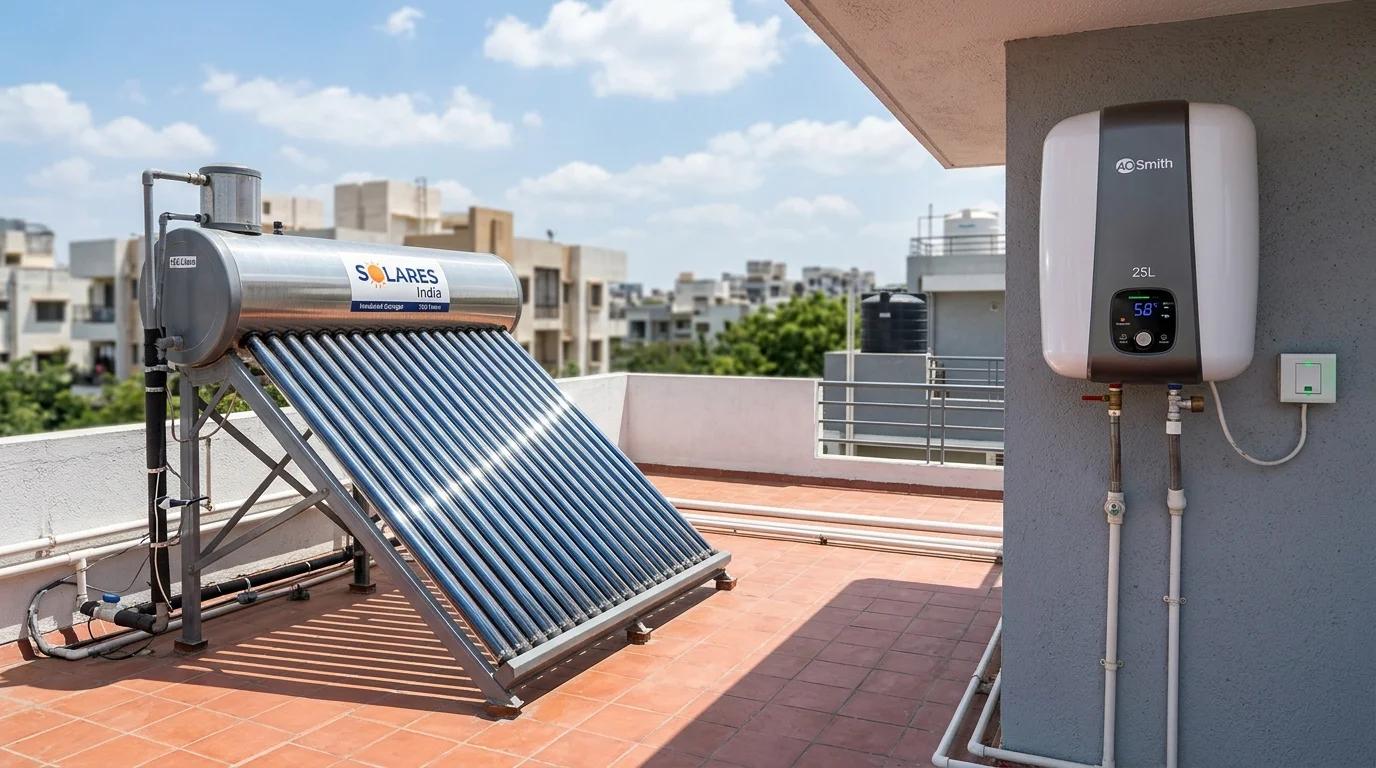
In households with regular geyser use, water heating represents one of the largest single contributors to winter electricity consumption. During chilly mornings, switching on two standard 2,000-watt storage geysers across multiple bathrooms draws 4 kW of simultaneous electrical demand, significantly increasing daily energy consumption (kWh) which, depending on your distribution company's (DISCOM) billing rules and slab structures, can elevate monthly bills into higher tariff tiers.
For homeowners building a new independent house, renovating a villa, or evaluating energy conservation measures, the core question is straightforward: Should you invest upfront in a rooftop solar thermal water heater, or install conventional electric storage geysers?
Solar water heating can substantially reduce electricity consumption on sunny days, but actual performance varies with local solar radiation, weather patterns, system sizing, structural orientation, and household hot-water demand. Conversely, electric geysers provide low initial purchase costs and on-demand heating regardless of weather, but generate an ongoing, lifelong operating cost on your monthly electricity bill.
In this guide, we break down the engineering principles, official Bureau of Energy Efficiency (BEE) standby loss standards, thermodynamic calculations, and real-world installation requirements to help you decide which water heating option suits your home.
Technical & Architectural Overview
Before analyzing financial metrics, it is essential to examine the physical mechanisms of capturing solar thermal radiation versus resistive electric heating.
1. Solar Thermal Water Heaters (ETC vs. FPC)
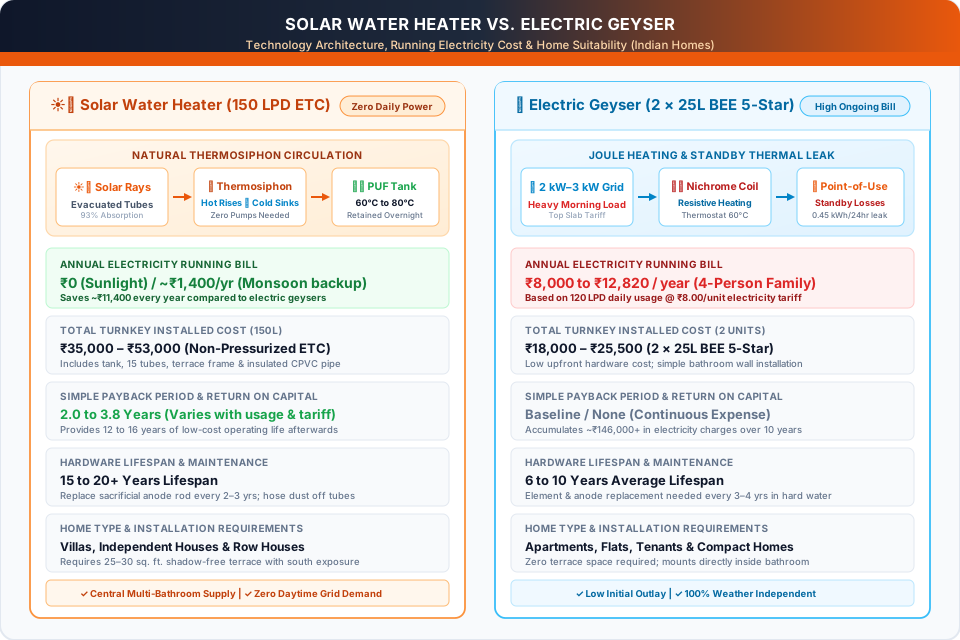
A residential solar water heater does not generate electricity; it converts incident solar irradiance directly into thermal energy using a closed or open fluid loop based on thermosiphon circulation. As water inside the solar collector warms, its density decreases. The warmer, lighter water naturally rises into an overhead insulated storage tank, while cooler, denser water from the bottom of the tank descends into the collector tubes.
In the Indian residential market, solar thermal systems are governed by quality guidelines under the Ministry of New and Renewable Energy (MNRE) and Bureau of Indian Standards (BIS) Compulsory Certification, divided into two primary collector technologies:
Evacuated Tube Collectors (ETC) — IS 16544 (Water Heating Systems) & IS 16542 (Storage Tanks):
- Mechanism: Composed of parallel double-walled borosilicate glass tubes. The space between the outer and inner glass layers is evacuated to create a high vacuum, eliminating convective and conductive heat transfer to ambient outdoor air. The outer surface of the inner tube features a solar-selective coating (such as Aluminum Nitrate or Al-N/Al) that absorbs high fractions of the solar spectrum while minimizing thermal emittance.
- Market Application: Accounts for the majority of residential retrofits in India due to lower equipment costs and strong thermal retention in cooler ambient temperatures. However, borosilicate glass tubes require care during handling and are susceptible to scaling in hard water regions.
Flat Plate Collectors (FPC) — IS 12933 (Solar Flat Plate Collectors):
- Mechanism: Employs an insulated, weatherproof metal casing housing a dark-coated copper absorber sheet bonded to copper riser tubes, protected by a top sheet of toughened, low-iron tempered solar glass.
- Market Application: FPC systems feature high mechanical durability against physical impacts (such as hail or falling tree branches). However, standard flat plate collectors incur higher thermal losses on cold, windy days compared to vacuum-sealed ETC tubes, and indicative market surveys suggest initial equipment costs for FPC are often higher due to copper material content.
Both collector designs feed into a storage tank insulated with 50 mm to 70 mm of high-density Polyurethane Foam (PUF). Under typical calm overnight conditions, quality PUF insulation helps limit nocturnal water temperature drops to an indicative benchmark of approximately 3°C to 8°C (varying with ambient night temperature, wind exposure, tank volume, and plumbing insulation), provided there is no reverse thermosiphon flow occurring through unvalved plumbing lines.
2. Electric Storage Geysers
Electric water heaters operate on the principle of Joule heating (resistive electrical heating):
- Line voltage (230V AC) is applied across a high-resistance nickel-chromium (Nichrome) heating element encased in an insulated copper or Incoloy alloy sheath immersed directly in the water tank.
- A mechanical capillary or electronic thermostat regulates water temperature between 55°C and 65°C, supported by a secondary thermal cut-out safety switch to prevent dry boiling.
- To inhibit electrochemical corrosion of the inner tank lining (vitreous enamel or stainless steel), many manufacturers install a replaceable sacrificial magnesium anode rod. The magnesium anode possesses a lower electrochemical potential than steel, corroding preferentially to protect the tank structure.
While electric immersion elements convert electrical energy into thermal heat at nearly 98% internal efficiency, the system's real-world seasonal efficiency is lowered by standing thermal losses—heat continually escaping through the insulated jacket throughout the day.
1. Running Cost Comparison: The Thermodynamics of Water Heating
Calculating water heating energy requires applying the basic thermodynamic specific heat equation:
Where:
- Q = Thermal energy transferred (in Kilowatt-hours, where 1 kWh = 3,600 kJ)
- m = Mass of water in kilograms (1 liter of pure water ≈ 1 kg)
- Cp = Specific heat capacity of water (4.184 kJ/kg·°C or 0.001162 kWh/kg·°C)
- ΔT = Temperature rise (Ttarget − Tinlet)
Benchmark Parameters & Health Standards
- Inlet Water Temperature (Tinlet): In central, western, and northern peninsular India, typical winter tap water arrives between 18°C and 22°C (dropping to 10°C–14°C in north Indian hill and plain regions during December/January). We establish 20°C as our baseline.
- Storage Target Temperature (Ttarget): Set at 60°C for central thermal storage.
Storage vs. Mixed Tap Water Volume: In our models, 120 liters represents the primary hot water volume heated to 60°C inside the storage tank. When blended at the bathroom shower mixer or bucket with ambient 20°C tap water, the resulting mixed volume follows thermal equilibrium:
Vmixed = Vhot × [(Thot − Tcold) ÷ (Tmixed − Tcold)]At a comfortable delivery temperature of 40°C, this yields:
Vmixed = 120 × [(60 − 20) ÷ (40 − 20)] = 240 LitersAcross typical bathing ranges (40°C to 42°C), this primary 120-liter volume delivers approximately 218 to 240 liters of warm bathing water (or up to ~267 liters if tempered down to 38°C).
Health & Safety Note on Storage vs. Tap Temperatures: The U.S. CDC Water Infection Control & Legionella Guidance recommends storing hot water at 60°C (140°F) in central water storage systems to inhibit colonization of Legionella pneumophila bacteria (which multiply between 20°C and 45°C).
However, water stored at 60°C presents a serious scalding burn risk, especially for young children and elderly residents. Installing a thermostatic mixing valve (TMV) or using mixer faucets to temper water down to a safe delivery range of 38°C to 43°C (100°F–110°F) at the point of use is strongly advised.
With Tinlet = 20°C and Ttarget = 60°C, the temperature differential is:
Understanding Scenario 1 (100 Liters) vs. Scenario 2 (120 Liters)
To ensure analytical clarity, we separate our calculations into two distinct scenarios:
- Scenario 1 (Theoretical 100-Liter Baseline): Demonstrates unit energy consumption per 100 L with a single storage geyser.
- Scenario 2 (Worked 4-Person Household — 120 Liters): Evaluates realistic daily water usage served by two distinct 25-liter bathrooms.
Scenario 1: 100-Liter Baseline Unit Calculation
For 100 liters of water heated by 40°C:
In an electric storage setup with a single 25-liter tank delivering 100 liters cumulatively across multiple heating cycles during the day (e.g., reheating 25-liter batches as household members use warm water at different intervals):
- In this baseline model, 5.28 kWh per day represents an illustrative overall seasonal efficiency estimate of ~88% (4.65 kWh ÷ 0.88 ≈ 5.28 kWh).
- Alternatively, viewed through a component energy balance: with ~98% element conversion efficiency (4.65 ÷ 0.98 ≈ 4.74 kWh) plus typical 24-hour standing heat loss (∼0.50 to 0.60 kWh), total daily input hovers around 5.24 to 5.34 kWh. Both methods produce comparable estimates for an unmanaged storage geyser cycle.
BEE 5-Star Standing Loss Standards Explained
Under the Bureau of Energy Efficiency (BEE) Standards and Labelling Scheme for Stationary Storage Type Electric Water Heaters (BEE Star Label Portal):
- BEE star ratings for stationary storage electric water heaters are based on measured 24-hour standing loss normalized to a 45°C temperature difference between the stored water and ambient test conditions (SL24 in kWh/24 hr/45°C).
- Rather than relying on a generalized formula, always verify the current BEE Star Label Portal and the official star label affixed to specific commercial models for certified standing loss thresholds. Star thresholds and test parameters are periodically revised under BEE regulations, and actual heat retention depends heavily on insulation density and build quality.
Even on days with little or no hot-water use, the tank may consume electricity to replace standing heat losses as the water cools below the thermostat cut-in threshold. Actual consumption depends on thermostat deadband, target temperature settings, and operating schedule (e.g., whether the geyser is left continuously powered on or switched off after use).
To learn how to verify your appliance ratings and meter measurements, explore our practical guide on how to read a residential electricity meter.
2. Worked Example: 4-Person Indian Household (Scenario 2)
To evaluate real-world economics, we establish an explicit set of assumptions for an Indian urban household:
| Assumption Parameter | Modeled Value | Engineering Basis |
|---|---|---|
| Household Size | 4 Members | Standard nuclear family (2 adults, 2 children/parents) |
| Daily Hot Water Consumption | 120 Liters Per Day (LPD) at ~60°C | Primary tank volume yielding ~218–240L mixed warm bathing water at the tap |
| Temperature Profile | ΔT = 40°C (20°C inlet → 60°C tank) | Central/Northern/Western Indian winter conditions |
| Active Heating Horizon | 250 Days per Year | Active horizon (remaining 115 days represent warm summer months where hot-water demand is minimal or ambient water meets bathing needs) |
| Electricity Tariff Rate | ₹8.00 per kWh | Composite domestic slab rate (energy charges + FPPCA + duties) |
| Electric Geyser Setup | 2 × 25-Liter BEE 5-Star Storage Geysers | Master bathroom + common bathroom (2 kW element each) |
| Solar System Setup | 150 LPD Evacuated Tube Collector (ETC) | Illustrative residential planning benchmark (actual sizing depends on draw patterns, collector orientation, and rated thermal output) |
| Overcast / Inclement Weather Days | 35 Days per Year | Dense monsoon rain or winter fog spells requiring auxiliary backup electricity |
Thermodynamic Math:
Useful thermal energy required per day:
Option A: Electric Geysers Calculation
In this model, the 6.41 kWh/day figure represents an illustrative overall seasonal efficiency estimate (~87%), where the 0.83 kWh/day delta between electrical input (6.41 kWh) and useful thermal heat (5.58 kWh) accounts for combined thermal standing losses through the insulated tank jackets and pipe distribution losses. Rather than stacking measured standing loss on top of an efficiency factor (which would double-count losses), this unified model reflects daily energy draw:
Option B: Solar Thermal System & Backup Electricity Audit
A common analytical error in solar reviews is assuming 100% free heating across all 365 days of the year, or providing conflicting runtime numbers for the backup element. We reconcile this with an explicit meteorological calculation:
Hypothetical Modeling Scenario for Sunny-Day Performance: For this illustrative model, we assume that the solar water heater supplies the required hot water without auxiliary electricity on 215 days per year. This is a hypothetical modeling scenario, not a measured performance guarantee for any specific location. A rated 150 LPD system capacity alone does not guarantee that 120 L of water will reach 60°C every day; actual thermal output depends on local solar irradiance, collector orientation, shading, ambient temperatures, seasonal hot water draw patterns, and morning vs. evening usage. Backup electricity may still be required on partly sunny days, during winter fog, or whenever hot-water demand exceeds available stored heat.
Overcast / Inclement Weather Days (35 Days):
- On heavily overcast or rainy monsoon days with dense cloud cover, direct solar irradiance drops substantially. The auxiliary 2 kW immersion coil is activated to raise the 120-liter tank volume.
- During the monsoon (July–August), incoming tap water is naturally warm (~26°C), requiring less heating (ΔT ≈ 30°C → 4.18 kWh). During cold winter fog spells in January, ΔT remains 40°C (5.58 kWh).
- Average energy per overcast day: ∼5.0 kWh.
- Operating runtime on a 2 kW element:
- Total Annual Backup Electricity:
(Note: If inclement weather extends to 40–45 days or water is fully cold-started, backup consumption reaches 200–225 kWh/year).
- Annual Backup Electricity Cost (@ ₹8.00/unit):
Side-by-Side Annual Comparison
| Performance Parameter | Option A: 2 × Electric Geysers | Option B: 150 LPD Solar Water Heater |
|---|---|---|
| Daily Useful Thermal Output | 5.58 kWh | 5.58 kWh |
| Daily Electricity Draw (Sunny Days) | 6.41 kWh | 0.00 kWh (hypothetical model assumption) |
| Daily Electricity Draw (Cloudy Days) | 6.41 kWh | ~5.00 kWh (2.5 hr backup runtime) |
| Total Annual Electricity Consumption | 1,602.5 kWh | 175.0 kWh |
| Annual Running Bill (@ ₹8.00/kWh) | ₹12,820 | ₹1,400 |
| Net Annual Operating Savings | — (Baseline expense) | ₹11,420 Saved per Year (under model assumptions) |
To calculate how individual appliance wattages translate into your overall bill, review our guide on how to calculate the electricity cost of any appliance.
3. Upfront Equipment, Plumbing & Installation Costs
A valid financial assessment must include turnkey capital expenditure—including structural mounting, electrical connections, and plumbing down-risers.
Illustrative Planning Estimates (Not verified contractor quotes or fixed commercial prices; actual costs vary significantly by brand, dealer, local plumbing labor, and site conditions). Planning cost ranges reflect typical residential market estimates as of 2026.
| Cost Component | Electric Storage Geysers (2 Units) | 150 LPD ETC Solar System (Non-Pressurized) | 150 LPD FPC Solar System (Pressurized) |
|---|---|---|---|
| Hardware Equipment | ₹16,000 – ₹22,000 (2 × 25L 5-Star) | ₹22,000 – ₹28,000 (Tank, 15 tubes, frame) | ₹38,000 – ₹50,000 (Copper collector, heavy tank) |
| Auxiliary Element & Thermostat | Included | ₹2,000 – ₹3,500 (2 kW coil + controller) | ₹2,500 – ₹4,000 (Integrated thermostat) |
| Mounting & Assembly Labor | ₹800 – ₹1,500 (Wall brackets) | ₹2,500 – ₹3,500 (Terrace civil assembly) | ₹3,000 – ₹4,500 (Terrace civil anchoring) |
| Valves & Ancillary Fittings | ₹1,200 – ₹2,000 (Angle valves, hoses) | ₹2,500 – ₹4,000 (Air vent, NRVs, gate valves) | ₹4,000 – ₹6,000 (Pressure relief & air release) |
| Dedicated Hot Water Plumbing Line | ₹0 (Internal bathroom loop only) | ₹6,000 – ₹14,000 (Insulated CPVC down-riser) | ₹8,000 – ₹16,000 (SDR-11 insulated CPVC line) |
| Total Turnkey Initial Outlay | ₹18,000 – ₹25,500 | ₹35,000 – ₹53,000 | ₹55,500 – ₹80,500 |
Plumbing Material & Pipe Volume Heat Loss
In an electric geyser installation, hot water travels less than 1 meter from the tank outlet to the mixer faucet. With a central rooftop solar system, water travels from the terrace down 1 to 3 stories (10 to 25 meters).
- Pipe Material Specification: Standard unrated PVC or UPVC pipes are generally unsuitable for high-temperature solar discharge lines; homeowners should use pipe materials approved by the manufacturer and relevant plumbing codes (such as hot-water-rated CPVC or composite piping) rated for the system's peak operating temperature and pressure.
- Quantifying Pipe Water Drain Volume: The volume of stagnant water contained in an uninsulated pipe run is calculated by cylinder volume:
As an illustrative example, consider a hot-water down-riser with an assumed 20 mm internal diameter (r = 10 mm) running 15 meters from the terrace to a first-floor bathroom (actual internal diameter varies according to the specific pipe schedule, standard dimension ratio, and manufacturer specification):
While a 15-meter run with an assumed 20 mm internal diameter holds approximately 4.7 liters of stagnant water, not every installation requires discarding all stagnant water every time. Stagnant water cools between intermittent uses, and actual hot-water arrival time depends on overall plumbing layout, actual pipe diameter, insulation quality, and distance from the terrace to the individual faucet. 3. Thermal Insulation Wrapping: The external down-riser must be insulated with 9 mm to 13 mm closed-cell elastomeric nitrile rubber or glass-wool insulation with an aluminum weather barrier to minimize transit heat loss.
4. Structural, Water Quality & Safety Factors
1. Terrace Structural Load & Safety
A common assumption is that any reinforced concrete cement (RCC) slab terrace can accommodate a solar water heater without prior checks.
- Based on typical residential manufacturer specifications, a filled 200 LPD solar water heater (water mass ~200 kg plus storage tank, manifold frame, and collector tubes ~80 kg to 140 kg) exerts a total static weight of approximately 280 kg to 340 kg.
- This mass is transferred to the roof slab through 4 to 6 small footpads, creating concentrated point loads rather than a purely uniform distributed load.
- Structural Precautions: Site-specific structural verification by a qualified civil engineer or experienced installer is strongly recommended before installation, especially on older buildings (20+ years old), pre-cast slab assemblies, or cantilevered roof overhangs.
- Waterproofing Integrity: Mounting footings should be bolted onto raised concrete plinth pads or non-penetrating weighted bases rather than anchoring directly into the waterproofing membrane, which can trigger rainwater leakage into the ceiling below.
2. Differentiating TDS from Water Hardness (Scaling Mechanics)
Homeowners often conflate Total Dissolved Solids (TDS) with Water Hardness:
- Total Dissolved Solids (TDS): Represents the sum of all dissolved inorganic mineral ions in water, including sodium, potassium, chlorides, sulfates, and carbonates. Water can possess a high TDS (e.g., 800 ppm) predominantly from sodium chloride without causing heavy scaling.
- Water Hardness: Specifically measures the concentration of multivalent divalent cations—predominantly dissolved Calcium (Ca2+) and Magnesium (Mg2+) ions, expressed in parts per million (ppm) or mg/L as CaCO3 equivalent.
Water Hardness Classification (as CaCO3):
- Soft: 0 to 60 ppm
- Moderately Hard: 61 to 120 ppm
- Hard: 121 to 180 ppm
- Very Hard: Above 180 ppm
When hard water is heated above 55°C, soluble calcium bicarbonate undergoes thermal decomposition, precipitating insoluble calcium carbonate (CaCO3):
- Impact on Solar ETC Tubes: In areas with elevated water hardness (>180 ppm CaCO3), scale accumulation and anode consumption accelerate. Operational observations show that precipitated lime scale forms an insulating layer on the inner glass tube surface, progressively impairing heat transfer and system efficiency over successive seasons depending on local mineral saturation indices and peak water temperatures.
- Maintenance Guidance: Follow your manufacturer's specific maintenance manual: inspect the sacrificial magnesium anode rod (if equipped) periodically, and perform chemical descaling flushes (using food-grade citric acid or inhibited sulfamic acid) when flow or thermal transfer degrades. Because water chemistry varies substantially across regions, local water testing is recommended.
3. Water Pressure & Booster Pump Ratings
- Standard low-cost ETC systems operate on gravity feed and are rated for low hydrostatic pressures (typically 0.2 to 0.4 bar).
- Standard gravity-fed tanks are typically rated only for low hydrostatic head; connecting them directly to a whole-house automatic pressure booster pump (operating at 2.5 to 4.0 bar) without verifying the tank's pressure rating or installing a pressure-certified model risks structural deformation or tank failure.
- Homeowners with booster pumps must explicitly install a Pressurized Solar Water Heater (a manufacturer-certified model typically specified for 4 to 6 bar working pressure) or a closed-loop heat exchanger model.
5. Payback Period & 10-Year Lifecycle Analysis
The financial return of a solar water heater depends on household occupancy, actual water consumption, local utility tariff slabs, and weather conditions.
Benchmark Payback Calculation (Worked 4-Person Family)
Using our Scenario 2 baseline as an illustrative simple payback model (not a universal savings guarantee):
- In our worked example, the initial capital expenditures (Turnkey Solar @ ₹44,000 installed vs. 2 × Electric Geysers @ ₹21,000 installed) represent chosen illustrative midpoint benchmarks selected from the quoted market ranges (₹18,000–₹25,500 for geysers and ₹35,000–₹53,000 for solar ETC):
- Illustrative annual net electricity bill savings under these modeling assumptions:
- Illustrative Simple Payback Period:
When Does the Payback Period Lengthen?
The 2-year payback scenario assumes consistent daily hot-water consumption across 250 days at an ₹8.00/kWh marginal tariff under our model's assumptions. Payback varies across different household conditions:
- Seasonal Usage Only (150 Days/Year): If hot water is used strictly during winter (annual geyser cost ₹7,690; solar backup ₹840; savings ₹6,850/yr), payback extends to 3.3 to 3.8 years.
- Lower Utility Tariff (₹6.00/kWh): In states with lower domestic tariffs, annual savings drop to ~₹8,560, extending payback to 2.7 to 3.2 years.
- Pressurized FPC System (High CapEx): Investing in a high-end pressurized FPC system costing ₹65,000 installed (ΔCapEx = ₹44,000) extends the payback timeline to 3.8 to 4.5 years.
10-Year Total Cost of Ownership (TCO) Model
Note on Tariff Escalation & Modeling Assumptions: Both the electric geyser baseline and the solar backup electricity projections apply an identical 3% annual compound tariff escalation rate starting from ₹8.00/kWh in Year 1. Mid-life unit replacements and maintenance figures represent illustrative estimates for total cost of ownership (TCO) comparisons, not commercial warranties or guaranteed equipment lifespans. This model assumes no major unit replacement for the solar system within 10 years, though individual repairs, valve replacements, or occasional tube replacements may still occur.
| Expense Component (10-Year Period) | Option A: 2 × Electric Storage Geysers | Option B: 150 LPD ETC Solar Water Heater |
|---|---|---|
| Initial Turnkey Installed Cost | ₹21,000 (illustrative midpoint) | ₹44,000 (illustrative midpoint with CPVC riser) |
| 10-Year Electricity Running Expense | ₹146,900 (modeled with 3% annual tariff escalation) | ₹16,050 (modeled with identical 3% annual escalation) |
| Maintenance, Anode (if equipped) & Element Replacements | ₹4,500 (2 element & anode replacements) | ₹5,000 (anode replacements if equipped, & descaling) |
| Mid-Life Unit Replacement | ₹10,500 (1 unit replaced at Year 6) | ₹0 (modeled assumption of no major unit replacement; individual repairs or tube replacements may occur) |
| Total 10-Year Cost of Ownership (TCO) | ₹182,900 | ₹65,050 |
| Net 10-Year Financial Savings | — (Baseline reference) | ₹117,850 Net Savings (under model assumptions) |
If your home already has or is considering a rooftop solar power plant, read our detailed guide on how much rooftop solar costs for an Indian home and compare sizing options with how many solar panels a home needs.
6. When a Solar Water Heater is NOT Recommended
While solar thermal water heaters offer strong financial returns under appropriate conditions, there are clear scenarios where installing one is inadvisable:
- Mid- or Lower-Floor Apartments: Residents in high-rise buildings lack private roof titles. Running an individual down-riser through common duct shafts across 5+ floors leads to excessive transit heat loss and plumbing costs that outweigh energy savings.
- Heavily Shaded Terraces: If adjacent high-rise constructions or tree canopies block direct sunlight between 9:00 AM and 3:00 PM, thermal absorption falls below operational viability.
- Low Hot-Water Demand: For single occupants or households where hot water is used for only 30 to 45 days per year, annual geyser electricity expense rarely exceeds ₹2,500. A ₹40,000 solar installation would take over 15 years to recover its initial cost.
- Severe Unmitigated Hard Water (>300 ppm CaCO3): Without water softening or dedicated descaling maintenance, glass tubes and heating elements suffer rapid degradation.
Summary Comparison & Decision Matrix
| Evaluation Parameter | Rooftop Solar Water Heater (ETC) | Electric Storage Geyser (BEE 5-Star) | Recommended Fit |
|---|---|---|---|
| Turnkey Initial Cost | ₹35,000 – ₹53,000 (with CPVC plumbing, indicative) | ₹8,000 – ₹12,000 (per bathroom, indicative) | Electric Geyser (lower barrier to entry) |
| Operating Electricity Cost | ₹1,200 – ₹1,800/yr (monsoon backup estimate) | ₹8,000 – ₹14,000/yr (family of 4 estimate) | Solar Water Heater (cuts energy substantially in this model) |
| Payback Period | 2.0 to 4.0 Years (under modeled conditions) | None (pure operating overhead) | Solar Water Heater (faster capital return) |
| Design Equipment Lifespan | 15 to 20 Years (indicative range) | 6 to 10 Years (indicative range) | Solar Water Heater (longer hardware life) |
| Inclement Weather Reliance | Requires 2 kW auxiliary coil in monsoon/fog | 100% weather independent | Electric Geyser (instant heat on demand) |
| Structural Space Demand | Typical planning estimate of 25–35 sq. ft. terrace | Mounted inside bathroom wall | Electric Geyser (zero roof required) |
| Multi-Point Central Supply | Central feed to all bathrooms & kitchen | Separate geyser needed per bathroom | Solar Water Heater (centralized plumbing) |
| Grid Demand Impact | Zero morning peak electrical draw | Adds 2 to 4 kW load per household | Solar Water Heater (eases connected load) |
Decision Summary
- Choose a Solar Water Heater if: Under the assumptions of our model, you own an independent bungalow, villa, row house, or top-floor terrace; have a family of 3 or more with regular hot-water usage; and have unshaded southern roof exposure.
- Choose an Electric Geyser if: You reside in an apartment or rental property; have limited or heavily shaded roof space; or require hot water for only a few weeks each winter.
Frequently Asked Questions
What official standards govern electric geysers and solar water heaters in India?
Electric storage water heaters are regulated by the Bureau of Energy Efficiency under the BEE Star Label Portal and Bureau of Indian Standards standard IS 2082 (Stationary Storage Type Electric Water Heaters). Solar thermal systems are subject to quality compliance under the Ministry of New and Renewable Energy (MNRE) and Bureau of Indian Standards (BIS) Compulsory Certification, with relevant product standards including IS 16544 for Evacuated Tube Collector systems, IS 16542 for Solar Thermal Storage Tanks, and IS 12933 for Flat Plate Collectors.
Does an ETC solar water heater work during cloudy or winter days?
Solar thermal collectors rely on solar irradiance rather than warm ambient air. In winter, as long as direct sunlight is present, evacuated vacuum tubes prevent heat from leaking back into the cold outdoor air, heating water to 60°C–75°C. On heavily overcast or rainy monsoon days with dense cloud cover, direct solar irradiance drops substantially, requiring an auxiliary electric backup coil (typically 2 kW running for 2 to 3 hours) to reach target bathing temperatures.
How does water hardness affect solar water heater maintenance?
Water with high calcium and magnesium hardness precipitates insoluble calcium carbonate scale when heated above 55°C. In evacuated tube collectors, scale accumulates inside the glass tubes, acting as an insulating layer that impairs heat transfer. In hard-water areas (>180 ppm CaCO3), homeowners should follow manufacturer guidance to inspect and replace the tank's sacrificial magnesium anode rod (if equipped) periodically and perform chemical descaling flushes when thermal output diminishes.
Can a solar water heater be used with a pressure booster pump?
Standard non-pressurized solar water heaters are gravity-fed systems rated only for low hydrostatic pressures (0.2–0.4 bar). Subjecting a standard gravity tank to 2.5–4.0 bar from a whole-house hydro-pneumatic pressure pump without a pressure-certified rating risks structural deformation or tank failure. Homeowners with pressure booster systems must install a certified Pressurized Solar Water Heater (typically rated for 4 to 6 bar working pressure) or an indirect heat-exchanger system.
How much water is contained in the down-riser pipe?
The volume of water contained in a down-riser pipe is determined by cylinder volume (V = π × r2 × L). An illustrative 15-meter run with a 20 mm internal diameter holds approximately 4.7 liters of water. Insulating the pipe with elastomeric nitrile rubber retards cooling between intermittent morning uses, minimizing heat loss and reducing the time required for hot water to reach the tap.
Sources and Regulatory References
For statutory engineering standards, official appliance energy ratings, and public health guidelines on residential water heating systems, refer to the following verified institutional resources:
- Bureau of Energy Efficiency (BEE), Ministry of Power, India: BEE Star Label Portal — Standards & Labelling Programme — Official national statutory portal regulating star-rated stationary storage electric water heaters under IS 2082 / BEE Schedule 1, establishing certified standing loss limits and energy consumption benchmarks.
- Ministry of New and Renewable Energy (MNRE), Government of India: MNRE Official Documents & Quality Control Orders — Official repository of national renewable policy notifications, scheme guidelines, and technical quality standards governing residential solar thermal installations.
- Bureau of Indian Standards (BIS): BIS Products Under Compulsory Certification (QCO Guidelines) — Statutory Indian Standards portal governing IS 2082 (stationary electric geysers), IS 16544 (evacuated tube solar water heating systems), IS 16542 (solar thermal storage tanks), and IS 12933 (flat plate collectors).
- Centers for Disease Control and Prevention (CDC), U.S. Department of Health and Human Services: Water Infection Control & Legionella Prevention in Potable Water Systems — Official public health toolkit specifying safe water storage temperature thresholds (60°C / 140°F) to prevent bacterial colonization in central hot-water plumbing.
- U.S. Department of Energy (DOE) & Environmental Protection Agency (EPA) — ENERGY STAR: Residential Water Heaters Guidance & Efficiency Criteria — Engineering benchmarks on water heater standby loss, thermal efficiency, and comparative lifetime operating economics.