Frequent grid interruptions, voltage sags, and seasonal power cuts make a residential backup power system—commonly referred to in Indian households as a Home Inverter / Home UPS—an essential piece of domestic infrastructure.
Yet, in many households, inverter and battery setups are purchased with imprecise capacity estimates. Common sizing challenges include:
- Buying an undersized inverter that overloads and trips whenever a ceiling fan starts or an extra appliance is switched on.
- Buying an undersized battery that drains after 90 minutes because the buyer ignored inverter conversion losses and battery Depth of Discharge (DoD) limits.
- Selecting an unsuitable waveform type without understanding how non-sinusoidal waveforms interact with modern BLDC fans, LED drivers, and sensitive electronics.
- Discharging lead-acid batteries past their recommended depth-of-discharge limits repeatedly, accelerating plate sulfation and reducing battery service life.
An inverter and a battery perform two separate, complementary functions. Sizing them correctly requires two distinct engineering decisions:
- Inverter Capacity (VA / Watts): Governs how much electrical load you can run concurrently at any given second.
- Battery Capacity (Ah / Watt-Hours): Governs how many hours that running load can operate before the stored chemical energy is depleted.
In this practical, evidence-based guide, we examine the core electrical principles, appliance consumption inventories, efficiency considerations, and battery chemistry characteristics needed to estimate your home's backup requirements realistically.
Technical Architecture: How a Home Inverter & Battery System Works
To select the right hardware, it helps to understand the power conversion flow inside a residential backup system:
A standard residential inverter/UPS performs three distinct operating roles:
- Grid-Present Mode (Mains Mode): When utility grid power is active, the inverter acts as an intelligent pass-through switch. It supplies utility alternating current (AC) directly to your home's connected circuits while simultaneously converting a portion of AC into direct current (DC) to recharge the deep-cycle battery bank using an internal multi-stage charger.
- Transfer Switching (Inverter vs. UPS Mode): When utility grid power fails or fluctuates beyond acceptable limits, an internal transfer switch shifts connected loads from grid to battery-inverted power. Importantly, transfer time (measured in milliseconds, typically 10–20 ms on standard inverters vs. 3–8 ms on dedicated UPS units) and AC input-voltage acceptance range (measured in Volts) are two separate technical parameters. Inverter Mode vs. UPS Mode primarily toggles the acceptable input-voltage window: UPS Mode narrows the threshold (often ~180V–260V) so the unit switches to battery before sensitive electronics brown out, whereas Inverter Mode widens it (often ~100V–290V) to avoid nuisance battery tripping on fluctuating rural or semi-urban grids. However, selecting UPS Mode does not convert a slow relay into an instantaneous transfer switch; if you must keep a desktop computer, NAS server, or gaming console from rebooting during an outage, check the manufacturer's certified transfer time on the technical datasheet and verify compatibility with your equipment's hold-up time.
- Inverter Mode (Backup Mode): The unit draws DC electrical power from the battery (typically 12V or 24V DC), transforms it to 220V–240V single-phase AC, and feeds your home's designated backup wiring sub-panel.
1. VA vs. Watts: Sizing Your Inverter Capacity
The first critical specification printed on every inverter carton is its VA rating (Volt-Amperes), such as 900 VA, 1,100 VA, 1,450 VA, or 2,000 VA. Homeowners frequently confuse VA with Watts, assuming that a 1,000 VA inverter can deliver 1,000 Watts of active electrical power. This assumption is incorrect.
The Power Factor (PF) Relationship
In alternating current (AC) circuits, electrical loads fall into three categories:
- Resistive Loads: Filament lamps, electric irons, geysers. Current and voltage remain in phase; Power Factor = 1.0.
- Inductive Loads: Ceiling fans, refrigerator compressors, washing machines, pumps. Magnetic coils cause alternating current to lag behind voltage, lowering the Power Factor to 0.70–0.85.
- Capacitive / Non-Linear Electronic Loads: Computers, televisions, LED driver power supplies.
The relationship between Real Power (Watts) and Apparent Power (Volt-Amperes) is determined by the system's Power Factor (PF):
Most residential inverters are designed with an assumed standard operating Power Factor of 0.80 (some entry-level units operate at 0.70, while premium high-frequency models achieve 0.85–0.90):
The assumed 0.80 power factor reflects a common engineering rating for residential inverter active output (e.g., an 1,100 VA inverter rated for approximately 880 Watts continuous active load). However, the inverter's rated output power factor and the connected appliances' operating power factors are distinct parameters. In practice, selecting the right inverter requires verifying both the total active running wattage (W) and the combined volt-ampere demand (VA) of your specific appliances.
Illustrative Output Ratings:
- 700 VA Inverter: 700 × 0.80 = 560 Watts continuous active output benchmark.
- 900 VA Inverter: 900 × 0.80 = 720 Watts continuous active output benchmark.
- 1,100 VA Inverter: 1,100 × 0.80 = 880 Watts continuous active output benchmark.
- 1,500 VA Inverter: 1,500 × 0.80 = 1,200 Watts continuous active output benchmark.
Modified Sine Wave vs. Pure Sine Wave
When selecting an inverter, you will encounter two primary output waveforms:
- Modified Sine Wave (Stepped / Quasi-Sine Wave):
- Produces a stepped approximation of alternating current with higher Total Harmonic Distortion (THD).
- While less expensive to manufacture, this non-sinusoidal waveform creates additional harmonic heating and noticeable acoustic hum in induction motor windings (such as conventional ceiling fans).
- Some switch-mode power supplies, variable-speed fan regulators, and timing circuits experience elevated component temperatures or electrical noise under prolonged operation.
- Pure Sine Wave:
- Produces a smooth, continuous sinusoidal AC waveform matching high-quality utility grid standards.
- Inductive fan motors run coolly without mechanical buzz; sensitive home electronics, LED drivers, and smart TVs operate under their intended electrical parameters.
- Recommendation: For modern residential homes containing LED lighting, BLDC motors, and digital electronics, a Pure Sine Wave inverter is strongly recommended to support appliance efficiency and reduce acoustic motor hum; actual noise reduction varies by appliance motor construction and inverter waveform quality. For medical equipment or other critical devices, verify compatibility and power-quality requirements with the equipment manufacturer. A pure sine wave output alone does not guarantee that a device is suitable for use with a particular inverter.
2. Calculating Your Essential Home Running Load
Before selecting hardware, compile an itemized inventory of the specific appliances you intend to power during a blackout. High-power appliances such as air conditioners, electric geysers, microwave ovens, and electric irons require an inverter-battery system specifically rated for their continuous wattage, starting surge (where applicable), and expected operating duration. The appropriate DC system voltage depends on the inverter model, total power demand, battery configuration, and manufacturer specifications. These appliances should not be connected unless the complete system is designed to support them safely.
Appliance Power Consumption Reference Table
The table below outlines indicative rated active power consumption for common Indian household appliances. Values are illustrative; always check the specific equipment nameplate or energy label for exact running draw and motor starting characteristics:
| Appliance Type | Standard Technology Draw | Energy-Efficient Alternative | Typical Starting Surge (Illustrative) |
|---|---|---|---|
| Ceiling Fan | 70W – 75W (Conventional induction) | 28W – 35W (5-Star BLDC motor) | 1.5× to 2.0× |
| LED Room Lighting | 9W – 12W per bulb / 20W tubelight | 7W – 9W high-lumen LED | 1.0× (Negligible) |
| Wi-Fi Router & ONT | 10W – 15W | 8W – 10W (DC UPS adapter) | 1.0× |
| Smart Television (43"–55") | 60W – 110W (Standard LED panel) | 50W – 70W (Energy-efficient LED model; check rated power) | 1.1× to 1.3× |
| Laptop Charging | 45W – 65W (Standard adapter) | 30W – 45W (Type-C GaN charger) | 1.1× to 1.2× |
| Set-Top Box (DTH) | 15W – 25W | 10W – 15W | 1.0× |
| Single-Door Refrigerator (190L) | 100W – 140W (Running) | 45W – 65W (Inverter compressor) | 2.0× to 4.5× (Compressor dependent) |
*Note on Surge Multipliers: Surge values listed above are indicative engineering estimates. Actual starting current depends heavily on specific motor design, mechanical backpressure (in compressors), capacitor sizing, and manufacturer electronics. Always consult appliance rating plates before finalizing inverter surge headroom.
Worked Baseline Household Load: 362 Watts
Suppose a typical 2BHK or 3BHK Indian family requires backup for their core essential living area during an evening outage:
- 3 × Conventional Ceiling Fans: 3 × 70W = 210 Watts
- 4 × LED Room Bulbs: 4 × 10W = 40 Watts
- 1 × Wi-Fi Router & Fiber Terminal: 1 × 12W = 12 Watts
- 1 × 43-inch LED Smart Television: 1 × 100W = 100 Watts
(Note: If your ceiling fans are modern 5-Star BLDC units consuming 30W each, your fan draw drops from 210W down to 90W, reducing your total running load to just 242 Watts—substantially extending your battery runtime).
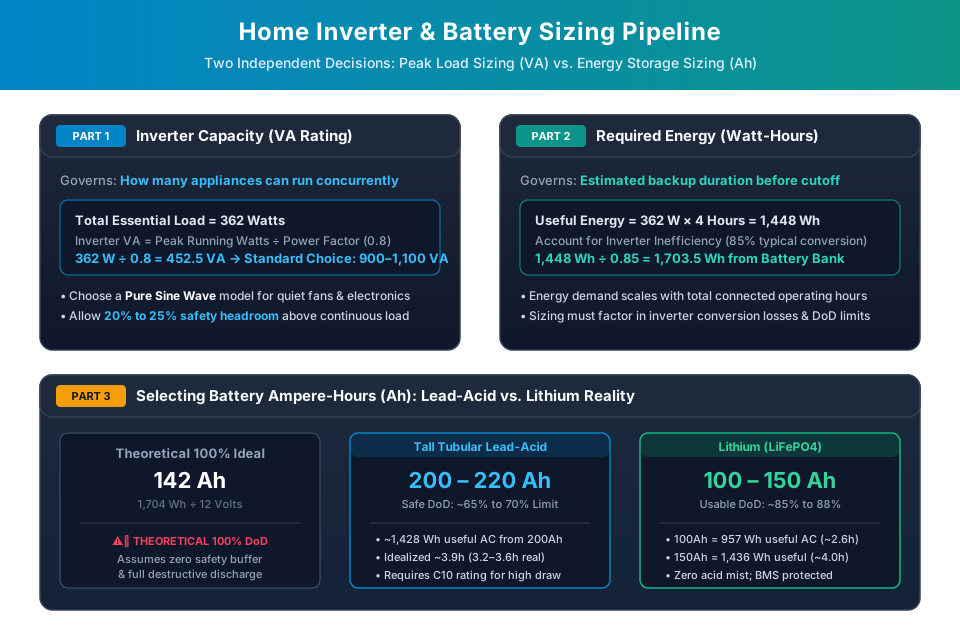
Sizing the Inverter: Active Watts vs. Apparent Power (VA)
For our illustrative 362-Watt active running load, homeowners frequently calculate an apparent power estimate using a nominal 0.80 power factor benchmark:
How to Interpret This Benchmark:
The 452.5 VA calculation is strictly an illustrative sizing estimate, not your exact appliance VA demand. An inverter's rated output power factor (often nominal 0.80) and the operating power factors of connected appliances are two separate things.When selecting an inverter in practice, keep two clear rules in mind:
- Check Inverter Continuous Watt Rating (W): Always ensure the inverter's continuous active watt rating exceeds your combined 362W running load with at least 20%–25% headroom (e.g., targeting ~450W–500W+ continuous rating).
- Check Connected Appliances' Actual VA & Surge Demand: Inductive loads like fans and compressor motors draw higher peak VA and starting currents. The inverter's VA rating and peak surge capacity must accommodate these startup demands.
Practical Inverter Selection: In the Indian market, pure sine wave inverters are typically available in standard ratings (700 VA, 900 VA, 1,100 VA, 1,450 VA):
- An 800 VA to 900 VA pure sine wave inverter (typically rated by manufacturers for ~560W to 720W continuous active load) serves as a practical candidate for a 362W load, operating comfortably around 50% to 65% of its continuous capability.
- An 1,100 VA inverter (~800W–880W continuous rating) provides additional capacity if you plan to connect a modern inverter refrigerator or occasional higher-wattage devices.
- Always confirm the manufacturer's continuous active watt rating and surge capacity for your specific equipment.
3. How to Calculate Battery Capacity in Ampere-Hours (Ah)
Once your inverter VA capacity is decided, you must calculate the battery energy storage capacity required to sustain your 362-Watt load for your target blackout duration.
Battery capacity is rated in Ampere-Hours (Ah) at a nominal voltage (typically 12 Volts DC for single-battery residential inverters).
The Four-Step Sizing Pipeline
Step 1: Calculate Total Useful Energy Demand (Watt-Hours)
Multiply your running active load by the number of continuous blackout hours you need. Suppose your area experiences typical peak power cuts of 4 hours:
Step 2: Account for Inverter Inefficiency
No power electronic converter is 100% efficient. When converting 12V DC stored in a chemical battery into 230V AC output, internal power transistors (MOSFETs), step-up transformers, and filtering circuits dissipate energy as heat.
Standard residential pure sine wave inverters operate at an average conversion efficiency of 85% (η = 0.85):
Step 3: Calculate Ideal Ampere-Hours at 12 Volts
To find the required electrical charge in Ampere-Hours (Ah), divide the total battery energy by the nominal battery voltage (12V):
Critical Engineering Reality Check: Why You Must Never Buy a 140 Ah Battery for This Scenario
Many superficial online guides stop here, recommending that the homeowner purchase a standard 140 Ah or 150 Ah battery. Doing so is a major engineering mistake.
The 142 Ah figure represents 100% theoretical discharge. In the real world, battery performance is constrained by physical electro-chemistry:
1. Depth of Discharge (DoD) Limits for Lead-Acid Batteries
Deeply discharging lead-acid batteries can accelerate sulfation and other degradation mechanisms, reducing capacity and service life. Follow the battery manufacturer's recommended discharge limits and avoid routine deep discharge.
- Cycle life is closely tied to Depth of Discharge and manufacturer plate engineering rather than a single universal number. For example, prominent manufacturers publish model-specific ratings—such as Exide citing up to 1,200 cycles at 80% DoD under standardized factory endurance test conditions for its premium InvaTubular series. In routine residential service, maintaining daily discharge within 60% to 70% DoD is recommended to preserve plate integrity and maximize lifespan across tubular models.
- Repeated deep discharges beyond manufacturer recommendations (such as regularly draining past 80%–90% DoD) accelerate active material shedding, positive grid corrosion, and hard sulfation, significantly shortening usable service life compared to standard cyclic life curves. Because cycle endurance varies by plate thickness, spine alloy, and brand, always consult the specific battery model's published cycle-life vs. DoD datasheet.
2. Temperature Effects vs. Chemical Aging
A battery's nameplate Ah rating reflects factory performance at 25°C to 27°C under standardized test conditions when brand new. Ambient temperature impacts lead-acid batteries through two distinct mechanisms:
- Low Ambient Temperatures (Cold Seasons): In colder weather, electrolyte viscosity rises and chemical diffusion slows, temporarily reducing immediately deliverable Ah capacity without causing permanent plate damage.
- Elevated Temperatures (Severe Summer Heat): Prolonged operation in high ambient heat (exceeding 35°C–40°C) accelerates internal positive grid corrosion and water evaporation, hastening permanent chemical aging and shortening the battery's overall operational lifespan.
Step 4: Correcting for Safe Depth of Discharge (DoD)
To extract 142 Ah of energy safely without exceeding an illustrative 70% Depth of Discharge threshold:
Realistic Engineering Analysis for a 200 Ah Lead-Acid Battery: A 12V 200 Ah battery possesses a nominal gross capacity of 2,400 Wh (12V × 200 Ah). Discharging to 70% DoD yields 1,680 Wh of gross DC energy. After passing through an 85% efficient inverter, deliverable useful AC energy is:
Dividing 1,428 Wh by our 362W load yields:
Critical Reality Check: Why 200 Ah Does Not Guarantee a Full 4 Hours:
While 3.94 hours appears close to 4 hours on paper, this is an idealized estimate under lab test conditions with zero safety margin:
- Peukert Capacity Derating: Lead-acid battery nameplates are rated at a slow 20-hour discharge rate (C20). Discharging a 200 Ah battery at 362W draws ~35 Amperes DC (approx. a C6 rate). Under this heavier discharge, internal resistance causes terminal voltage to sag prematurely, reducing effective deliverable Ah by 10% to 15%.
- Battery Aging and Ambient Temperature: As a lead-acid battery ages, deliverable capacity gradually diminishes. Cold winter ambient temperatures temporarily lower immediately available Ah capacity due to slower chemical mobility, whereas prolonged summer heat accelerates internal grid corrosion and permanent chemical aging.
- Actionable Sizing Context: To target a 4-hour backup for an illustrative 362W load, stepping up to a 220 Ah or 240 Ah Tall Tubular battery (or considering a C10-rated cyclic model) is a possible option to provide extra capacity margin. However, a C10 rating alone does not ensure four hours of backup. Actual runtime depends on the battery model's specific discharge curve at the actual current draw, inverter low-voltage cutoff threshold, ambient temperature, and progressive chemical aging. Homeowners can also practice light load management during extended outages (such as turning off 1 ceiling fan or the television to lower running draw to ~250W–280W), or evaluate a 150 Ah Lithium (LiFePO4) battery bank which maintains higher terminal voltage stability under heavy discharge.
The Lithium (LiFePO4) Alternative
If you select a modern Lithium Iron Phosphate (LiFePO4) battery instead of conventional lead-acid:
- Lithium chemistry supports an 85% to 88% Depth of Discharge (DoD = 0.85–0.88) on suitable cyclic storage cells; cycle-life is model-dependent and varies by cell quality, operating temperature, and manufacturer specifications (check the manufacturer's datasheet for published cycle curves under defined test conditions).
- For our 1,448 Wh useful AC energy demand, accounting for 85% inverter conversion efficiency (η = 0.85), the gross energy required from the lithium battery bank is 1,703.5 Wh.
- With an 88% usable DoD on a nominal 12.8V system:
- Sizing Takeaway: A 12.8V 150Ah LiFePO4 battery provides approximately 1.44 kWh of estimated usable AC energy (12.8V × 150 Ah × 0.88 × 0.85 ≈ 1,436 Wh) under the stated assumptions. Actual runtime depends on the battery BMS cutoff, inverter low-voltage disconnect, and operating conditions.
- A smaller 12.8V 100 Ah LiFePO4 battery provides 957 Wh of useful AC energy, delivering ~2.6 hours of backup for a 362W load, or ~4.8 hours if the load is trimmed to 200W.
4. How Many Hours of Backup Will You Actually Get?
If you already own an inverter and battery, or want to evaluate how different appliances affect your runtime, use the Universal Backup Runtime Equation:
Comprehensive Runtime Matrix (12V Battery Systems)
These calculations are energy-based estimates, not guaranteed operating times. The stated values do not independently model the battery's discharge curve, Peukert exponent, inverter standby consumption, wiring losses, or low-voltage cutoff behavior. For a more accurate estimate, use the selected battery model's discharge data at the expected current and cutoff voltage.
The table below illustrates idealized theoretical backup estimates across common residential loads. To maintain strict analytical consistency across all chemistries, each column calculates net deliverable AC useful energy after incorporating safe Depth of Discharge and an 85% inverter conversion efficiency (η = 0.85):
- 100 Ah Tubular (12V @ 70% DoD): 12V × 100 Ah × 0.70 × 0.85 = 714 Wh useful AC (Idealized)
- 150 Ah Tubular (12V @ 70% DoD): 12V × 150 Ah × 0.70 × 0.85 = 1,071 Wh useful AC (Idealized)
- 200 Ah Tubular (12V @ 70% DoD): 12V × 200 Ah × 0.70 × 0.85 = 1,428 Wh useful AC (Idealized)
- 100 Ah LiFePO4 (12.8V @ 88% DoD): 12.8V × 100 Ah × 0.88 × 0.85 = 957 Wh useful AC (Idealized)
Engineering Notice on Lead-Acid Runtime Expectations:
All lead-acid runtime figures in this matrix represent idealized theoretical calculations. In real-world operation—particularly at heavier continuous loads exceeding 300 Watts on a 12V bus (where discharge current exceeds 30 to 50 Amperes DC)—the Peukert effect, internal cell resistance, and terminal voltage sag will cause actual backup times to be noticeably lower than these laboratory estimates.
Important Sizing Disclaimer: The backup hours in the table below are mathematical approximations derived from nominal battery energy formulas under idealized conditions. These figures do not represent guaranteed backup times. Real-world runtime will vary due to the Peukert effect (non-linear capacity loss under heavier discharge currents), battery state of health and aging, ambient operating temperature, internal plate resistance, wiring and terminal I²R voltage drops, and the inverter's low-voltage disconnect cutoff threshold (typically 10.5V to 10.8V). Consult the battery manufacturer's certified C-rate discharge curves for verified backup performance under your specific load profile.
| Connected Running Load (Watts) | 100 Ah Tubular (714 Wh - Idealized) |
150 Ah Tubular (1,071 Wh - Idealized) |
200 Ah Tubular (1,428 Wh - Idealized) |
100 Ah LiFePO4 (12.8V) (957 Wh - Idealized) |
|---|---|---|---|---|
| 100 Watts (1 Fan + 2 LEDs + Wi-Fi) |
~7.1 Hours | ~10.7 Hours | ~14.3 Hours | ~9.6 Hours |
| 200 Watts (2 Fans + 4 LEDs + Wi-Fi) |
~3.6 Hours | ~5.4 Hours | ~7.1 Hours | ~4.8 Hours |
| 362 Watts (Our 4-Person Baseline) |
~2.0 Hours | ~3.0 Hours | ~3.9 Hours* | ~2.6 Hours |
| 500 Watts (3 Fans + TV + PC + Lights) |
~1.4 Hours | ~2.1 Hours | ~2.9 Hours | ~1.9 Hours |
| 700 Watts (High Load / Inverter Fridge active) |
~1.0 Hour | ~1.5 Hours | ~2.0 Hours | ~1.4 Hours |
*Important Engineering Note on Calculated Runtimes: The runtime figures above represent idealized theoretical calculations under laboratory test assumptions and are not guaranteed backup durations. In real-world operation, lead-acid tubular batteries discharged at heavier continuous loads (such as 362W to 700W on a 12V bus, drawing 35A to 70A DC) experience Peukert capacity loss and terminal voltage sag, resulting in shorter backup than theoretical values. Actual delivered runtime depends on the specific battery model's discharge curve, operating temperature, state of health, wiring losses, and the inverter's low-voltage disconnect cutoff threshold (~10.5V to 10.8V). Always cross-reference the manufacturer's C-rate discharge data or manage non-essential loads during extended outages.
Understanding Peukert's Law and Battery C-Ratings (C10 vs. C20)
When reviewing battery specification sheets, you will encounter discharge ratings such as C10 vs. C20:
- C20 Rating (Standard Inverter Batteries): The battery's rated Ah capacity is tested across a slow 20-hour discharge period. For instance, a 150 Ah C20 battery delivers its full nominal capacity only when discharged at a modest 7.5 Amperes continuously over 20 hours.
- Peukert's Law: In lead-acid electrochemistry, discharging at higher current rates reduces deliverable energy before reaching the low-voltage cutoff. Under heavier continuous loads (such as 400W–600W on a 12V system, drawing 40–60A DC), delivered capacity is noticeably lower than the rated C20 capacity.
- C10 vs. C20 Designation: A C10 rating reflects capacity measured over a faster 10-hour discharge period (common in solar and deep-cycle industrial specifications). However, a C10 or C20 rating designation alone does not inherently verify internal spine alloy or plate thickness across different manufacturers.
- Actionable Recommendation: Rather than relying solely on the C-rating label, request and compare the manufacturer's published discharge performance curves and cut-off voltage tables to verify how much capacity the specific model delivers at your household's expected discharge rates.
5. Which Battery Chemistry Is Right for Your Home?
Choosing the correct battery chemistry dictates your upfront purchase price, ongoing maintenance demands, physical placement constraints, and long-term cost per cycle.
Comparative Chemistry Breakdown
| Performance Parameter | Flat Plate Lead-Acid | Tall Tubular Lead-Acid | Lithium Iron Phosphate (LiFePO4) |
|---|---|---|---|
| Illustrative Capital Cost Range* | Lowest (~₹8,000 – ₹11,000 for 150 Ah) | Moderate (~₹12,000 – ₹17,000 for 150 Ah) | Higher (~₹24,000 – ₹38,000 for 100–150 Ah) |
| Expected Service Life Illustrative estimates only; depends on model, cycling, temperature, and maintenance |
Illustrative ~2 to 3 Years (Varies with daily discharge depth; verify manufacturer datasheet) | Illustrative ~4 to 6 Years (Model-dependent estimate; e.g., Exide InvaTubular documents up to 1,200 cycles @ 80% DoD under standardized laboratory test conditions) | Illustrative ~8 to 12 Years (Model-dependent estimate, commonly citing 2,500 to 4,000 cycles under specified test conditions; service life and cycle curves vary significantly by cell quality, operating temperature, and BMS settings; check manufacturer datasheet) |
| Recommended Usable DoD | 50% (Poor tolerance to deep discharge) | 65% to 70% (Engineered for regular deep cycles) | 85% to 90% (High usable energy density) |
| Routine Maintenance | Frequent distilled water inspection (typically monthly; follow product manual) | Periodic distilled water inspection (typically every 2–3 months; inspect float level caps) | Low routine maintenance; periodic terminal torque and BMS inspection per manual |
| Gassing & Ventilation | Significant hydrogen & acid mist emission | Moderate outgassing (Requires vent caps & airflow) | Zero acid mist (Requires dry, ventilated placement) |
| Recharging Speed (0 to 100%) Illustrative only; varies by battery capacity, charger current, and charging profile |
Slow (Typically ~10 to 14 Hours depending on charger current setting) | Moderate (Typically ~8 to 12 Hours depending on charger current setting) | Fast (Illustrative ~2 to 4 Hours with compatible CC/CV charger; verify manufacturer charging current limits) |
| Physical Weight & Footprint Model-specific; verify manufacturer datasheet |
Heavy (Indicative ~40–50 kg for 150 Ah) | Very Heavy (Indicative ~55–65 kg for 150 Ah) | Lightweight (Indicative ~12–18 kg for 100 Ah) |
*Pricing & Performance Note: Price ranges (₹8,000 to ₹38,000) are indicative market estimates; verify current local quotations across Indian distributors. Recharge times (such as 2–4 hours for lithium or 8–12 hours for tubular), physical weights, and expected lifespan (such as 4–6 years for tubular or illustrative 8–12 years / 2,500–4,000 cycles for lithium) are illustrative, model-dependent engineering estimates rather than universal guarantees. LiFePO4 battery service life varies by cell grade, operating temperature, depth of discharge, charge settings, and usage frequency. Published cycle-life figures are model-specific and must be verified against the manufacturer's official technical datasheet and stated test conditions. For example, while Exide publishes up to 1,200 cycles at 80% DoD for its specific InvaTubular product range under standardized test conditions, this does not represent a universal rule across all tubular batteries. Similarly, while IEC 62619 establishes safety requirements for industrial and stationary lithium batteries, it does not constitute an automatic safety certification for every commercial residential battery pack. Always consult the manufacturer's official model datasheet and local dealer warranty terms before purchase.
Total Cost of Ownership (TCO) Considerations
While lithium (LiFePO4) carries a significantly higher initial purchase price than tubular lead-acid, evaluating battery investment on an annualized or per-cycle basis provides important financial context:
- Under daily or severe cycling (e.g., 250+ deep cycles per year), a tubular battery may require replacement after 4 to 5 years, incurring repeated replacement costs, labor, and disposal logistics.
- High-grade LiFePO4 batteries with quality cells and certified BMS protection can deliver extended cycle longevity under proper thermal conditions, narrowing or offsetting the initial upfront price premium over their lifecycle. However, LiFePO4 battery service life varies by cell quality, temperature, depth of discharge, charge settings, and usage frequency. Published cycle-life figures are model-specific and should be checked against the manufacturer's datasheet and stated test conditions.
- Conversely, for households with infrequent blackouts (e.g., 20–30 brief outages per year), the higher initial capital expense of lithium may not yield a commensurate financial payback, making tall tubular lead-acid the more cost-effective choice.
Decision Framework by Household Need:
- Choose Tall Tubular if: You seek a proven, cost-effective balance of upfront equipment price and long-term durability; have a dedicated, well-ventilated utility area (such as a utility balcony, covered service terrace, or ventilated utility alcove); and can perform periodic distilled water inspections according to manufacturer instructions.
- Consider Lithium (LiFePO4) if: You require faster recharge recovery during frequent, closely spaced power outages; have limited floor space; and are willing to invest in a dedicated, lithium-compatible inverter with certified Battery Management System (BMS) integration.
- Flat-plate lead-acid batteries: Many conventional flat-plate models are less suitable for frequent deep cycling than batteries specifically designed for cyclic inverter use. Performance varies by model, so compare the manufacturer's cycle-life and discharge specifications before choosing a battery for regular power cuts.
Important Safety & Installation Notice for Lithium Batteries:
While lithium (LiFePO4) chemistry does not release corrosive acid mist or hydrogen during standard charging, no high-capacity electrochemical energy storage system is zero-risk or truly "fit-and-forget." All battery banks store concentrated chemical energy. A safe lithium setup strictly requires:
- A certified Battery Management System (BMS) providing cell-level over-voltage, under-voltage, over-current, short-circuit, and thermal cutoff protection.
- An inverter or charger programmed with an exact manufacturer-approved CC/CV charging profile (charging lithium with an aggressive lead-acid desulfation or equalization voltage profile can destroy the cells or trigger BMS shutdown).
- Installation in a dry, ventilated equipment space away from flammable materials and direct solar exposure. While standards like IEC 62619 define safety requirements for stationary industrial and secondary lithium batteries, standard compliance alone does not guarantee safety if consumer installation, charging profiles, or thermal clearances are neglected.
6. Inverter-Battery Matching, Safety & Common Buying Mistakes
Even with the correct numbers on paper, practical hardware mismatches can cause fire hazards, nuisance tripping, or premature equipment failure.
Worked Buying Checklist: Step-by-Step Hardware Verification (for an Illustrative 362W Load)
To turn sizing calculations into a safe purchasing decision, compare these four core specifications directly from manufacturer datasheets:
- Inverter Continuous Active Output (Watts): Ensure the inverter's continuous watt rating exceeds your combined running load. For an illustrative 362W load, a 900 VA pure sine wave inverter rated for ~720 Watts continuous output provides plenty of active power headroom.
- Inverter VA Rating and Starting Surge Capacity: Check that the VA capacity handles inductive motor surges (e.g., ceiling fans starting simultaneously). An inverter rated at 900 VA to 1,100 VA comfortably absorbs transient surges from typical domestic fans and LED electronics.
- Battery Ah Rating, System Voltage, and Discharge Data: Match your required backup duration to the battery's published discharge curve at your expected current draw (e.g., ~30–35A on a 12V bus for 362W). A 150 Ah to 200 Ah tubular battery or a 100 Ah to 150 Ah LiFePO4 pack provides practical reserve capacity, keeping in mind that actual runtime depends on the cutoff voltage and operating temperature.
- Approved Charging Current and Chemistry Compatibility: Verify that the inverter's internal charger supports your battery chemistry (lead-acid profile vs. LiFePO4 CC/CV profile) and can be set to the battery manufacturer's recommended charging current limit (typically 10% to 15% of the C20 Ah rating for flooded tubular lead-acid).
1. Inverter DC System Voltage (12V vs. 24V vs. 48V)
Inverters are engineered with specific nominal DC bus voltage architectures (such as 12V, 24V, or 48V DC) to balance continuous power handling, DC amperage, and conductor sizing.
Under the electrical relationship Power = Voltage × Current (P = V × I), supplying higher wattage at lower voltages requires proportionately higher DC current:
- 12 Volt Architecture (Single Battery): Widely utilized for compact domestic inverters (typically up to ~900 VA to 1,200 VA). As power draw increases beyond this level, delivering high wattage from a 12V battery requires substantial DC current (approaching 70A to 100A DC), increasing resistive heat (I2R heat loss) and demanding heavier cabling.
- 24 Volt Architecture (Two Batteries in Series): Commonly specified by manufacturers for medium-capacity units (often across the ~1,400 VA to 2,500 VA category). Operating at 24V halves the required DC current for an equivalent wattage, allowing the inverter to run more efficiently and reducing cable gauge demands.
- 48 Volt Architecture (Four Batteries in Series or 48V Pack): Typically implemented in higher-capacity residential and light-commercial systems (frequently above 3,000 VA) intended for heavier multi-room or appliance loads.
- Manufacturer Specification Rule: System DC voltage is a fixed hardware attribute of the specific inverter model you select; an inverter rated for 24V DC requires a 24V battery configuration. Always configure battery bank voltage strictly according to the inverter manufacturer's hardware specifications and user manual.
2. Matching Inverter Charging Current to Battery Ah
Every inverter contains an internal AC-to-DC battery charger. Most modern pure sine wave inverters feature a selector switch or digital menu for charging current:
- The C/10 Charging Rule of Thumb: In Indian residential lead-acid installations, charging current is conventionally sized around 10% to 15% of the battery's rated C20 Ampere-Hour capacity (C/10 to C/8) as a practical operational guideline:
- 100 Ah Battery: Typically configured for 10 to 12 Amperes.
- 150 Ah Battery: Typically configured for 12 to 15 Amperes.
- 200 Ah Battery: Typically configured for 15 to 20 Amperes.
- Manufacturer Specification Precedence: The C/10 rule is an empirical guideline, not a universal law. Always verify the manufacturer's maximum initial charging current limit on the battery's specification label. Applying excessive charging current beyond the manufacturer's thermal rating causes excessive gassing, electrolyte loss, and grid corrosion, while an undersized charging setting prolongs recharge times to 16–22 hours between consecutive power cuts.
3. DC Cable Sizing, Protection and Terminal Maintenance
Inverter DC cables carry high continuous current (for example, a 600W load on a 12V system draws over 55 Amperes DC):
- Cable Sizing Principles: Do not select DC cable size by guesswork or copy a size from another installation. The required conductor cross-section depends on continuous and peak current, cable length, installation conditions, allowable voltage drop, and the inverter manufacturer's instructions. Have a qualified electrician select the cable and DC overcurrent protection for the specific system.
- Circuit Protection & Safety: Install an appropriately rated DC fuse or DC-rated circuit breaker positioned immediately adjacent to the positive battery terminal to protect against severe short circuits and fire hazards.
- Terminal Integrity & Polarity: Ensure heavy-duty crimped ring lugs are used with protective insulation boots. Terminals must be torqued securely to manufacturer specifications, as loose terminals generate high contact resistance, causing localized melting and premature low-voltage inverter tripping. Always double-check polarity prior to energizing, and coat lead-acid terminals with pure petroleum jelly or anti-corrosion spray to retard sulfate build-up.
- Professional Installation: High-current DC connections carry serious fire and arc-flash risks. Always have primary battery cabling, fuse blocks, and transfer bypass switches installed and inspected by a qualified electrical technician.
4. Ventilation and Acid Fume Safety
Lead-acid batteries emit flammable hydrogen gas and corrosive acid vapors during the bulk and absorption charging phases:
- Never install lead-acid batteries inside unventilated, enclosed wooden cabinets or directly inside bedrooms.
- Ensure the installation area has adequate cross-ventilation.
- Keep batteries away from open flames, gas cylinders, spark-generating contactors, or direct sunlight.
7. Summary Selection Guide: Choosing Your Setup in 60 Seconds
Use this quick sizing matrix to select your ideal combination based on home configuration:
| Household Profile | Typical Backup Load | Recommended Inverter | Recommended Battery Bank | Estimated Backup Duration |
|---|---|---|---|---|
| Compact 1BHK / Studio 1–2 Residents |
150 Watts (1 Fan + 2 LEDs + Wi-Fi + Laptop) |
700 VA – 900 VA Pure Sine Wave (12V) |
100 Ah to 120 Ah Tall Tubular (12V) |
4.5 to 6.0 Hours |
| Standard 2BHK / 3BHK 3–4 Residents (Our Baseline) |
350 – 400 Watts (3 Fans + 4 LEDs + Wi-Fi + TV) |
1,000 VA – 1,150 VA Pure Sine Wave (12V) |
150 Ah to 200 Ah Tall Tubular (12V) |
Approximately 2.7–4.1 Hours (Idealized calculation; actual runtime may be lower) |
| Apartment with Lithium Need Low-maintenance indoor setup |
350 – 400 Watts (3 Fans + 4 LEDs + Wi-Fi + TV) |
1,000 VA – 1,200 VA Lithium-Compatible Sine Wave |
100 Ah (12.8V / 1.28 kWh) LiFePO4 with built-in BMS |
~2.4 to 2.7 Hours (Idealized estimate; 957 Wh net AC) |
| Large Villa / Independent House 4–6 Residents + Inverter Refrigerator |
650 – 800 Watts (4 Fans + Refrigerator + TV + PC + Lights) |
1,500 VA – 2,000 VA Pure Sine Wave (24V System) |
2 × 150 Ah or 2 × 200 Ah Tall Tubular in Series (24V Bank) |
~2.7 to 4.4 Hours (Idealized range across 650W–800W load: 2 × 150Ah [2,142 Wh net AC] yields ~2.7h @800W to ~3.3h @650W; 2 × 200Ah [2,856 Wh net AC] yields ~3.6h @800W to ~4.4h @650W) |
*Theoretical Estimation Notice: All backup runtimes listed in this guide represent calculated engineering benchmarks under laboratory assumptions (85% inverter conversion efficiency; 70% DoD for tubular lead-acid; 88% DoD for LiFePO4). Actual real-world runtime varies based on dynamic appliance load fluctuations, room temperature, progressive chemical aging, and inverter low-voltage disconnect setpoints.
Frequently Asked Questions
Can an existing home inverter and battery be retrofitted with solar panels later?
Not automatically with every setup. Retrofitting an existing regular inverter with rooftop solar panels requires careful technical compatibility verification:
- Inverter & Grid Mains Logic: Standard residential inverters prioritize utility grid power and maintain the battery continuously on AC float charge. Adding an external solar charge controller without intelligent control logic may cause conflicting charging cycles or prevent solar power from effectively displacing grid consumption. Specialized solar conversion units or dedicated solar hybrid inverters (such as rMPPT solar UPS systems) are typically recommended to prioritize solar power over grid electricity automatically.
- Charging Voltage & Chemistry Setpoints: The solar charge controller's absorption, float, and equalization voltage setpoints must be fully compatible with your battery chemistry (tubular lead-acid vs. LiFePO4). Incompatible setpoints risk severe battery overcharging, electrolyte boiling, or BMS disconnects.
- Controller Sizing & Protection: The charge controller's DC input window must safely accommodate the PV array's open-circuit voltage (Voc) and current, backed by appropriate DC surge protection and circuit breakers.
Why do ceiling fans make a humming noise on some inverters?
Ceiling fans hum when powered by Square Wave or Modified Sine Wave inverters. The abrupt, stepped voltage transitions in non-sinusoidal waveforms induce harmonic distortions in the stator windings of induction motors, causing mechanical vibrations and acoustic hum. Pure Sine Wave inverters generate a smooth sinusoidal AC waveform that may reduce waveform-related acoustic hum and harmonic heating; actual acoustic performance depends on appliance motor design and inverter quality.
Can I run a refrigerator on a 900 VA home inverter?
Refrigerator starting behavior, rated input wattage, defrost cycle draw, and compressor technology vary by model and manufacturer. While modern inverter-driven compressors have lower starting surges, compatibility cannot be assumed solely from running wattage. Check the appliance nameplate and the inverter's surge/overload rating before connecting refrigeration loads. Older reciprocating compressors demand starting surges 3× to 5× their running wattage, which can cause overload trips on smaller inverters.
How often should I check the water level in a tubular battery?
Inspect the electrolyte level at the interval specified in the battery manufacturer's user manual—typically every 2 to 3 months under normal conditions, or more frequently during hot summer months and heavy cyclic usage. Float indicator designs (such as red indicator rings, green/red float needles, or graduated level marks) vary by brand and model; always refer to the specific manufacturer's manual rather than relying on generic color assumptions. When topping up serviceable flooded lead-acid batteries, add only pure distilled water up to the recommended maximum mark—never overfill, and never add battery acid or tap water during routine maintenance. Crucially, never attempt to pry open, pierce, or add water to sealed maintenance-free (SMF), VRLA, or gel batteries, as doing so destroys their catalytic recombination seals, voids the warranty, and creates severe personal safety hazards.
What is the difference between a Home UPS and an Inverter?
The primary difference lies in the AC input-voltage acceptance range and transfer time, which are two distinct technical specifications:
- Input-Voltage Acceptance Range: Inverter Mode typically accepts a wide grid voltage window (approximately 100V to 290V), making it suitable for general household lighting, fans, and motor appliances where minor voltage sags are harmless. In contrast, UPS Mode restricts the input window to a narrower, safer band (typically 180V to 260V) to shield sensitive electronics from undervoltage stress.
- Transfer Time Specification: While UPS Mode is designed with IT and office equipment in mind, the label "Home UPS" does not automatically guarantee an ultra-fast transfer time across all budget models. Standard home inverters/UPS units exhibit transfer times ranging from 10 to 20 milliseconds, whereas dedicated computer offline/line-interactive UPS systems transfer in under 4 to 8 milliseconds. If you need to keep a desktop computer, Wi-Fi router, or gaming console continuously powered without rebooting, always check the manufacturer's specified transfer time on the product datasheet against your device's power supply hold-up time.
Sources and Regulatory References
For statutory safety standards, engineering certifications, and technical guidelines governing inverters and secondary storage batteries, refer to the following official resources:
- Bureau of Indian Standards (BIS): IS 13369:2024 — Stationary Lead-Acid Batteries with Tubular Positive Plates (Specification Details) — Statutory Indian technical specification governing tubular-positive-plate stationary lead-acid battery construction, safety requirements, and standardized laboratory testing protocols. Use this standard as a manufacturing and testing benchmark; verifying a specific battery's operational lifespan in service requires the manufacturer's technical datasheet.
- Bureau of Indian Standards (BIS): IS 16242 (Part 1):2025 — Uninterruptible Power Systems (UPS): Part 1 Safety Requirements (First Revision) — Statutory Indian safety standard (harmonized with IEC 62040-1:2017, superseding the 2014 edition under the BIS Compulsory Registration Scheme, verifiable via the official BIS LIMS database) specifying general constructional safety, electrical insulation, and operational test methods for residential and commercial uninterruptible power systems.
- International Electrotechnical Commission (IEC): IEC 62619: Secondary Cells and Batteries for Renewable Energy Storage & Stationary Industrial Applications — Authoritative safety benchmark governing secondary lithium cells and battery management systems (BMS) for industrial and stationary storage applications. Note: IEC 62619 specifies cell testing and BMS safety logic for stationary systems, but does not serve as an automatic consumer safety certification for every commercial residential battery pack.
- Institute of Electrical and Electronics Engineers (IEEE): IEEE Std 485 — Recommended Practice for Sizing Lead-Acid Batteries for Stationary Applications — Recognized electrical engineering standard providing formal methodologies for stationary lead-acid battery sizing, discharge-rate capacity derating (Peukert effect), temperature compensation, and end-of-life aging margins.
- Exide Industries: Exide InvaTubular Technical Specifications & Cycle-Life Documentation (Official PDF) — Official manufacturer technical datasheet detailing model-specific Ah capacities at C20 rating, gross filled and dry weights, physical dimensions, and cycle life characteristics (up to 1,200 cycles @ 80% DoD for InvaTubular series under standardized laboratory test conditions).
- Luminous Power Technologies: Luminous Inverter Batteries Product Documentation Portal — Model-specific technical datasheets and product catalogs detailing continuous watt ratings, charging current specifications, and tubular battery capacities.
- Livguard Energy Technologies: Livguard Inverter & Battery Technical Resources — Product brochures and technical specification sheets for tall tubular inverter batteries and sine wave UPS systems.
Critical Evidence Clarification on Regulatory Standards vs. Commercial Claims:
Statutory standards (such as BIS IS 13369:2024 for tubular lead-acid batteries, IS 16242 (Part 1):2025 for UPS safety, and IEC 62619 for stationary lithium cells) establish baseline electrical safety and test protocols. However, the title of a standard does not automatically verify specific brand claims regarding cycle longevity, recharge speed, or physical weight. Furthermore, generic manufacturer web portals only provide brand overviews. For verifiable model-specific metrics—such as cycle life curves, internal resistance, C-rate capacity degradation, and recharge profiles—consumers should consult the official model-specific printed technical datasheet and certified laboratory test reports.*Pricing & Market Benchmark Note: Hardware price ranges cited (e.g., ₹8,000 to ₹38,000) represent indicative market estimates; verify current local quotations across reputable brands (such as Luminous, Exide, Microtek, and Livguard). Final consumer costs vary by regional GST rates, local scrap battery buyback values, and retailer warranty provisions.