A refrigerator is one of the very few electrical appliances in a household that remains plugged into the wall outlet 24 hours a day, 365 days a year. Because of its continuous connection, homeowners frequently assume that the appliance consumes power uninterruptedly at a flat rate. In reality, a refrigerator operates dynamically: its motor-driven compressor cycles on and off or continuously modulates its operating speed based on the thermal cooling load inside the cabinet.
Household refrigeration can account for a noticeable share of residential electricity consumption, depending on appliance size, age, climate and household usage patterns. While simple behavioral adjustments and preventive maintenance can substantially reduce power consumption, energy efficiency must never come at the expense of food safety. Finding the optimal balance between thermodynamic efficiency, component maintenance, and microbiological preservation is the key to running a cost-effective, dependable kitchen.
This comprehensive guide breaks down how modern refrigeration cycles function, identifies the primary operational factors that inflate electricity bills, explains ideal temperature setpoints, outlines physical maintenance protocols for door gaskets and condenser coils, compares Direct Cool and Frost-Free architectures, provides calculation formulas for measuring power usage, and decodes the Bureau of Energy Efficiency (BEE) star-labelling system.
1. Why Does a Refrigerator Use Electricity Every Day?
Although a refrigerator is permanently connected to the electrical mains, the compressor does not draw full power at all times.
Understanding how a refrigerator uses electricity requires examining the distinction between standard and inverter compressor mechanics:
- Conventional Reciprocating Compressors: In traditional fixed-speed refrigerators, the compressor operates on an all-or-nothing binary cycle. When the internal thermostat detects that the interior temperature has risen above the setpoint, the compressor switches on at 100% capacity. Once the compartment reaches the desired coolness, it shuts off completely until the temperature drifts back up. Electricity consumption during active cooling is high, while consumption during idle periods drops to near-zero (powering only micro-controllers and display sensors).
- Variable-Speed Inverter Compressors: Modern energy-efficient refrigerators use variable-speed inverter compressors that adjust their operating speed dynamically to match actual cooling demand. Instead of frequent stop-start cycles, an inverter compressor modulates its speed continuously, ramping up during peak cooling requirements (such as after loading groceries or during hot afternoons) and slowing down to maintain steady temperatures.
| Operating Parameter | Fixed-Speed Compressor | Variable-Speed Inverter Compressor |
|---|---|---|
| Operating Logic | Binary (100% Full On or 0% Off) | Modulating (Adjusts motor speed dynamically based on cooling load) |
| Startup Characteristic | Higher startup current draw during frequent cycling | Gradual acceleration with reduced mechanical shock and cycling stress |
| Temperature Stability | Cyclic temperature swings around the thermostat setpoint | Steadier compartment temperature with reduced thermal fluctuations |
| Relative Energy Efficiency | Standard baseline | Can use significantly less energy under comparable operating conditions |
A refrigerator's overall energy consumption is never determined solely by its nameplate wattage rating. A 150-watt refrigerator running on a 40% duty cycle (active for 9.6 hours per day) consumes roughly 1.44 kilowatt-hours (kWh) daily, whereas the same appliance subjected to a damaged door seal or poor ventilation might run on a 75% duty cycle, consuming 2.7 kWh daily—nearly double the power.
Four core external variables govern compressor duty cycle and power consumption:
- Frequency and Duration of Door Openings: Every time the door opens, cold, dense air spills out along the floor, replaced immediately by warm, moisture-laden ambient air.
- Ambient Room Temperature: Higher kitchen temperatures increase heat infiltration through the insulated cabinet walls, requiring more mechanical work from the refrigeration system.
- Internal Food Mass and Temperature: Introducing warm, freshly cooked leftovers requires the evaporator to remove substantial sensible and latent heat.
- Thermostat Setpoints: Setting the dial to excessively cold levels forces the compressor to run longer against diminishing thermodynamic returns.
Food Safety Rule: While reducing compressor runtime lowers electricity consumption, temperature settings must never be compromised. Perishable foods must remain at or below 4°C (40°F) to inhibit hazardous bacterial growth (Listeria monocytogenes, Salmonella, and E. coli).
2. How Does a Refrigerator Work? The Refrigeration Cycle
A refrigerator does not physically "generate cold." Instead, it functions as a closed-loop heat pump that extracts thermal energy from inside the insulated cabinet and discharges it into the surrounding kitchen air.
This heat-transfer process operates on the classic vapor-compression refrigeration cycle, cycling a chemical refrigerant through four consecutive thermodynamic stages:
The 4 Stages of the Vapor-Compression Cycle
- Compression (The Compressor):
The cycle begins when low-pressure refrigerant vapor enters the electrically driven compressor pump located at the base of the unit. The compressor squeezes the gas, raising both its pressure and its temperature substantially. The refrigerant exits as a high-pressure, superheated vapor. - Condensation (The Condenser Coils):
The superheated vapor flows into the condenser tubing (mounted on the exterior back, underneath the cabinet, or embedded within the side panels). As ambient kitchen air flows across the exterior of the coils, heat radiates out into the room. As the refrigerant cools down under high pressure, it condenses from a hot vapor into a warm, high-pressure liquid. - Expansion (The Capillary Tube / Expansion Valve):
The high-pressure liquid passes through a very narrow, constricting copper tube known as the capillary tube. As the liquid forces its way through this restriction into a wider passage, its pressure drops abruptly. This sudden drop in pressure causes flash evaporation, plummeting the refrigerant's boiling point and creating an extremely cold, low-pressure liquid-vapor mist. - Evaporation (The Evaporator Coils):
The frigid refrigerant mixture circulates through the evaporator coils located inside the freezer and refrigerator compartments. Because the refrigerant is colder than the air inside the refrigerator, it absorbs heat from the surrounding air and food items. In normal operating conditions, this absorbed latent heat evaporates the refrigerant into low-pressure vapor, which is sucked back into the compressor inlet to repeat the cycle.
A calibrated thermostat or electronic temperature sensor continuously monitors internal air temperature. When the compartments reach their programmed target (e.g., 3°C in the fresh food section and -18°C in the freezer), the control board commands the compressor to cycle off or drop to its lowest maintenance RPM.
When ambient room temperatures rise or doors are opened repeatedly, heat rushes into the cabinet, warming the evaporator coils and forcing the compressor to run longer and harder to extract the excess thermal energy.
3. What Factors Increase Refrigerator Electricity Consumption?
Electricity consumption is dictated by the thermal load placed on the refrigeration circuit. When adverse conditions prevent the unit from shedding heat or allow warm air to leak inside, energy efficiency deteriorates.
| Operational Factor | Physical Mechanism | Impact on Electricity Consumption |
|---|---|---|
| High Ambient Room Temperature | Steeper thermal gradient across the cabinet walls accelerates heat conduction into the interior. | Cooling load increases; compressor runtime rises noticeably as kitchen ambient temperature climbs. |
| Worn or Damaged Door Gasket | Compromised magnetic seal allows cold air to escape and warm, humid room air to infiltrate continuously. | Substantially increases daily electricity usage, elevates compressor duty cycle, and causes heavy frost buildup. |
| Frequent or Prolonged Door Openings | Convective displacement dumps the entire volume of chilled air, introducing ambient heat and humidity. | Forces the compressor to execute an extended high-capacity pull-down cycle to re-establish temperature. |
| Excessively Cold Temperature Settings | Operating at setpoints colder than food safety requires forces the compressor to work against higher pressure ratios. | Increases electrical power consumption and compressor runtime without offering additional food preservation benefits. |
| Inadequate Ventilation Clearance | Restricted airflow traps rejected heat around the condenser coils, elevating local ambient temperature. | Compressor head pressure rises; motor works under higher strain and runs longer to reject equivalent heat. |
| Dust Accumulation on Condenser Coils | A layer of lint, dust, and pet hair acts as thermal insulation on accessible coils, impeding convective heat dissipation. | Degrades heat-exchange efficiency, elevating compressor power draw and increasing component wear. |
| Excessive Frost Buildup (Manual Defrost) | Frost acts as an insulating blanket over the evaporator plates, blocking heat transfer from the food compartment. | Compressor must run longer to cool the compartment through the insulating ice layer. |
| Degraded or Failing Components | Faulty defrost timers, sticking thermostats, worn fan motors, or weak compressor valves degrade mechanics. | Results in continuous or erratic compressor operation and substantially higher electricity consumption. |
Important Note on Condenser Coil Architecture
Not all residential refrigerators feature exposed, accessible black wire coils mounted on the exterior rear panel. Modern refrigerator designs vary significantly:
- Exposed Rear Wire-and-Tube Coils: Common on older appliances and single-door models. Easily visible on the back panel and prone to collecting household dust.
- Bottom-Mounted Fan-Forced Coils: Positioned underneath the cabinet behind the front toe-kick grille. A small fan draws air across the compact coil. These collect carpet lint and pet hair rapidly and require periodic vacuuming.
- Internal Skin Condensers (Hot-Wall Condensers): Many contemporary frost-free double-door refrigerators route condenser tubing directly inside the metal exterior side panels. The exterior side walls of the refrigerator naturally feel warm or hot to the touch during active cooling cycles. These coils cannot and should not be physically cleaned, as they are completely sealed inside the steel casing. For skin-condenser models, maintaining adequate air clearance on both sides of the refrigerator is critical for heat dissipation. Always consult the manufacturer's user manual before attempting any cleaning.
4. Ideal Refrigerator and Freezer Temperature Settings
Operating a refrigerator at improper temperature settings is one of the most common causes of wasted household electricity. Setting temperatures too cold wastes power and can inadvertently freeze delicate fresh produce, while setting temperatures too warm risks food spoilage.
| Compartment | Recommended Temperature Target | Primary Operational Objective | Consequence of Incorrect Setting |
|---|---|---|---|
| Fresh Food (Refrigerator) | 3°C to 4°C (37°F to 40°F) | Maintains safe storage for dairy, cooked food, and produce; suppresses bacterial growth. | >4°C: Accelerated food spoilage and safety risks. <2°C: Inadvertently freezes delicate foods and leafy produce; causes unnecessary cooling power draw. |
| Freezer Compartment | -18°C (0°F) | Halts enzymatic decay, keeps meats, poultry, and frozen goods safely preserved. | >-15°C: Softened ice cream, freezer burn, microbial risks. <-20°C: Unnecessary deep cooling with increased energy use. |
Understanding Numbered Thermostat Dials
Many single-door and basic double-door refrigerators do not feature a digital display calibrated in degrees Celsius. Instead, they feature an analog dial marked with numbers such as 1 to 5 or 1 to 7, or labeled Low / Med / High or Min / Normal / Max.
A common point of confusion: The numbers on an analog dial do not represent degrees Celsius.
Instead, higher numbers correspond to higher cooling power:
- Setting 1: Minimum cooling (warmest setting).
- Middle Numbers (e.g., 3 on a 1–5 dial): Typically intermediate cooling levels.
- Highest Numbers (e.g., 5 or 7): Maximum cooling power (coldest setting; forces the compressor to run for longer periods).
However, dial calibrations vary considerably across brands, cabinet capacities, and ambient operating environments. Rather than assuming a specific number corresponds to an exact temperature, start with the manufacturer's recommended baseline setting in your owner's manual, then verify the actual internal temperature using an appliance thermometer. Adjust the control gradually if necessary.
According to official guidance from the U.S. Food and Drug Administration (FDA), refrigerators should be kept at or below 4°C (40°F) and freezers at -18°C (0°F) to inhibit bacterial growth and maintain food safety.
Verifying Temperatures with an Inexpensive Appliance Thermometer
Built-in thermostats measure air temperature at a single sensor location, which may differ from the actual temperature on individual shelves. To verify real-world storage conditions:
- Purchase a dedicated, low-cost liquid-in-glass or bimetallic appliance thermometer.
- Place the thermometer in a glass of water and position it in the center of the middle refrigerator shelf (the water buffers transient air temperature changes when the door opens).
- Leave it undisturbed for 8 to 12 hours (ideally overnight).
- Read the temperature immediately upon opening the door:
- If the reading is above 4°C, adjust the control one step colder.
- If the reading is below 2°C, adjust the control one step warmer.
- Allow 24 hours between adjustments for the internal thermal mass to stabilize.
Food Safety Caution: Do not raise refrigerator temperatures above 4°C or freezer temperatures above -18°C to save electricity. Food safety authorities establish 4°C as the critical upper threshold below which harmful bacteria multiply very slowly. Preventing food waste and foodborne illness must always take precedence over minor energy savings.
5. Refrigerator Door Gasket: How to Check Air Leakage
The door gasket is a flexible elastomeric (PVC or silicone) seal containing a magnetic strip embedded inside its outer perimeter. When the door closes, the magnetic strip pulls firmly against the steel cabinet face, forming a continuous, airtight barrier.
Why a Damaged Seal Wastes Electricity
When a gasket cracks, warps, dries out, or gathers sticky grime, the airtight seal breaks. Cold air, being heavier and denser than warm air, falls out of the gap at the bottom of the door. Simultaneously, warm, humid kitchen air is sucked into the gap at the top.
This continuous exchange causes two major issues:
- Uninterrupted Thermal Load: The compressor runs for significantly longer periods to remove the heat entering through the breach.
- Moisture and Frost Buildup: Ambient humidity condenses onto cold internal surfaces, creating heavy frost on the evaporator plates and ice around freezer drawers, which further degrades heat exchange.
The Practical Paper Test Protocol
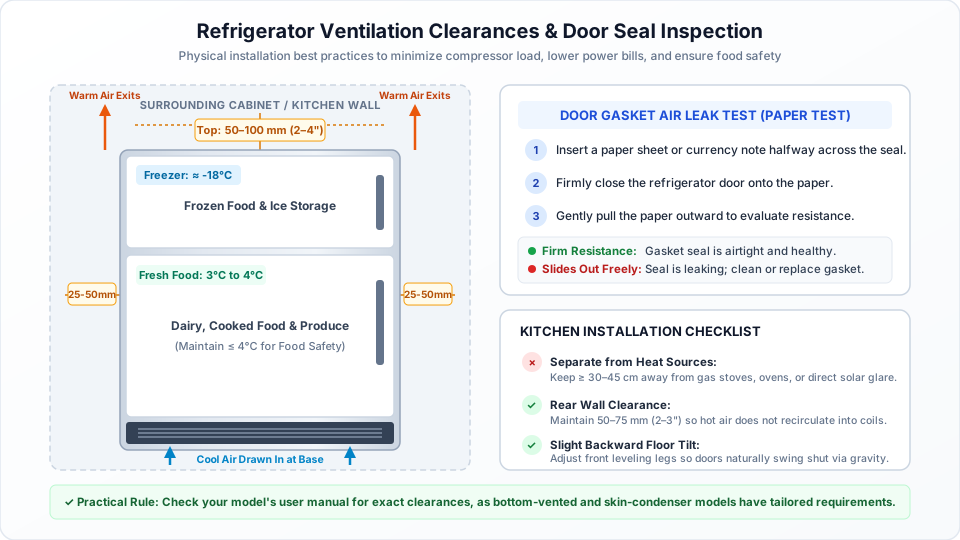
To determine whether your door gasket is leaking, perform the standard paper test:
- Take a standard sheet of printing paper or a crisp paper currency bill.
- Open the refrigerator door, place the paper halfway across the cabinet rim, and close the door firmly onto the paper.
- Gently pull the paper outward:
- Good Seal: You should feel firm, even friction and resistance as you pull the paper out.
- Compromised Seal: If the paper slides out easily with little to no resistance, the magnetic force has weakened or the rubber is distorted.
- Repeat this test every 15 to 20 centimeters (6 to 8 inches) along the entire perimeter of the door, paying particular attention to the corners and the bottom edge, where food spills accumulate and gaps most frequently develop.
Note: The paper test is a quick household screening method rather than a laboratory diagnostic. If condensation, frost streaks, or visible daylight appear through the closed door edge, the seal requires attention.
Gasket Maintenance and Replacement
- Cleaning: Clean gaskets every 2 to 3 months using lukewarm water and a mild dish soap or baking soda solution. Wipe with a microfiber cloth and dry thoroughly. Never use harsh chlorine bleach, petroleum solvents, or abrasive scouring pads, as these dry out the plasticizers in the rubber, causing it to crack and turn brittle.
- Addressing Seal Gaps: If you notice localized gaps or dirt accumulation, inspect the channel for food residues or misaligned tracks. Avoid applying unapproved heat sources such as high-heat dryers directly to the gasket unless specifically instructed by the manufacturer, as excessive heat can permanently warp the vinyl or degrade the door liner.
- Replacement: If the gasket is torn, split, hardened, or mold-infested, replacement gaskets are readily available from manufacturer service centers. Most modern gaskets snap directly into a retaining groove on the door liner, while older models may be secured with retaining screws behind the outer lip.
6. Condenser Coils and Refrigerator Ventilation
The condenser is the component responsible for dumping the heat extracted from inside the refrigerator into the ambient environment. If heat cannot escape efficiently from the condenser, the entire refrigeration cycle suffers.
How Dirt and Dust Degrade Energy Efficiency
Accessible condenser coils naturally attract airborne dust, hair, and kitchen grease over time. As dust accumulates, it forms an insulating blanket over the metal tubing.
When heat cannot dissipate quickly through this insulating dust layer:
- Condensing pressure and temperature rise inside the sealed system.
- The compressor must work against higher back-pressure (head pressure), drawing higher electrical current.
- The compressor takes longer to satisfy the internal thermostat, elevating power consumption and accelerating component wear.
Safe Cleaning Protocol for Accessible Coils
If your refrigerator has exposed coils (either at the back or underneath behind a front toe grille):
- Safety First: Always unplug the refrigerator from the electrical wall outlet before cleaning.
- Accessing Coils:
- Rear-mounted coils: Gently pull the refrigerator outward from the wall.
- Bottom-mounted coils: Pop off the plastic front toe grille at the base of the appliance.
- Cleaning: Use a long, flexible, cylindrical condenser coil brush combined with a vacuum cleaner hose attachment to dislodge and remove accumulated dust and pet fur.
- Frequency: Clean accessible coils once every 6 to 12 months (or every 3 to 6 months in households with indoor dogs or cats).
Reminder: If your refrigerator has internal skin condensers (smooth, warm side panels), do not attempt to dismantle the panels. Keep the exterior sides clean and dusted.
Proper Kitchen Ventilation Clearances
Trapping a refrigerator inside a tightly fitted cabinet enclosure without airflow creates a hot microclimate. As the condenser expels heat, trapped warm air elevates the local ambient temperature, degrading the appliance's heat-exchange capacity.
Always prioritize the clearance specifications printed in your refrigerator's owner manual, as required spacing varies significantly across appliance architectures (built-in bottom-vented models, for example, have very different air channels than freestanding skin-condenser units).
As general illustrative examples:
- Top Clearance: Many freestanding models benefit from approximately 50 to 100 mm (2 to 4 inches) of open vertical clearance to allow rising warm convective air to escape.
- Rear Clearance: An illustrative gap of roughly 50 to 75 mm (2 to 3 inches) between the rear panel and the kitchen wall prevents heat stagnation for rear-exhaust models.
- Side Clearance: A clearance of approximately 25 to 50 mm (1 to 2 inches) on both sides allows convective airflow, which is especially important for refrigerators with side-wall skin condensers.
Practical Rule: Consult your model's installation manual first. If fitting your refrigerator into custom cabinetry, ensure dedicated intake and exhaust ventilation paths are incorporated according to manufacturer design specifications.
Isolating from External Heat Sources
Positioning a refrigerator directly adjacent to heat-emitting kitchen appliances substantially increases thermal loading:
- Cooking Ranges and Ovens: Maintain a physical separation of at least 30 to 45 cm (12 to 18 inches) between the refrigerator and gas stoves, ovens, or dishwashers, or install an insulated barrier panel between them.
- Direct Sunlight: Avoid positioning the refrigerator directly in front of large south- or west-facing windows where intense solar radiant heat strikes the cabinet exterior.
7. Frost Buildup and Defrosting: Direct Cool vs. Frost-Free
Residential refrigerators fall primarily into two engineering categories, each with distinct cooling mechanics, defrosting protocols, and energy consumption characteristics.
| Operational Feature | Direct Cool Refrigerator | Frost-Free Refrigerator |
|---|---|---|
| Primary Cooling Method | Natural convection; cooling coils directly encircle the freezer compartment walls. | Forced-air convection; a concealed evaporator coil circulates chilled air via an internal electric fan. |
| Frost Formation | Moisture freezes directly onto the exposed freezer walls, accumulating as visible ice over time. | Frost accumulates only on the hidden internal evaporator coil behind the rear freezer wall. |
| Defrosting Mechanism | Manual defrosting required (pressing a defrost button or powering off the unit). | Automatic; an electronic timer and heater element melt frost periodically (every 8 to 24 hours). |
| Electrical Consumption Factors | Lower baseline auxiliary consumption (no internal circulation fans or periodic defrost heating elements). | Includes auxiliary loads from continuous air-circulation fans and periodic electric defrost heaters; total energy depends on volume, design, and compressor efficiency. |
| Typical Capacity Range | Typically single-door units (150 to 250 Litres). | Double-door, triple-door, and side-by-side units (200 to 700+ Litres). |
Why Frost Increases Power Consumption in Direct Cool Units
In Direct Cool refrigerators, ice acts as a thermal insulator. When moisture freezes onto the interior cooling walls, it creates a progressive thermal barrier between the refrigerant circuit and the compartment air.
Because heat cannot easily penetrate a dense layer of ice, the thermostat senses a warm cabinet, forcing the compressor to run longer to keep internal temperatures down. Operating a manual-defrost refrigerator with choked ice buildup noticeably increases daily power consumption and reduces cooling effectiveness.
Critical Safety Rules for Defrosting
- When to Defrost: Defrost a manual-defrost refrigerator when frost becomes thick enough to interfere with storage space, door closure, or normal cooling. Follow the manufacturer's recommended defrosting instructions in your user manual.
- Never Use Sharp Tools: Never use a knife, screwdriver, metal scraper, or ice pick to chip away stubborn ice from freezer walls. Evaporator plates are manufactured from soft, thin aluminum tubing. Puncturing an evaporator tube instantly vents the refrigerant gas into the room, renders the refrigerator completely inoperative, requires costly coil replacement, and poses potential safety hazards.
- Safe Manual Defrosting: Press the central defrost button on the thermostat dial or switch the appliance off. Remove perishables into an insulated cooler bag, leave the door open, place a towel to absorb meltwater, and let the ice melt naturally.
- Frost-Free Maintenance: If a Frost-Free refrigerator develops heavy ice on the exterior vents of the freezer back-wall, this indicates a component failure (such as a blown thermal fuse, defective defrost timer, failed bimetal defrost sensor, or burned-out heating element). Do not attempt to force the ice off with hot air guns or knives; contact a qualified technician to service the automatic defrost loop.
8. Everyday Habits That Reduce Refrigerator Electricity Consumption
In addition to component maintenance, everyday user habits directly influence how often the compressor runs. Implementing these evidence-grounded operational practices reduces unnecessary power drain:
- Minimize Door Opening Time:
Decide what you need before opening the refrigerator door. Leaving the door ajar while preparing ingredients dumps the internal air charge, forcing a full cooling cycle. - Refrigerate Hot Leftovers Promptly:
Do not leave cooked food on the kitchen counter until it reaches room temperature. Divide large portions into smaller, shallow containers so they cool faster, and refrigerate them within two hours of cooking (within one hour when the surrounding temperature is above 32°C). Avoid placing a very large, steaming pot directly into the refrigerator; smaller portions help the refrigerator cool food more efficiently without posing food safety hazards. - Maintain Internal Air Circulation Pathways:
Keep the refrigerator reasonably stocked, but leave enough space around food items for cold air to circulate freely. Avoid blocking internal air vents or discharge louvers. Forced-air Frost-Free models rely on unobstructed air channels to distribute cooling evenly. - Avoid Overloading Door Shelves with Heavy Weight:
Storing excessive numbers of heavy two-liter glass or liquid bottles on the door bins can sag the door hinges over time, pulling the upper corner of the magnetic gasket out of alignment and allowing warm air infiltration. - Cover All Liquids and Moist Foods:
Uncovered liquids, open stews, and cut watermelons release moisture into the cabinet air. The compressor and evaporator must work extra hours to condense and freeze this moisture out of the air. Keep all food items sealed in airtight containers. - Avoid Fiddling with Temperature Dials:
Once you establish a stable baseline (3°C to 4°C in the fridge, -18°C in the freezer), leave the settings alone. Constantly adjusting dials between day and night destabilizes the internal thermal mass. - Managing Long Vacations and Absences:
If traveling for several weeks:- On models equipped with a "Holiday / Vacation Mode," activating the feature keeps the freezer frozen while idling or elevating the fresh food compartment to reduce power.
- If emptying and unplugging the unit entirely, always leave the doors propped slightly open to allow air circulation and prevent severe mold, mildew, and foul odors from developing inside the cabinet.
Debunking the Extreme Claim: You may encounter the online tip that "a refrigerator must always be packed tight with water jugs to save electricity." While thermal mass (like chilled food) helps buffer temperature swings during door openings, an over-packed refrigerator restricts convective airflow, creates hot spots, overworks circulation fans, and increases initial cool-down energy. The best practice is to keep the refrigerator reasonably stocked while ensuring clear air channels around containers and avoiding blocked vents.
9. How to Calculate Refrigerator Electricity Consumption
Calculating the real-world operating cost of your refrigerator can be done using two practical methods: estimating from the manufacturer's star label or measuring actual consumption directly using a plug-in energy meter.
Method 1: Estimation from the BEE Star Label
Every certified refrigerator sold in India displays an official Bureau of Energy Efficiency (BEE) label stating its standardized Annual Energy Consumption in kWh/year.
Illustrative Numerical Example:
Suppose you evaluate a typical 260-Litre double-door Frost-Free refrigerator with a BEE Star Label indicating an illustrative annual consumption of 210 kWh/year (this figure serves as an educational example rather than a specific brand's rating). If your residential electricity tariff is ₹8.00 per unit (kWh):
- Daily Consumption: 210 kWh ÷ 365 days = 0.575 kWh/day (roughly half a unit per day)
- Monthly Consumption: 210 kWh ÷ 12 months = 17.50 kWh/month
- Monthly Running Cost: 17.50 kWh × ₹8.00 = ₹140.00 per month
- Annual Running Cost: 210 kWh × ₹8.00 = ₹1,680.00 per year
Practical Context: The annual energy consumption figure on a BEE star label is determined under standardized laboratory testing conditions as specified in relevant national regulations and test standards (such as IS 17550 / IEC 62552). In real-world kitchens, variations in ambient temperature, food loading, and door-opening frequency mean actual home consumption may differ from standardized test results.
Method 2: Direct Measurement Using a Plug-In Energy Meter
To capture the true, dynamic electricity draw of your refrigerator in your specific household environment, use an appropriately rated digital plug-in kWh energy monitor (such as a dedicated socket energy meter or smart power monitoring plug).
Measurement Steps:
- Test Duration: Measure consumption over a minimum of 7 to 14 full days. Because a refrigerator's compressor cycles dynamically in response to grocery shopping days, weekend cooking, and changing day/night temperatures, a single 24-hour reading is insufficient.
- Calculation Example: If the plug meter records a total consumption of 6.30 kWh over 7 full days (168 hours):
- Daily Average: 6.30 ÷ 7 = 0.90 kWh/day
- Monthly Projection: 0.90 × 30 = 27.0 kWh/month
- Monthly Cost (@ ₹8/kWh): 27.0 × ₹8.00 = ₹216.00 per month
Electrical Safety Guidelines for Plug-in Meters:
- Matched Current and Plug Ratings: Compressors draw an inductive inrush surge at startup. Always select a quality energy meter that matches the current rating of your refrigerator's plug and wall socket (typically 6A or 16A depending on the appliance specifications).
- Socket Safety: Avoid using loose travel adapters or underrated multi-plugs to bridge different pin sizes, as poor contact points cause electrical resistance, localized heat buildup, and voltage fluctuations. Follow the meter manufacturer's installation and load instructions carefully.
10. How to Read a BEE Star Label on a Refrigerator
The Bureau of Energy Efficiency (BEE), under the Ministry of Power, Government of India, mandates energy performance star labels on all residential refrigerators sold in the country.
Understanding the information on the label ensures you make an informed decision when evaluating your current appliance or purchasing a new one:
- Star Rating (1 to 5 Stars): The prominent colored stars indicate relative efficiency within that specific product category and applicable label period. A 5-Star unit is the most efficient, while a 1-Star unit represents the minimum allowable energy performance standard under that specific schedule.
- Electricity Consumption (Units/Year): Located prominently in the central panel. This indicates the estimated annual power consumption in kWh/year under standard test conditions. This number allows direct running-cost calculations.
- Appliance Category & Type: Specifies whether the appliance is Direct Cool (Single Door) or Frost-Free (Double/Multi-Door). These categories are tested and rated under different benchmark standards and formulas.
- Total Storage Volume (Litres): Details the gross and net usable capacity, frequently broken down into Fresh Food Storage Volume and Freezer Storage Volume.
- Label Validity Period: Displayed along the bottom of the label. Check the validity period printed on the actual BEE label. The Bureau of Energy Efficiency periodically revises its energy-efficiency criteria, so always use the label applicable to the model and purchase period. A model certified under an earlier validity schedule may have different star-tier criteria compared to the latest standards.
Crucial Consumer Comparison Insight
A fundamental rule of appliance efficiency: Never compare star ratings across different capacity sizes or across different product categories.
- A 5-Star 450-Litre Frost-Free side-by-side refrigerator might consume 280 kWh/year.
- A 3-Star 190-Litre Direct Cool single-door refrigerator might consume 165 kWh/year.
Even though the single-door unit has fewer stars, its total electrical consumption is lower simply because it has less volume to cool, no internal air-circulation fans, and no electric defrost heaters. Always compare star ratings and annual kWh figures between models of comparable storage volume, within the same design category, and certified under the same label validity period. Official regulations and star-rating schedules are maintained on the BEE Standards & Labelling Programme.
11. When Should You Replace an Old Refrigerator?
Refrigerators are durable consumer appliances that frequently operate reliably for many years. However, when an older appliance exhibits high electricity draw or recurring mechanical faults, homeowners must evaluate whether continuing to run it remains cost-effective compared to upgrading to a modern model.
Key Factors When Evaluating an Aging Refrigerator
- Measured High Energy Consumption: Older non-inverter compressors operate with lower mechanical efficiency, and cabinet insulation or door seals can deteriorate over extended use, resulting in elevated energy consumption.
- Compressor Running Abnormally Long: If a refrigerator runs almost continuously even during cooler weather and when lightly loaded, it indicates struggling heat-exchange components or significant thermal leakage.
- Persistent Condensation and Frost: Recurring condensation along external cabinet joints or unmanageable frost buildup often indicates compromised seals or degraded internal insulation.
- Repair Costs vs. Replacement Value: When repair estimates for major components (such as sealed-system leaks or compressor replacements) approach a significant portion of a new refrigerator's price, investing in a new, energy-efficient model with a manufacturer warranty is often the more prudent financial decision.
Techno-Economic Payback Period Formula
To evaluate whether replacing an older refrigerator makes financial sense, apply the simple payback period formula:
Illustrative Case Study (Hypothetical Values):
- Existing Appliance: Hypothetical 14-year-old 250-Litre double-door frost-free refrigerator estimated at roughly 550 kWh/year.
- New Replacement Appliance: Modern 5-Star 250-Litre inverter double-door refrigerator rated at an illustrative 170 kWh/year.
- Net Price of New Refrigerator: ₹26,000 (after applicable exchange discounts).
- Electricity Tariff: ₹8.00 per kWh.
Calculations:
- Annual Electricity Saved: 550 kWh − 170 kWh = 380 kWh/year
- Annual Financial Savings: 380 kWh × ₹8.00 = ₹3,040.00 saved per year
- Simple Payback Period: ₹26,000 ÷ ₹3,040 = 8.55 Years
Practical Decision Factors: If an existing refrigerator continues to operate efficiently and maintains safe food temperatures reliably, replacement solely for electricity savings represents a long-term capital recovery. However, if the appliance faces imminent, costly repairs (such as an out-of-warranty compressor replacement), the cost of avoided repairs can be factored alongside annual electricity savings, significantly altering the economics in favor of a new, warranted unit. Base your decision on measured power consumption, repair history, and overall reliability rather than age alone.
12. Common Refrigerator Energy-Saving Myths vs. Reality
| Popular Energy Myth | Engineering Reality & Practical Advice |
|---|---|
| Myth 1: Turning the temperature dial to the coldest number keeps food better and saves power. | False. Operating below recommended baselines drives up compressor workload, freezes vegetables, and increases power consumption. Safe food preservation requires maintaining ≤4°C in the fresh food section and -18°C in the freezer. |
| Myth 2: A refrigerator should be 100% packed at all times to conserve energy. | Misleading. Moderate food mass helps retain cold air during brief door openings, but an overstuffed refrigerator blocks internal air vents, creates uneven temperature zones, and forces circulation fans to work harder. Keep food reasonably stocked while preserving airflow gaps. |
| Myth 3: Every refrigerator has coils on the back that must be cleaned every year. | Incorrect. Many contemporary models utilize internal "skin condensers" sealed inside the side walls. Cleaning is only applicable to accessible exposed rear coils or bottom-mounted coils behind the toe grille. |
| Myth 4: A 5-Star refrigerator uses less electricity than every 3-Star model on the market. | False. Star ratings only apply within identical capacity, product categories, and label validity periods. A large 5-Star 500-Litre refrigerator consumes substantially more total kilowatt-hours annually than a modest 3-Star 190-Litre single-door unit. |
| Myth 5: If the compressor runs continuously, the refrigerator must be defective. | Context-dependent. On older fixed-speed units, continuous running indicates a fault (leak, open door, failing seal). On modern inverter compressor refrigerators, running continuously at modulated low speeds is the intended design to maintain steady temperatures efficiently. |
13. Frequently Asked Questions (FAQs)
How many electricity units (kWh) does a refrigerator use per day?
A modern energy-efficient single-door Direct Cool refrigerator typically consumes between 0.4 and 0.8 kWh (units) per day. A standard medium-sized (250 to 350 Litre) Frost-Free double-door refrigerator consumes between 0.6 and 1.2 kWh per day. Older refrigerators or large side-by-side multi-door models can consume noticeably more power per day, depending on ambient room temperature, gasket integrity, and usage habits.
What is the ideal temperature setting for a refrigerator and freezer in India?
For the main refrigerator (fresh food) compartment, the ideal food-safe temperature target is 3°C to 4°C (37°F to 40°F). For the freezer compartment, the international benchmark is -18°C (0°F). On analog dials, start with the manufacturer's recommended baseline setting, then verify internal temperature with an appliance thermometer and adjust gradually if needed.
Does opening the refrigerator door frequently increase electricity consumption significantly?
Yes. Every time the door opens, cold, dense air immediately spills out across the kitchen floor and is replaced by warm, moist ambient air. When doors are opened repeatedly or left ajar for extended periods, the compressor must operate for longer pull-down cycles to remove the introduced heat and moisture, noticeably increasing daily electricity usage.
Does a 5-star refrigerator always consume less electricity than a 3-star model?
Only when comparing models within the same category, similar storage volume, and certified under the same label validity period. A 5-Star 450-Litre frost-free refrigerator will consume more total kilowatt-hours annually than a 3-Star 190-Litre direct-cool refrigerator. To determine true operating costs, always compare the absolute Annual Energy Consumption (kWh/year) figure printed on the BEE label.
How often should refrigerator condenser coils be cleaned?
If your refrigerator has accessible condenser coils (either mounted on the exterior rear panel or underneath the cabinet behind a front toe grille), they should be inspected and vacuumed or brushed once every 6 to 12 months (or every 3 to 6 months in homes with pets). If your refrigerator has smooth side panels (internal skin condensers), the coils are sealed inside and do not require physical cleaning.
Does frost buildup in the freezer increase electricity consumption?
In manual-defrost Direct Cool refrigerators, yes. Solid ice acts as a thermal insulator over the cooling plates. When frost accumulates excessively, it impedes heat transfer from the food compartment to the refrigerant, forcing the compressor to run longer and increasing power consumption. Manual-defrost refrigerators should be defrosted whenever frost begins encroaching on storage space, affecting door closure, or according to the manufacturer's recommended guidelines.
Is an inverter compressor refrigerator truly more energy-efficient than a non-inverter model?
Yes. Variable-speed inverter compressors adjust their operating speed dynamically to match actual cooling demand, avoiding the high inrush starting current and inefficient on-off cycling of traditional compressors. Under comparable operating conditions with varying thermal loads, an inverter refrigerator can use significantly less electricity while maintaining steadier temperatures.
How can I measure my refrigerator's actual electricity consumption at home safely?
The most reliable method is to plug the refrigerator into a digital plug-in energy meter (kWh monitor) that matches the electrical rating of the appliance and wall socket. Leave the meter connected for at least 7 to 14 consecutive days to record a representative average across grocery loading cycles and ambient temperature shifts. Divide the total measured kWh by the number of test days to obtain your true daily average, and multiply by 30 to project monthly consumption.
14. References and Authoritative Resources
- Bureau of Energy Efficiency (BEE), Ministry of Power, Government of India: Standards and Labelling Programme – Regulatory Overview and Appliance Schedules. beeindia.gov.in/show_content.php?lang=1&level=1&lid=322&ls_id=198
- Bureau of Energy Efficiency (BEE), Ministry of Power: BEE (Particulars and Manner of their Display on Label of Household Direct Cool and Frost-Free Refrigerators) Regulations and Schedules. beeindia.gov.in
- ENERGY STAR (U.S. EPA & DOE): Energy-Efficient Refrigerators: Purchasing Guidance, Configurations, and Product Specifications. energystar.gov/products/refrigerators
- U.S. Food and Drug Administration (FDA): Refrigerator Thermometers: Cold Facts about Food Safety. fda.gov/food/buy-store-serve-safe-food/refrigerator-thermometers-cold-facts-about-food-safety
- Centers for Disease Control and Prevention (CDC): Food Safety in the Kitchen – Preventing Food Poisoning and Safe Refrigeration Guidelines. cdc.gov/food-safety/prevention/