
Freshwater scarcity, depleting underground aquifers, and soaring municipal water tanker expenses have made sustainable water management one of the most critical challenges for modern residential homes. While clean energy technologies such as rooftop solar capture solar irradiance to displace fossil grid power, rooftop rainwater harvesting (RWH) intercepts natural precipitation before it is lost to urban runoff, turning an otherwise wasted seasonal deluge into an invaluable freshwater asset.
Despite its intuitive simplicity, a durable and hygienic residential rainwater harvesting system requires sound hydraulic engineering. Intercepting rainfall from an exposed rooftop, separating the initial soot-laden wash, filtering out suspended sediments, and directing clean water into an airtight storage cistern or subterranean aquifer recharge pit involves specific design principles.
This guide provides an evidence-based, practical roadmap to residential rooftop rainwater harvesting. We cover the core components, step-by-step working mechanics, a rigorous comparison between storage cisterns and groundwater recharge structures, sizing calculation formulas, water safety standards, seasonal maintenance protocols, and common installation pitfalls.
1. What Is Rooftop Rainwater Harvesting?
Rooftop Rainwater Harvesting (RWH) is the intentional collection, conveyance, filtration, and retention of rainwater that falls directly onto the roof surfaces of residential, commercial, or institutional buildings. Instead of allowing precipitation to drain away as uncontrolled surface runoff, the captured water is directed either into:
- Surface or Underground Storage Tanks (Cisterns) for direct, non-potable (or treated potable) household consumption.
- Artificial Groundwater Recharge Structures (recharge pits, trenches, or injection shafts) to replenish local aquifers and stabilize falling water tables where soil and hydrogeological conditions permit.
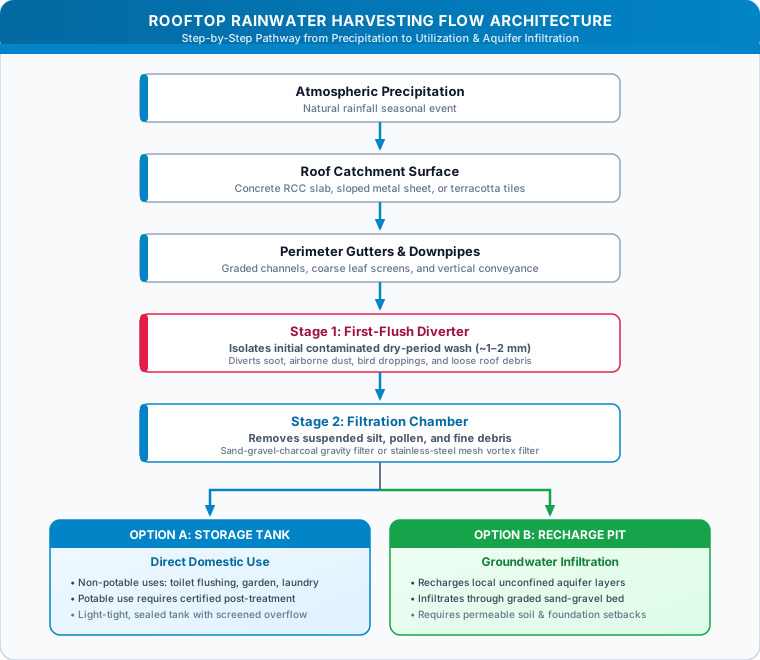
Rainwater Harvesting vs. Conventional Stormwater Drainage
A critical conceptual distinction exists between conventional urban stormwater drainage and an engineered rainwater harvesting system:
| Evaluation Parameter | Conventional Stormwater Drainage | Engineered Rainwater Harvesting System |
|---|---|---|
| Primary Objective | Rapidly convey storm runoff away from pavements, foundations, and roads to mitigate localized flooding and structural water damage. | Retain, filter, and preserve rooftop runoff on-site for immediate non-potable household utility or sub-surface aquifer replenishment. |
| Water Quality Outcome | Water flows across ground-level paved surfaces where it frequently picks up soil silt, road dust, and urban debris, making direct domestic reuse impractical without extensive municipal treatment. | Runoff is intercepted directly from elevated roof catchments, minimizing ground-level contamination, though roof-level residues and atmospheric particulates still require preliminary diversion and filtration. |
| Environmental Impact | Discharges peak stormwater volumes into urban drains, which can contribute to downstream drainage congestion during cloudbursts. | Mitigates peak stormwater surge volumes, helps reduce urban runoff peaks, and aids localized groundwater recharge where hydrogeology allows. |
| Household Economic Value | Municipal flood-management infrastructure; provides no direct non-potable water supply for the individual household. | Can offset domestic utility water consumption, reduce pumping from deep wells, and lower reliance on seasonal water deliveries. |
2. Main Components of a Home Rainwater Harvesting System
A residential rainwater harvesting system functions through an interconnected sequence of physical subsystems: water flows from the elevated Roof Catchment Surface, through perimeter Gutters & Downpipes, passes an automated First-Flush Diverter to discard dry-period residues, moves through a multi-stage Filtration Chamber, and finally arrives at a dedicated Clean Storage Tank or Groundwater Recharge Structure.
1. Roof Catchment Surface
The roof acts as the initial catchment surface. The hydraulic efficiency and initial purity of runoff depend significantly on the roofing material, slope, surface condition, and design assumptions:
- Reinforced Cement Concrete (RCC) Flat Slabs: Common in urban residential buildings. Published technical manuals model concrete roofs differently depending on slope, texture, and absorption assumptions: residential guides frequently use planning ranges between 0.70 and 0.80, while some engineering and green-design manuals cite values up to 0.90 to 0.95 for smooth, dense finishes. Because flat terraces are often accessible for household activities, regular sweeping helps remove surface dust and soot.
- Sloped Galvalume / Coated Metal Sheets: Frequently used in modern villas, utility sheds, and sloped canopies. Smooth, non-porous metal sheets typically exhibit high runoff planning ranges (0.80 to 0.90), generate low surface friction, and wash clean quickly during rainfall.
- Clay / Terracotta Pitched Tiles: Traditional aesthetic roofing typically modeled in technical literature with approximate planning ranges between 0.70 and 0.85. While chemically inert, unglazed clay tiles are slightly porous and can harbor moss or algae in shaded corners, increasing filtration load.
2. Gutters and Conveyance Downpipes
Gutters channel horizontal runoff along roof edges toward vertical downpipes:
- Gutter Materials: Heavy-duty UV-stabilized UPVC, seamless powder-coated aluminum, or galvanized mild steel (GI). Avoid unplasticized thin PVC gutters that warp or crack under prolonged summer UV exposure.
- Sizing and Slope: Common residential installations often utilize 100 mm to 150 mm (4 to 6 inches) gutter profiles with a recommended gradient of 1:100 to 1:200 (a 5 mm to 10 mm drop per meter of horizontal length) toward downpipes to prevent standing water and silt settlement. These dimensions serve as general residential design benchmarks rather than universal rules. Engineering standards (such as the National Building Code of India) require sizing gutters and downpipes according to the tributary roof catchment area and local peak rainfall intensity (e.g., 50 mm/hr to 100 mm/hr during intense monsoon cloudbursts). Undersized gutters or too few downpipes cause hydraulic backpressure, causing gutters to overtop during heavy downpours and wasting potential harvest.
- Bracket Spacing: Heavy rainfall adds significant dynamic weight. Support brackets are typically anchored into masonry or fascia boards at regular intervals (commonly every 0.8 to 1.0 meters, or closer in high-wind regions) to prevent sagging when full.
3. Leaf Screen and First-Flush Diverter
Before water reaches filtration, preliminary screening and diversion minimize macroscopic debris and initial dry-period residues:
- Gutter Leaf Guard: A coarse wire mesh or perforated gutter guard installed at downpipe drop inlets to intercept dead leaves, twigs, and nesting materials.
- First-Flush Diverter: During extended dry spells, atmospheric particulates, vehicle exhaust soot, bird droppings, and loose roof dust accumulate on the catchment. The initial rainfall wash carries the highest concentration of these surface residues.
- Planning Estimate & Realistic Volume: Diverting approximately the first 1 to 2 mm of rainfall (roughly 1 to 2 liters per square meter of roof catchment) is widely cited in technical literature as an illustrative preliminary planning baseline. However, this is not a universal fixed rule: actual diversion volume must be adapted to roof cleanliness, antecedent dry days, roofing material texture, and local atmospheric pollution levels.
- Worked Volume Calculation: Consider a typical 100 m² (approx. 1,076 sq ft) roof catchment. An initial rainfall wash of 1 mm mathematically equates to roughly 100 liters of initial runoff before absorption losses (or ~111.5 liters for a 1,200 sq ft / 111.5 m² roof). Because a standard 110 mm (4-inch) vertical PVC standpipe holds approximately 9.5 liters per linear meter of pipe, a single pipe cannot store a 100-liter first flush. When homeowners install multiple downpipe diverters (for example, four 20-liter standpipes totaling 80 liters), this provides approximately 0.72 mm of preliminary diversion depth across an 111.5 m² roof—useful for initial rinsing, but short of a full 1.0 mm diversion unless larger standpipe diameters (such as 160 mm pipe) or a centralized diversion box are installed. The selected diversion volume must balance water conservation against desired initial cleaning depth.
- Diverter Configurations: A common mechanical design uses a vertical standpipe with an internal floating ball: as initial dirty runoff fills the column, the ball rises until it seats against an upper rubber gasket, routing subsequent cleaner flow to the filter. A slow-drain trickle valve or cleanout plug allows the diverted chamber to empty slowly over 24 hours, resetting the system for subsequent showers.
4. Filtration Chamber
Rainwater exiting the first-flush diverter still contains fine suspended sediments, pollen, and microscopic particulate matter. A dedicated filtration unit removes these suspended solids:
- Layered Sand-Gravel-Carbon Gravity Filter: A traditional multi-layer chamber containing:
- Base layer: Coarse river gravel (drainage layer).
- Middle layer: Pea gravel followed by a layer of Certified Granular Activated Carbon (GAC). Technical Note on Charcoal vs. Activated Carbon: Traditional masonry filter guides often casually prescribe "crushed charcoal." However, ordinary wood charcoal has low internal surface area (< 200 m²/g), irregular pore distribution, and rapidly saturates. In contrast, certified virgin granular activated carbon (GAC, commonly coconut-shell derived) features typical product-specification surface areas exceeding 1,000 m²/g and iodine numbers of 900 to 1,050 mg/g. These properties enable adsorption of many dissolved organic odors, chlorine byproducts, and certain volatile compounds. However, GAC is not a universal barrier: it does not eliminate all agrochemicals, heavy metals, or dissolved inorganic salts, and its performance depends strictly on carbon grade, bed depth, flow velocity, and Empty Bed Contact Time (EBCT). Spent carbon must be periodically replenished, as exhausted media loses adsorption capacity and can harbor bacterial biofilm.
- Top layer: Clean coarse silica sand (traps fine suspended solids and silt).
- Modular Stainless Steel (SS) Mesh / Pop-Up Filters: Contemporary compact wall-mounted filters utilizing stainless steel wire mesh cartridges (typically 100 to 200 microns). Many incorporate centrifugal vortex action that flushes heavy grit toward a waste port while directing clear water into the storage line. These require significantly less physical footprint than masonry sand beds.
5. Clean Water Storage Cistern or Recharge Structure
The filtered water arrives at its terminal destination:
- An Above-Ground or Sub-Surface Storage Tank: Must be protected from direct sunlight to inhibit algae growth, tightly sealed against dust and insects, constructed from non-toxic water-safe materials, and fitted with screened air vents and overflow traps.
- An Artificial Groundwater Recharge Structure: Engineered to infiltrate water safely into permeable sub-soil strata without causing localized saturation or structural foundation instability.
3. How the System Works Step by Step
The operational sequence of a properly designed rooftop rainwater harvesting installation follows five clear, sequential phases:
- Precipitation Interception: Rain falls upon the roof catchment surface, collecting atmospheric moisture while washing away loosely bound surface dust.
- Gutter Collection and Conveyance: Water flows by gravity into perimeter gutters, passes through coarse leaf guards, and travels down vertical downpipes toward ground level.
- Automated First-Flush Separation: The initial wash (estimated based on roof size and antecedent dry periods, typically around 1 to 2 mm of rainfall depth) fills the primary first-flush diverter chamber. The diverter seals its intake once full, locking the dirty wash away from the main supply line.
- Fine Filtration: Clean subsequent runoff passes through the sand-gravel bed or stainless-steel mesh filter cartridge, cutting turbidity and capturing suspended particulates.
- Storage Retention or Aquifer Infiltration: Clarified water enters the storage cistern through a calmed inlet (which prevents stirring bottom sediments) or routes toward a permeable recharge structure to replenish local groundwater reserves.
4. Storage Tank vs. Recharge Pit: In-Depth Comparison
A fundamental design decision is whether to store harvested rainwater for direct domestic consumption or infiltrate it into the ground. Once water passes through primary filtration, homeowners evaluate two distinct destinations based on property requirements:
- Option A: Clean Storage Tank (Direct Use): Captures filtered rainwater for direct domestic applications such as laundry, toilet flushing, and garden landscaping, offsetting daily municipal water consumption.
- Option B: Groundwater Recharge Pit (Aquifer Infiltration): Routes filtered water directly into sub-surface permeable layers to help replenish the local water table where geological conditions permit.
Many modern residential layouts combine both into a dual-stage setup, where filtered water fills the storage cistern first and surplus overflow routes to an auxiliary recharge pit.
Detailed Functional Differences
Storage Tank (Direct Household Use)
- Primary Function: Provides immediate access to collected water for domestic utility applications (laundry, toilet flushing, landscaping, evaporative cooling, and vehicle washing). While rainwater is typically low in dissolved minerals compared to deep groundwater, actual water characteristics and mineral content depend on the roof material, surface residues, and atmospheric conditions.
- Physical Characteristics: Requires above-ground food-grade polyethylene (HDPE/LLDPE) rotational tanks, prefabricated fiberglass (FRP) cisterns, or underground RCC masonry sumps.
- Operational Constraint: Storage capacity is finite. Once a 3,000-liter or 10,000-liter tank fills during an intense monsoon downpour, all surplus runoff must be safely diverted to overflow drains or an auxiliary recharge structure.
Recharge Pit (Groundwater Aquifer Infiltration)
- Primary Function: Infiltrates harvested water to replenish unconfined sub-surface aquifers, counteracts cone-of-depression drawdowns around residential borewells, and helps stabilize the local water table.
- Physical Characteristics: An excavated pit, trench, or recharge shaft lined with porous masonry or perforated concrete rings, backfilled with graded filter media (such as boulders, coarse gravel, pea gravel, and coarse river sand). In accordance with Central Ground Water Board (CGWB) technical manuals, recharge structure design must never rely on arbitrary, universal pit dimensions. Instead, structure volume and surface area are calculated based on tributary catchment area, peak design rainfall intensity, and the infiltration capacity of underlying soil strata.
- Operational & Safety Constraints: Highly dependent on local hydrogeology. Recharge structures require permeable soils (sandy loam, fractured rock, alluvial silt) and an adequate unsaturated vadose zone above the water table. In impermeable heavy clay soils, natural percolation can be too slow for a conventional recharge pit, requiring specialized drainage designs, larger infiltration areas, or alternate stormwater management solutions depending on site conditions. Crucially, required setbacks (to avoid sub-grade soil saturation, reduced bearing capacity, or interference with shallow septic absorption fields) and recharge-pit dimensions must be verified against applicable local regulations, site hydrogeology, and advice from a qualified professional.
Comparative Evaluation Table
| Design Parameter | Dedicated Storage Cistern (Tank) | Groundwater Recharge Pit |
|---|---|---|
| Primary Beneficiary | Individual household (immediate water self-sufficiency). | Immediate household borewell and surrounding community aquifer. |
| Direct Utility Savings | Immediate reduction in municipal water bills and tanker deliveries. | Indirect: aids local aquifer replenishment under suitable hydrogeological conditions; specific borewell water levels and pumping performance depend on regional groundwater dynamics. |
| Capacity Limitation | Strictly limited by tank volume (e.g., 2,000 L to 15,000 L). | Intake capacity governed by soil percolation rate and filter surface area; requires an engineered overflow path for cloudbursts. |
| Footprint & Space | Requires dedicated terrace, backyard, or underground space. | Sub-surface footprint; surface area can be landscaped or covered with a reinforced manhole slab. |
| Capital Expenditure (CapEx) | Moderate to High (tanks, structural foundations, automated booster pump, dual plumbing). | Low to Moderate (excavation, porous concrete rings, graded filter gravel). |
| Hydrogeological Dependency | Completely independent of soil type or water table depth. | Critically dependent on permeable soil permeability and unconfined aquifer characteristics. |
| Water Availability Timing | Available on demand throughout dry periods until stored volume is exhausted. | Recharges subterranean reserves; requires extraction via a borewell or open well. |
| Maintenance Demands | Regular tank desludging, vent mesh inspections, and pump servicing. | Periodic inspection of inlet silt traps and cleaning or replacement of filter media based on silt accumulation and runoff quality. |
5. Rainwater Harvesting Potential: Calculation Formulas & Sizing
How much water can a home realistically collect? The theoretical and practical yield can be calculated using the standard empirical runoff formula.
The Annual Harvesting Equation
Harvesting potential is calculated using the standard empirical runoff formula widely referenced in civil engineering frameworks:
Where:
- Area (A, in m²): Total horizontal projected catchment area of the roof (convert square feet to square meters by dividing by 10.764).
- Rainfall (R, in mm): Average annual precipitation of your local geographic region.
- Runoff Coefficient (C): This factor estimates how much rainfall runs off a roof and reaches the collection system. Its value depends on the roof material, surface condition, slope, and design assumptions. Published technical manuals use different coefficients, so select a value from a suitable local design reference rather than treating one figure as universal. The estimate should also account for collection losses separately where appropriate. Approximate planning ranges cited across engineering references include:
- Concrete RCC Flat Roof: Frequently modeled between 0.70 and 0.80 in general residential guides, while some engineering and green-building manuals use values up to 0.90 to 0.95 for dense, smooth finishes.
- Corrugated Metal / Galvalume: Typically 0.80 – 0.90.
- Clay Roof Tiles: Typically 0.70 – 0.85.
- System Efficiency Factor (E): Accounts for first-flush diversion waste, gutter splash losses, and filter screen rejection. Typically taken as 0.80 to 0.85 (80% to 85%) in preliminary sizing models.
Practical Worked Calculation: Theoretical Potential
Consider a typical detached single-family home with the following specifications:
- Roof Surface: RCC Flat Slab of 1,200 sq ft ≈ 111.5 m²
- Location: City with an average annual rainfall of 900 mm
- Runoff Coefficient (C): 0.80 (Standard planning estimate for flat concrete)
- Collection & Filter Efficiency (E): 0.85
Calculating step-by-step:
Theoretical Yield = 111.5 × 900 × 0.68 = 68,238 Liters per Year
Crucial Distinction: Theoretical Potential vs. Usable Household Supply
While the empirical equation yields 68,238 liters per year, it is critical to recognize that this represents gross theoretical collection potential, not the actual volume of water a household will realistically utilize.
In monsoon-influenced regions, rainfall is often concentrated in a few months, but the timing and intensity vary by location and year. Use local rainfall records to estimate how much water can be collected and how much storage capacity is practical.
Consequently, usable water is constrained by three physical factors:
- Finite Cistern Capacity: A storage tank holds a finite volume at any given time. A typical residential cistern (often sized between 5,000 and 10,000 liters) may fill rapidly during heavy downpours; subsequent runoff from ongoing storms will overflow into storm drains or recharge structures unless domestic demand is continuous or auxiliary storage is provided.
- Timing of Household Demand: Household water needs occur daily, whereas rainfall occurs in episodic events. The volume of rainwater actually utilized depends on whether domestic consumption coincides with or rapidly follows collection periods.
- First-Flush Rejection: Initial runoff following dry periods carries accumulated catchment dust and residues, and must be diverted away from clean storage.
Illustrative Residential Case Study: 1,200 sq ft RCC Terrace in Gujarat (Western India)
To understand how rooftop rainwater harvesting principles translate from empirical formulas into practical household water management, consider this illustrative engineering planning model for a typical detached home. (Note: This scenario presents an illustrative design calculation based on regional meteorological benchmarks, not an audited meter study of a specific home).
- Site & Catchment: A two-story independent home featuring a 1,200 sq ft (~111.5 m²) accessible flat RCC terrace.
- Meteorological Benchmark: Assuming an illustrative annual precipitation of 780 mm, reflective of regional meteorological averages (for context, CGWB district groundwater publications cite a long-term average annual normal rainfall of approximately 799.6 mm for Ahmedabad district, with over 90% falling across the southwest monsoon from late June through September).
- Gross Harvesting Potential:Gross Potential = 111.5 m² × 780 mm × 0.78 × 0.85 ≈ 57,660 Liters per Year
- Installed System Architecture:
- Catchment divided into four 110 mm downpipes, each equipped with a 20-liter vertical first-flush diverter (total 80 liters preliminary diversion capacity). Note on diverter capacity vs. volume: For an 111.5 m² roof, diverting a full 1.0 mm rainfall depth requires ~111.5 liters before surface absorption losses. An 80-liter diverter setup therefore provides approximately 0.72 mm of preliminary diversion depth—a practical compromise for routine roof dust rinsing, though achieving a full 1.0 mm wash would require expanding standpipe dimensions (e.g., four ~28-liter standpipes or a centralized ~115-liter chamber).
- Compact wall-mounted stainless-steel pop-up filter (120-micron mesh).
- An 8,000-liter underground RCC sump lined with food-grade waterproof epoxy, connected to an automated 0.5 HP booster pump feeding dedicated plumbing lines for 3 toilet flush cisterns and 2 garden bib taps.
- A high-level overflow pipe routing excess monsoon water into an on-site groundwater recharge pit (sized according to local soil percolation rates and designed with appropriate structural setbacks verified by a qualified engineer).
How the Collected Water May Be Used
The estimated annual yield is not the same as the volume a household can store or use. Actual results depend on rainfall timing, first-flush losses, roof and gutter performance, tank capacity, household demand, and the infiltration capacity of any recharge structure.
For example, an 8,000-liter tank can hold up to 8,000 liters at a time, but the annual volume supplied to household fixtures may be higher if the tank refills several times over the rainy season. Conversely, water overflowing into a recharge structure should not be counted as successfully recharged groundwater unless the system's infiltration performance and local sub-surface conditions have been assessed.
Treat the figures in this example as planning estimates, not guaranteed annual savings or measured recharge volumes. Actual utility bill or tanker expense reductions depend on local water tariffs, commercial tanker rates, and real-world household consumption patterns.
6. Maintenance Checklist and Troubleshooting Common Problems
Neglected rainwater harvesting systems quickly become breeding grounds for mosquitoes, harbor unpleasant odors, or clog entirely during the first heavy shower. A systematic seasonal maintenance schedule ensures long-term performance.
Seasonal Maintenance Schedule
1. Pre-Monsoon Preparation (May – June)
- Catchment Cleaning: Thoroughly sweep and wash the roof surface to remove accumulated dust, soot, and bird droppings before the first seasonal shower.
- Conveyance Inspection: Clear leaves, twigs, and silt from gutters and downpipe drop heads. Ensure all mounting brackets are securely anchored.
- First-Flush Servicing: Inspect the first-flush diverter, clear the slow-drain orifice, and clean out any residual sediment from the bottom cleanout plug.
- Filter Preparation: Clean or replace stainless-steel filter mesh cartridges, or remove and wash the top coarse sand layer in masonry gravity filters.
2. Monsoon Operation & Routine Monitoring (July – September)
- Diverter Function: Check the first-flush mechanism after major downpours to ensure it seats properly and drains freely.
- Filter Rinsing: Rinse and backwash stainless-steel filter screens every 2 to 4 weeks during peak rainfall to prevent flow restriction.
- Overflow Pathways: Verify that storage tank and recharge pit overflow outlets discharge freely without pooling near foundations.
3. Post-Monsoon Winterization & Inspection (October – November)
- Chamber Desludging: Drain and clean any residual silt and sludge from the first-flush standpipe.
- Vent Screens: Inspect fine corrosion-resistant wire mesh on tank air vents and overflow pipes to maintain insect-proof protection.
- Sediment Assessment: Inspect the storage cistern floor for fine sediment deposition and plan periodic desludging as needed based on local silt load.
Common Problems and Remedial Actions
- Foul Swampy Odor or Discoloration:
- Cause: Organic matter (leaf rot, bird droppings) entering the tank and undergoing anaerobic decomposition in bottom sediment layers.
- Fix: Ensure the first-flush diverter is operating and draining properly between storms. Install a calmed inlet (an upturned curved elbow at the tank bottom) so incoming water enters smoothly without resuspending existing sediment.
- Mosquito Breeding in the Cistern:
- Cause: Missing or damaged air vent screens, loose manhole lids, or an open overflow line without a non-return flap valve.
- Fix: Seal all tank inspection manhole lids with rubber gaskets. Fit all air vents and overflow pipes with corrosion-resistant fine wire mesh (such as Grade 304 stainless steel mesh) and install a non-return flap or water trap on overflow outlets.
- Severe Gutter Overflow During Cloudbursts:
- Cause: Gutter cross-section is undersized for local cloudburst intensity, downpipe drop points are too few or spaced too far apart, or leaf guards are clogged.
- Fix: Add intermediate downpipe drop points to reduce tributary catchment area per downpipe, clear gutter guards, and ensure gutters maintain a consistent fall toward outlets.
- Algae Proliferation Inside the Tank:
- Cause: Sunlight penetration through translucent or semi-white polyethylene tank walls, fueling photosynthetic microalgae blooms.
- Fix: Ensure the storage tank is completely protected from direct sunlight—by choosing UV-stabilized opaque tanks or underground masonry tanks with completely light-sealed covers.
7. Water Quality, Filtration Standards, and Drinking Safety
One of the most dangerous misconceptions regarding rainwater harvesting is the belief that because rainwater is naturally distilled from clouds, it is instantly pure and safe to drink straight from a basic mesh filter.
Contaminants in Untreated Harvested Rainwater
Even after preliminary physical filtration, harvested rooftop water frequently carries hazardous impurities:
- Microbiological Pathogens: Bird droppings, rodent feces, and animal tracks on roofs harbor virulent pathogenic organisms, including Escherichia coli (E. coli), Salmonella, Campylobacter, and protozoan cysts such as Cryptosporidium and Giardia. Standard mesh or sand filters do not reliably eliminate microscopic pathogens.
- Atmospheric Pollutants & Chemical Fallout: As rain falls through urban or industrial airsheds, droplets absorb airborne sulfur dioxide (SO₂), nitrogen oxides (NOₓ), vehicle exhaust particulates, and industrial chemical traces. In agricultural fringes, aerial drift deposits pesticide and herbicide residues onto roof surfaces.
- Heavy Metals & Leached Compounds: Metal flashings, lead-soldered gutters, degraded roofing sheets, or asphalt coatings can leach trace heavy metals (lead, zinc, copper) into runoff. Standard carbon and sediment filters do not eliminate heavy metals or dissolved mineral ions.
The Potable Purification Pathway: Why UV and Carbon Are Not a Magic Bullet
To treat stored rainwater to potable standards, a multi-barrier treatment train must address physical particles, dissolved chemical residues, and microbiological pathogens in progressive sequence:
- Sediment and Particulate Filtration: Sub-micron or multi-stage sediment cartridges help clarify water and reduce turbidity. However, their ability to trap microscopic cysts or parasites depends strictly on the filter's tested specification (such as absolute vs. nominal micron ratings and recognized third-party performance certifications). Coarse sediment filtration alone cannot inactivate viruses or dissolved chemicals.
- Activated Carbon Block Filtration: Granular activated carbon (GAC) or solid carbon block cartridges adsorb many volatile organic compounds (VOCs), pesticides, atmospheric chemical residues, and objectionable odors. However, standard carbon filters do not remove all dissolved minerals, fluorides, nitrates, or dissolved heavy metals.
- Disinfection (UV or Thermal): Properly sized and validated Ultraviolet (UV) disinfection reactors can inactivate bacteria and viral pathogens by disrupting cellular nucleic acids. Efficacy depends heavily on water clarity (as suspended turbidity shields microorganisms from UV rays), flow rate, and reactor lamp maintenance. UV light provides zero chemical filtration and does not alter heavy metal toxicity. Boiling can neutralize microbiological risks, but it similarly concentrates non-volatile chemical contaminants.
- Site-Specific Testing and Tailored Treatment: Simply assembling a sediment cartridge, carbon filter, and UV lamp does not guarantee safe potable water across all catchments. In accordance with public health guidance from the World Health Organization (WHO) and the CDC, rainwater can harbor diverse biological pathogens and chemical pollutants. Prior to drinking, water must be tested by an accredited laboratory against statutory standards, such as BIS IS 10500:2012 in India. If specific contaminants (such as heavy metals, agrochemicals, or excessive dissolved solids) are identified, appropriate treatment technologies—such as certified membrane processes or ion exchange—must be engineered based on verified laboratory test results.
8. Common Installation Mistakes to Avoid
Even high-grade components can fail if system geometry and hydraulic layout are flawed. Avoid these common installation errors:
- 1. Omitting the First-Flush Diverter: Relying solely on a mesh filter without an automated first-flush bypass allows dissolved bird feces and roof soot to enter storage. This degrades water quality and clogs filter cartridges prematurely.
- 2. Installing Unscreened Overflow Pipes: Connecting tank overflow lines directly to an open garden or stormwater drain without a fine corrosion-resistant mesh screen or a water-trap air gap allows insects, roaches, and rodents to enter clean water storage.
- 3. Undersized Guttering and Downpipe Geometry: Choosing undersized downpipes or gutters for a given roof area and local rainfall intensity causes water to back up and overtop gutters during monsoon cloudbursts, wasting potential yield.
- 4. Inadequate Setbacks Near Foundations and On-Site Sanitation: Siting a groundwater recharge structure too close to structural footings risks sub-grade soil saturation, reduced bearing capacity, or differential settlement. Conversely, locating a recharge pit too close to septic soakaways risks contaminating local groundwater reserves with biological pathogens or nitrates. In accordance with Central Ground Water Board (CGWB) technical design principles, recharge structures must be engineered for site-specific conditions. Required setbacks and recharge-pit dimensions must be verified against applicable local regulations, site hydrogeology, and advice from a qualified professional.
- 5. Directing Untreated Runoff into Borewells: Directing untreated rooftop runoff into a borewell can introduce sediment and contaminants into the groundwater system and may damage the recharge arrangement. Do not use an existing borewell as a recharge route unless the design complies with applicable regulations and has been assessed by a qualified groundwater professional.
9. Installation Cost Factors and Economic Considerations
Rainwater harvesting is a site-specific infrastructure investment. Total project expenditure varies widely depending on property layout, roof area, and structural choices.
Key Cost Drivers
- Storage Tank Construction: Above-ground triple-layer polyethylene (HDPE) tanks typically have lower material and installation expenses. Custom underground reinforced concrete (RCC) sumps offer superior durability and preserve outdoor yard space, but involve significant structural excavation, masonry, shuttering, waterproofing, and labor costs.
- Earthwork and Excavation: Soil profile, presence of subsurface rock strata, and local groundwater table depth directly dictate excavation machinery and labor costs for underground cisterns or recharge pits.
- Filtration Technology: Simple DIY masonry sand-gravel filters carry modest material costs but require physical yard footprint. Commercial self-cleaning stainless-steel vortex pop-up filters carry higher upfront equipment costs but require minimal space and lower routine maintenance.
- Plumbing and Conveyance Routing: Retrofitting an existing multi-story home often requires external UPVC downpipe drops, horizontal collection headers, trenching, and bypass valves. Incorporating RWH during new building construction reduces plumbing costs significantly.
- Pumping and Distribution: Gravity-fed garden taps require no pumping power. Pressurizing a domestic dual-plumbing network (supplying dedicated toilet flush lines and washing machines) requires an automatic booster pump and pressure controller.
- Local Labor and Masonry Rates: Regional civil construction wages, plumbing rates, and transport logistics vary across urban, peri-urban, and rural areas.
Economic Considerations and Payback
In urban centers with seasonal municipal water cuts or reliance on private water tankers, a properly sized residential rainwater storage system can provide substantial utility savings by reducing dependence on external water supplies. However, financial payback is highly household-specific: it depends on actual local rainfall distribution, storage capacity, household consumption, and prevailing water tanker or utility tariff rates. Rather than relying on generic payback estimates, homeowners should obtain detailed, itemized quotations from local contractors and evaluate their actual seasonal water expenses.
10. India-Specific Regulations and Guidelines
In India, rapid groundwater depletion has led to evolving rooftop rainwater harvesting frameworks. Because statutory requirements and enforcement vary widely by state, urban local body, and local building bye-laws rather than following a single uniform national code, property owners should review applicable local rules:
- Central Ground Water Board (CGWB) Directives: The Central Ground Water Board (CGWB), under the Ministry of Jal Shakti, publishes official technical manuals for artificial recharge to groundwater, categorizing assessment units into Safe, Semi-Critical, Critical, and Over-Exploited zones. In stressed areas, rainwater harvesting and groundwater recharge are key statutory mandates.
- Bureau of Indian Standards (BIS) Guidelines:
- IS 15797:2008 — Roof Top Rainwater Harvesting: Guidelines (PDF): Provides technical guidance on rooftop rainwater harvesting, including collection, conveyance, filtration, and storage arrangements.
- IS 10500:2012 — Drinking Water Specification (PDF): Describes drinking-water quality requirements, including physical, chemical, and microbiological parameters. Harvested rainwater intended for drinking should be appropriately treated and tested against applicable drinking-water quality requirements.
- Model Building Bye-Laws & Municipal Mandates:
- India's Model Building Bye-Laws, 2016 include rainwater-harvesting provisions for plots of 100 m² or more. These model provisions are intended for adoption by states and local authorities, so the applicable threshold, approval requirements, and enforcement should be verified with the relevant municipal or urban development authority.
- Individual states and urban local bodies (such as BWSSB in Bengaluru, CMWSSB in Chennai, and municipal corporations across Gujarat, Maharashtra, and other states) formulate their own specific statutory bye-laws, plot thresholds, and property tax rebate incentives. Always verify the prevailing bylaws of your local municipality.
11. Frequently Asked Questions (FAQs)
Does rainwater harvesting work during light rain or drizzle?
Yes, but the efficiency depends on the catchment slope and roof material. During light drizzles or misty showers, a substantial fraction of moisture is consumed by initial surface wetting and rooftop evaporation before meaningful runoff begins. Metal and coated pitched roofs shed water during light drizzles much faster than porous concrete or tiled surfaces. Additionally, during a light drizzle, the runoff may only fill the first-flush diverter without generating surplus water for the storage tank.
Can a rainwater harvesting system be retrofitted into an existing house?
Yes. Retrofitting is straightforward for homes with external downpipes. The existing vertical downpipes are intercepted before they reach ground drains, interconnected with a horizontal header pipe, and routed through a wall-mounted filter into an above-ground HDPE tank or an adjacent yard recharge structure. Concealed internal downpipes embedded inside structural concrete columns require more planning, but can often be intercepted at terrace or plinth collection points.
How often should filters and first-flush diverters be cleaned?
- First-Flush Diverter: Inspect the slow-drain orifice and cleanout cap after major storms to ensure it has drained and reset. Remove accumulated sediment every few weeks during the rainy season.
- Stainless-Steel Mesh Filter: Remove the cartridge, backwash under a tap, and scrub with a soft brush periodically (typically every 2 to 4 weeks during peak monsoon).
- Sand-Gravel Filter: Scrape off the top 2 to 3 cm of silt-clogged sand midway through the rainy season, and wash or replenish the gravel and charcoal layers based on silt accumulation and runoff quality.
Can rooftop rainwater recharge an existing borewell or tube well directly?
Directing untreated rooftop runoff into a borewell can introduce sediment and contaminants into the groundwater system and may damage the recharge arrangement. Do not use an existing borewell as a recharge route unless the design complies with applicable regulations (such as Central Ground Water Board (CGWB) artificial recharge manuals) and has been assessed and certified by a qualified groundwater professional.
References & Official Guidelines
- WHO rainwater collection and storage guidance — *World Health Organization sanitary inspection and maintenance guidelines for rainwater tanks.
- BIS IS 10500:2012 Drinking Water Specification (PDF) — Bureau of Indian Standards drinking water physical, chemical, and microbiological limits.
- BIS — Know Your Standard — Search the official BIS catalogue for IS 15797:2008 and its available details or amendments.
Conclusion
Rooftop rainwater harvesting transforms an underutilized seasonal resource into long-term water security. By installing the appropriate catchment conveyance, an automated first-flush diverter, proper filtration, and either a clean storage cistern or a well-engineered aquifer recharge pit, homeowners can substantially reduce utility bills, shield themselves from summer water tanker crises, and actively contribute to replenishing depleting groundwater reserves.