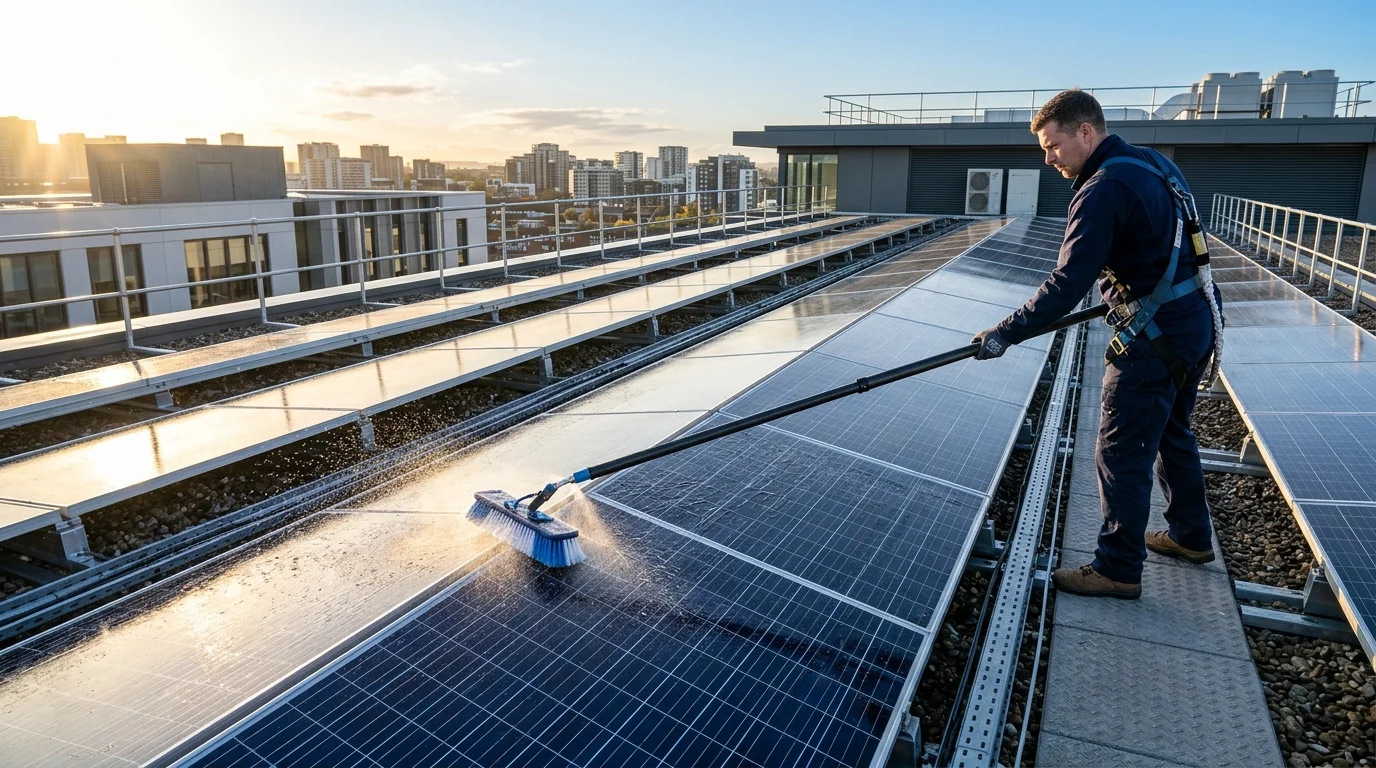
A rooftop solar photovoltaic (PV) system is one of the lowest-maintenance power generation assets in existence. Because solar modules are solid-state electronic devices with no moving gears, circulating oils, or high-wear mechanical bearings, many system owners assume they can simply "set and forget" their rooftop array for 25 to 30 years.
However, leaving solar panels completely unattended outdoors inevitably leads to an insidious performance drain known as soiling. Atmospheric dust, vehicle soot, agricultural particulate, bird droppings, and tree pollen settle across the tempered glass surface, forming an opaque barrier that physically blocks sunlight from reaching the silicon solar cells beneath.
According to the September 2025 fact sheet by the International Energy Agency Photovoltaic Power Systems Programme (IEA-PVPS) and research syntheses by the National Laboratory of the Rockies (NLR, formerly NREL), soiling causes an estimated global annual energy production loss of approximately 4% to 7%. In localized arid, desert, agricultural, or heavily industrialized environments, particulate accumulation can lead to significantly higher generation penalties—often reaching 15% to more than 30% during prolonged dry intervals if left uncleaned.
This comprehensive technical guide provides homeowners, facility managers, and solar asset operators with an authoritative, practical framework for solar panel cleaning and preventive maintenance: why panels get dirty, optimal cleaning intervals, step-by-step cleaning procedures, tools to use (and avoid), electrical safety protocols, and how to calculate whether manual cleaning is financially justified.
1. Why Solar Panels Need Cleaning: The Science of Soiling
To understand why clean solar panels are essential, it is necessary to examine how photovoltaic cells convert photon flux into direct-current (DC) electricity:
Optical Transmission Loss
A solar module extracts electrical energy from solar irradiance ($G$, measured in $\text{W/m}^2$). The front tempered glass of a modern PV module is coated with a nanoscale anti-reflective coating (ARC) designed to improve optical transmittance.
When microscopic particulates accumulate on the glass surface:
- Direct Absorption: Dark particulates (such as carbon soot from diesel exhaust or industrial smoke) absorb incident photons, dissipating solar energy as localized heat rather than allowing it to enter the semiconductor junction.
- Diffuse Scattering: Mineral dust and silica scatter incoming sunlight away from the active absorber layer, increasing Fresnel reflectance.
- Spectral Shift: Heavy soil layers filter shorter wavelengths of light, altering the spectral distribution reaching the silicon wafer.
Electrical String Mismatch and Shading Dynamics
The impact of dirt on a solar array is rarely uniform. In a traditional series string, when sunlight is obstructed on one section, the current that can pass through that group of cells drops:
In modern photovoltaic modules, bypass diodes and split-cell (half-cut) architectures are engineered to mitigate these mismatch losses by routing string current around heavily shaded cell sub-strings. However, this electrical bypass reduces the operating DC voltage of the string, forcing the inverter's Maximum Power Point Tracker (MPPT) to shift away from optimal efficiency. Furthermore, frequent or continuous diode conduction subjects the bypass diodes and junction box to sustained thermal stress, elevating the risk of premature component fatigue over multi-year operation.
The Mechanism of Reverse-Bias Hot Spots
When an opaque obstruction (such as dried bird lime or fallen leaves) covers an individual cell while adjacent cells remain illuminated, the shaded cell cannot conduct the full current generated by the rest of the unshaded string.
As explained in technical solar reliability curricula (such as India's Directorate General of Training [DGT] rooftop solar standards), the shaded cell is forced into reverse bias, behaving as an electrical resistor that dissipates generated power as localized heat. These hot spots create sustained thermal stress that can cause localized encapsulant browning, backsheet deterioration, accelerated cell aging, and permanent performance loss across the affected module (learn more about long-term cell aging and degradation mechanisms in our detailed guide on solar panel degradation causes and lifespan).
2. How Often Should Solar Panels Be Cleaned?
There is no universal cleaning schedule that applies equally to every installation. Cleaning frequency depends on local environmental variables including particulate density, rainfall patterns, module tilt angle, tree proximity, and airborne pollutants.
The following table provides practical starting guidance for cleaning intervals across typical environmental settings. These intervals should be treated as flexible operational baselines rather than rigid rules; system owners should monitor real-world dirt accumulation and observable generation trends to fine-tune their schedule:
| Environmental Setting | Primary Soiling Agents | Typical Soiling Severity | Recommended Starting Guidance |
|---|---|---|---|
| Arid / Desert Belts (e.g., Western India, Southwest US, Middle East) |
Fine sand, airborne silica, clay dust, seasonal dust storms. | Severe / High (rapid accumulation during dry months) |
Every 2 to 4 weeks as a baseline; clean following major dust storms. |
| Urban & Highway Corridors (High traffic density, industrial zones) |
Diesel soot, rubber tire dust, oily exhaust hydrocarbons, smog. | Moderate to High (forms sticky, persistent surface film) |
Every 4 to 8 weeks depending on observable soot accumulation. |
| Agricultural & Rural Regions (Active farming, orchards, grain silos) |
Crop dust, fertilizer drift, organic pollen, bird droppings. | Variable / Seasonal (spikes during harvest and blooming) |
Monthly during harvest and spring bloom; quarterly during dormant seasons. |
| Temperate & High-Rainfall Zones (Frequent moderate downpours, tilt > 15°) |
Ambient dust, pollen, organic leaf litter. | Low to Moderate (rain provides partial surface rinsing) |
2 to 4 times per year (e.g., post-winter and late summer). |
| Coastal Shorelines (< 5 km) (Marine salt spray, high humidity) |
Airborne salt crystals forming conductive crust. | Moderate (salt crust accelerates frame corrosion) |
Every 4 to 6 weeks to rinse corrosive salt deposits. |
Note: Soiling severity and cleaning frequency should always be adapted based on visual inspection, seasonal weather shifts, and localized monitoring data rather than treated as mandatory intervals.
3. Step-by-Step Solar Panel Cleaning Process
Cleaning solar panels requires strict adherence to safety protocols. Photovoltaic modules generate hazardous DC voltages whenever exposed to light, and wet rooftop surfaces present severe slip and fall hazards.
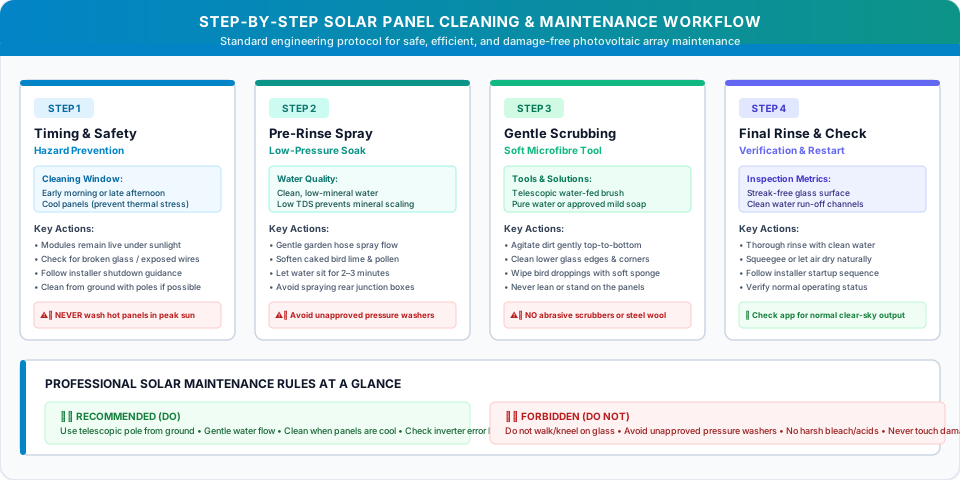
Follow this systematic standard operating procedure:
Step 1: Pre-Wash Safety Inspection and Array Isolation
Before introducing water to the array:
- Critical Electrical Warning (Modules Remain Live Under Light): Solar modules generate direct-current (DC) voltage whenever daylight strikes their surface. Shutting down the inverter does NOT de-energize the solar panels or their immediate DC string wiring. Ordinary system owners should never attempt internal electrical isolation or touch exposed connectors. Always consult your installer's specific operating guidelines or hire a qualified solar technician if you are unsure about safe shutdown procedures.
- Inspect for Physical & Electrical Damage: Visually inspect the modules from the ground or a safe access point. Never wash panels that have cracked front glass, exposed conductors, burnt junction boxes, or chewed wiring. Introducing water to damaged laminates presents an immediate risk of electric shock, short circuits, and equipment damage.
- Fall Protection: If panels are roof-mounted, cleaning from the ground using telescopic extension poles is strongly advised. Working directly on roofs requires certified fall-arrest protection, secure anchorages, and non-slip footwear.
Step 2: Time the Wash for Early Morning or Dusk
Never clean solar panels during peak midday sunshine.
Under intense sun, dark silicon cells heat up significantly above ambient air temperature. Pouring cold tap water onto hot modules introduces sharp thermal stress gradients across the tempered glass, polymer encapsulant, and internal busbar solder joints.
Major module manufacturers (such as JinkoSolar and Goldi Solar) standardly recommend cleaning arrays during early morning hours, late afternoon/dusk, or on overcast days when module temperatures and water temperatures are well balanced and water does not evaporate rapidly into dry mineral spots.
Step 3: Dry Sweep Loose Debris
Before applying water:
- Use a soft-bristled broom or leaf blower on low power to gently remove loose pine needles, twigs, leaves, and surface dust.
- Clearing dry debris prevents water from turning loose leaves into sticky sludge that adheres to the glass frame corners.
Step 4: Low-Pressure Pre-Rinse (Soak Phase)
- Using a standard garden hose with an adjustable spray nozzle set to a gentle shower or fan pattern, thoroughly wet down the entire array from top to bottom.
- Let the water soak into stubborn dirt, lichen, and dried bird lime for 2 to 3 minutes to loosen particulate bonding.
- Maintain Low Pressure: Use gentle, low-pressure water flow. High-pressure washers should generally be avoided for residential cleaning; they should only ever be used if explicitly permitted by the specific module manufacturer's maintenance manual, adhering strictly to their specified nozzle distance, spray angle, and pressure limits to prevent seal degradation or water ingress.
- Avoid directing water jets into module cable connectors (MC4 plugs) or underneath junction boxes.
Step 5: Gentle Agitation with a Soft Water-Fed Brush
- Attach a soft microfibre brush head to an extendable telescopic water-fed pole.
- Starting at the highest panel row, work downward using uniform overlapping horizontal strokes.
- Apply light, gentle pressure. Let the microfibre bristles lift the softened dirt rather than scrubbing with heavy downward force.
- Pay special attention to the bottom aluminum frame edge, where silt and algae tend to accumulate in water dams.
Step 6: Spot-Free Final Rinse
- Rinse each module thoroughly with clean, low-TDS water to flush away all suspended dirt particles.
- Inspect the glass from an angle to verify that no haze, streaks, or missed bird deposits remain.
- If using pure deionized (DI) water, panels can be allowed to air dry naturally without leaving mineral residue. If using standard tap water in a moderate-hardness area, gently squeegee the glass with a clean rubber blade from top to bottom.
Step 7: System Restart & Monitoring Verification
- Allow panels to dry and verify that all rooftop electrical enclosures are sealed and dry.
- Re-energize the system in accordance with the installer's startup sequence.
- Observe the inverter startup sequence (typically 1 to 5 minutes countdown). Confirm the status indicator confirms normal operating status with zero ground-fault or isolation error codes.
- Log into your mobile solar monitoring app at solar noon on the next clear day to observe the post-cleaning kilowatt recovery.
4. Best Tools and Cleaning Materials
Using improper equipment can permanently score anti-reflective coatings and risk voiding manufacturer warranties. Equipping yourself with the correct tools ensures safe and effective cleaning:
| Tool / Material | Recommended Specification | Purpose & Engineering Rationale |
|---|---|---|
| Telescopic Water-Fed Pole | Carbon fibre or hybrid aluminum pole (extending 4 to 10 meters). | Allows safe cleaning of rooftop arrays directly from ladders, scaffolding, or ground level without stepping onto the roof. |
| Soft-Bristle Solar Brush | Split-fiber flagged nylon or microfibre bristles (< 0.25 mm filament diameter). | Soft enough to prevent scratching the glass or wearing away the microscopic anti-reflective coating (ARC). |
| Purified / Deionized (DI) Water | Deionized or reverse-osmosis filtered water with low mineral content (low TDS). | Helps prevent dissolved calcium, magnesium, and silica from depositing hard mineral water spots when drying. |
| Rubber Squeegee | Automotive-grade soft rubber or silicone blade with non-metallic plastic head. | Quickly clears excess rinse water to prevent water droplet lensing and mineral residue on hot days. |
| Cleaning Detergent (Optional) | Manufacturer-approved, biodegradable, pH-neutral (pH 6.5 – 7.5), non-abrasive solar soap. | Helps emulsify heavy oil, vehicle exhaust grease, and stubborn bird droppings without leaving surfactant films. |
To preserve module warranties and equipment integrity, strictly avoid the following materials:
- Unapproved High-Pressure Washers: High water velocity can breach laminate edge seals, force moisture into junction boxes, and cause internal cell stress.
- Abrasive Powders & Scouring Pads: Steel wool, abrasive scouring pads, and scouring powders will scratch the anti-reflective glass coating, permanently lowering light transmission.
- Corrosive Chemicals: Bleach, ammonia, strong acids, or caustic alkalines corrode aluminum frames, damage silicone edge seals, and strip glass coatings.
- Hard Tap Water in Arid Zones: High-mineral groundwater leaves chalky mineral deposits that adhere to glass surfaces over repeated washing cycles.
5. Rainwater vs. Manual Cleaning: Why Rain Alone Is Often Insufficient
A common assumption among prospective solar buyers is that “solar panels are completely self-cleaning whenever it rains.” While natural precipitation does provide partial cleaning under specific conditions, relying solely on rain often leads to cumulative energy loss for several reasons:
1. The Light Rain "Mud Splatter" Effect
In dusty or urban environments, light drizzle scrubs particulate pollution out of the air. When light rain hits a dusty panel, it can turn dry surface dust into a liquid slurry of muddy water.
If rain ceases shortly thereafter, the water quickly evaporates under returning sunshine, leaving an adherent mud crust across the glass that reduces power output more than dry, loose dust alone.
2. Module Tilt Angle and Frame Edge "Damming"
Modern crystalline silicon modules are framed by an anodized aluminum lip measuring 2 to 5 mm above the glass surface.
On residential roofs with shallow tilt angles or commercial flat roofs with low-tilt racking:
- Rainwater naturally runs toward the bottom edge.
- Surface tension and the raised aluminum frame lip prevent complete water runoff.
- The pooled water collects suspended silt, pollen, and soot, forming a sediment mud dam along the lowest row of cells.
- When dry, this bottom strip partially blocks the lower portion of the bottom solar cells, potentially causing partial shading and localized power losses, depending on the module and string configuration.
3. Insoluble Organic and Chemical Contaminants
Natural precipitation cannot easily dissolve or remove:
- Bird Droppings (Uric Acid): Dried bird lime contains insoluble compounds that bond strongly to glass.
- Tree Sap & Pollen: Organic tree resins create a sticky, hydrophobic film that repels rainwater.
- Industrial Smog & Diesel Soot: Oily, petroleum-based hydrocarbons require mechanical friction or approved mild surfactants to break down.
6. Common Cleaning Mistakes to Avoid
Even well-intentioned maintenance can cause damage if executed incorrectly. Avoid these critical mistakes:
1. Thermal Stress from Cold Water on Hot Glass
Spraying cold water onto sun-heated panels creates localized mechanical tension across the glass pane. Solar glass is tempered and under high internal compression; excessive thermal stress can cause glass damage, accelerate encapsulant fatigue, or stress internal soldered cell interconnections.
2. Walking, Kneeling, or Standing on Modules
Never allow anyone to stand, walk, or kneel on solar modules. Crystalline silicon wafers are less than 170 microns thick.
While the tempered front glass may flex under human weight without immediately shattering, that flexing produces microscopic microcracks inside the silicon cells. These microcracks are invisible to the naked eye but propagate over time due to daily thermal expansion, isolating cell regions and creating hot spots that permanently degrade output.
3. Using Unapproved Pressure Washers
Standard commercial pressure washers can force water past edge seals into the module laminate, compromise waterproof junction box seals, or degrade surface anti-reflective coatings. Always adhere to module manufacturer guidelines regarding permissible cleaning tools.
4. Cleaning with Untreated Hard Tap Water
In areas with high dissolved mineral solids, allowing untreated wash water to dry naturally deposits a chalky layer of mineral scale. Over time, these mineral deposits adhere to the glass and reduce optical transmission. Where tap water is hard, using purified water or squeegeeing excess water before it evaporates is recommended.
5. Using Abrasive Scouring Pads or Metal Scrapers
Using razor blades, metal putty knives, or abrasive scouring pads to scrape off dried debris will score the glass surface. Scratches create diffuse light scattering, permanently reducing module efficiency.
6. Ignoring Electrical Shock Hazards
Solar modules cannot be "turned off" at the panel level when exposed to daylight; active strings generate hundreds of volts of DC. Washing modules with damaged cables, loose connectors, or cracked backsheets while standing in water creates an immediate pathway for electrical shock.
7. Solar Panel Maintenance Checklist
Routine preventive maintenance involves far more than simply washing the glass. A comprehensive maintenance routine preserves system reliability, catches balance-of-system (BOS) faults early, and maintains electrical safety:
| Maintenance Task | Inspection Frequency | Diagnostic Objective & Method | Actionable Guidelines |
|---|---|---|---|
| Generation Monitoring Verification | Weekly / Monthly | Compare inverter app daily kWh yield against expected clear-sky seasonal benchmarks. | Investigate significant, unexpected generation decreases that cannot be explained by weather patterns. |
| Visual Glass & Frame Inspection | Monthly | Inspect glass for heavy soiling, bird lime, crack lines, frame distortion, or moss. | Schedule cleaning if dirt covers bottom cell rows or bird droppings are visible on active cells. |
| Inverter Physical & Status Check | Monthly | Verify cooling heatsink fins are free of dust or obstructions; check status indicator. | Clean heatsink air intake; record error codes if amber or red warning indicators appear. |
| Vegetation & Tree Canopy Management | Quarterly | Check nearby tree branches or vines that may cast shadows across the array. | Safely trim vegetation to prevent shading on active panels and reduce organic leaf drop. |
| Racking & Clamping Hardware | Bi-Annually | Inspect mid-clamps, end-clamps, and roof mounting hardware for signs of loosening or corrosion. | Re-torque hardware to the racking manufacturer's engineering specification if loose. |
| Cabling & Conduit Integrity | Bi-Annually | Verify DC cables are properly secured to racking, clear of roof surfaces, and undamaged by rodents. | Secure sagging cables with UV-rated ties; install wire mesh critter guards if birds or rodents nest beneath modules. |
| Electrical Insulation & String Testing | Annually (Professional) | Measure string open-circuit voltage ($V_{oc}$), operating current ($I_{mp}$), and insulation resistance ($R_{iso}$). | Qualified technician assesses measurements against commissioning records and applicable standards (e.g., IEC 62446). |
| Thermal Infrared (FLIR) Inspection | As Needed / Diagnostic Recommendation | Scan operating array under full sun (>600 W/m²) for localized cell hot spots, failed bypass diodes, or internal cell degradation. | Recommended when diagnosing unexplained generation loss, after severe weather, or for formal warranty claims (not required as a routine annual task for standard residential arrays). |
8. When Should You Hire a Professional?
Deciding whether to clean solar panels yourself or hire a professional service depends on roof access, physical safety, and technical capability. Even on single-story homes, walking on roofs involves significant slip-and-fall hazards—especially when surfaces are wet and soapy—as well as potential electrical risks from live DC circuits.
Unless your array can be comfortably and safely reached from the ground or a secure platform using an extendable water-fed pole, hiring a qualified, insured solar maintenance professional is generally the safer and more reliable choice. Professional service is especially recommended in the following scenarios:
1. High-Pitch, Multi-Story, or Fragile Roofs
Falls from heights are among the most common causes of residential maintenance accidents. If accessing your solar array requires climbing onto a multi-story building, negotiating steep roof pitches, or walking across fragile roofing materials (such as clay tiles or slate that easily crack underfoot), professional contractors equipped with certified personal fall arrest systems (PFAS) and specialized access equipment are indispensable.
2. Commercial and Industrial Rooftops (C&I)
Commercial installations spanning hundreds of kilowatts require industrial water-fed rotary brush systems, reverse osmosis water purification rigs, and formal safety work permits. Commercial operators must also comply with occupational health and safety regulations.
3. Recurring Inverter Ground Faults or Error Codes
If your solar inverter displays error messages such as "Isolation Fault" (Riso Low), "Ground Fault", or "DC Arc Fault", the issue is electrical, not merely cosmetic. Introducing water to an array with active insulation faults can create severe electrical short-circuit or fire hazards. Certified solar technicians must diagnose and repair cable faults before any cleaning takes place, regardless of whether you operate an on-grid, off-grid, or hybrid solar system.
4. Extreme Mineral Water Hardness
If your municipal water has high mineral hardness and you do not possess demineralization equipment, professional cleaners bring specialized pure-water filtration rigs that ensure clean, spot-free drying.
9. Signs Your Solar Panels Need Maintenance
Rooftop photovoltaic arrays operate silently in the background, making it easy to overlook developing faults until electricity bills noticeably increase. Identifying performance bottlenecks early prevents temporary soiling from evolving into permanent module degradation or electrical fire hazards. Watch for these seven critical warning signs:
1. Unexpected, Persistent Drop in Daily Kilowatt-Hour Generation
The most definitive operational sign of soiling or balance-of-system distress is an unexpected divergence between solar irradiance and actual power output.
- What to Look For: Review your solar monitoring app's clear-sky performance curves. While seasonal cloud cover, winter sun angles, and extreme summer ambient temperatures (which naturally derate silicon cell efficiency by ~0.35% to 0.40% per °C above 25°C) cause normal yield fluctuations, an unseasonal 10% to 25% drop on bright sunny days strongly points to surface contamination or sub-string failure.
- Action: Compare historical output under identical clear-sky conditions. If performance remains consistently depressed below expected baselines, inspect the array for accumulated dust or organic matter.
2. Inverter Warning Indicators and Fault Codes
Modern solar inverters perform continuous insulation resistance (Riso) and electrical safety diagnostics prior to grid synchronization.
- What to Look For: Amber or red warning LEDs, or digital error messages such as "Isolation Fault" (Riso Low), "Ground Fault", or "DC Arc Fault". These faults frequently appear on damp, dewy mornings when condensation forms a conductive moisture path to ground through cracked module backsheets or weathered cable insulation.
- Action: Never introduce water to an array exhibiting active insulation or ground faults. Keep the system dry and engage a qualified solar technician to conduct DC megohmmeter insulation resistance testing.
3. Visible Dark Discoloration, Browning, or Hot Spots
Localized overheating causes visible physical alterations in module packaging materials.
- What to Look For: Distinct darkened or brown patches on front silicon cells, localized yellowing of the ethylene-vinyl acetate (EVA) encapsulant, or charred circular blemishes on the rear polymer backsheet directly behind specific cells.
- Action: These symptoms indicate severe reverse-bias heating, typically triggered by persistent localized obstructions (such as baked-on bird droppings) or internal cell busbar microcracks. Affected panels should be evaluated using infrared thermography and potentially claimed under manufacturer performance warranties.
4. Silt, Mud, or Algae Damming Along Bottom Frame Edges
On shallow-pitch roofs (under 15°), natural water runoff is impeded by the raised 2 to 5 mm anodized aluminum frame lip.
- What to Look For: A continuous band of dried silt, pollen, or greenish algae settled directly above the bottom frame edge, covering the lower 1 to 3 centimeters of the lowest row of solar cells.
- Action: Because modern half-cut modules have cell sub-strings oriented along the bottom row, bottom-edge damming can disproportionately derate generation. Clean the lower frame channel using soft microfibre bristles and consider installing anti-soiling water drainage clips to facilitate natural runoff.
5. Chalky Mineral Limescale Streaks Across Glass
Using untreated hard municipal tap water or mineral-heavy well water for previous cleanings leads to mineral precipitation.
- What to Look For: White, milky, or chalky calcified streaks that cannot be rinsed away with standard water. In hard-water areas, calcium and magnesium salts bake into the glass pores and microscopic anti-reflective coating under intense solar UV exposure.
- Action: Avoid abrasive bathroom limescale cleaners or muriatic acid, which permanently strip the anti-reflective coating. Use demineralized pure water (<10 ppm TDS) combined with a manufacturer-approved gentle cleaning solution followed by thorough deionized water rinsing.
6. Sagging, Exposed DC Cables Resting on Abrasive Roofing
Thermal cycling, wind vibration, and UV exposure degrade standard plastic zip ties over years of rooftop service.
- What to Look For: DC string cables hanging below the module racking and resting directly against rough asphalt shingles, concrete tiles, or metal roof seams. Wind-induced abrasive rubbing can wear down cable jackets, exposing live DC conductors to pooling rainwater.
- Action: Re-secure all loose cabling using UV-resistant stainless steel PV cable clips or solar-rated nylon ties. Ensure all wiring remains elevated above roof surfaces and away from drainage valleys.
7. Bird Nesting, Pests, or Accumulated Debris Under the Array
The shaded cavity between solar panels and the roof deck creates an attractive microclimate for pigeons, rodents, and wasps.
- What to Look For: Accumulation of twigs, feathers, leaves, or nesting debris under panels, along with heavy bird lime across the glass. Rodents frequently gnaw on cross-linked polyethylene (XLPE) DC wire insulation, creating an immediate electrical short-circuit and fire hazard.
- Action: Install specialized wire mesh bird barriers (solar critter guards) around the perimeter of the array. Never pressure wash under panels while wiring is exposed; inspect cables thoroughly before clearing nesting materials.
10. Cleaning Costs and Performance Benefits: The ROI Calculation
Is professional solar panel cleaning worth the investment? The answer depends on the relationship between cleaning costs, actual soiling recovery, and your local electricity tariff.
The Break-Even Economic Formula
To determine whether cleaning your solar array makes financial sense, use this straightforward ROI formula:
Where:
- Annual kWh Generation: Baseline expected annual generation of your array (e.g., 6,500 kWh for a 5 kW array in a sunny climate).
- Recoverable Soiling Loss %: Estimated proportion of generation loss recovered through cleaning.
- Electricity Tariff: Cost per kilowatt-hour avoided from the grid (or feed-in credit earned under your net metering arrangement).
- Cleaning Cost: Out-of-pocket cost for DIY supplies or professional contractor fees.
Comparative Financial Case Study: 6 kW Residential System
The following scenario illustrates the economic logic for a 6 kW residential rooftop array generating 8,400 kWh annually in an urban setting.
The cost parameters in the table below (such as ~$25 amortized annual DIY supplies and $140 for bi-annual professional servicing) and the 10% recoverable soiling loss are illustrative modeling assumptions used to demonstrate the ROI formula. Actual service prices, DIY kit expenses, and generation recovery percentages vary significantly by geographic location, roof accessibility, system size, and local labor rates.
| Parameter | Moderate Tariff Scenario ($0.16 / kWh) | High Tariff Scenario ($0.32 / kWh) |
|---|---|---|
| Baseline Annual Generation | 8,400 kWh | 8,400 kWh |
| Illustrative Recoverable Soiling Loss (10%) | 840 kWh | 840 kWh |
| Annual Financial Value of Recovered Energy | $134.40 / year | $268.80 / year |
| Professional Cleaning Cost (Bi-Annual) | $140.00 ($70 × 2 visits) | $140.00 ($70 × 2 visits) |
| Net Annual Financial Gain from Professional Cleaning | -$5.60 (Marginal / Break-even) | +$128.80 net profit |
| DIY Cleaning Cost (Equipment Amortized) | ~$25.00 / year | ~$25.00 / year |
| Net Annual Gain via Safe DIY Cleaning | +$109.40 net profit | +$243.80 net profit |
Note: Real-world generation recovery varies based on baseline dirt accumulation, subsequent rainfall events, cleaning thoroughness, and system design.
Practical Economic Conclusions
- High-Tariff Regions: In areas with high grid electricity prices or commercial demand charges, regular professional cleaning can deliver a positive return on investment, recovering more energy value than the service cost.
- Arid and Dusty Climates: In heavily soiled environments where localized generation penalties can reach 15% to 30% during extended dry seasons, scheduled washing is often essential to prevent substantial financial forfeiture in lost generation.
- Temperate Climates with Regular Rainfall: In moderate environments with adequate module tilt and frequent seasonal rains, cleaning intervals can often be extended (for example, once or twice annually, or solely when visual inspection or monitoring logs confirm soiling derating), preventing unnecessary maintenance overhead.
Official Industry Standards & Technical References
- International Energy Agency (IEA-PVPS Task 13): Soiling Losses: Impact on the Performance of Photovoltaic Power Plants (Fact Sheet 2025) — Global technical evaluation documenting 4%–7% worldwide annual energy yield reduction due to soiling.
- National Laboratory of the Rockies (NLR, formerly NREL): NLR Solar Research Hub — Empirical field data on photovoltaic soiling rates, optical transmission losses, and array performance modeling.
- Directorate General of Training (DGT), Ministry of Skill Development, Government of India: Rooftop Solar PV Training Standards — Technical training documentation covering PV module reverse-bias hot spots, bypass diode mechanics, and routine system maintenance.
- JinkoSolar Installation & Maintenance Manual: Official PV module user and maintenance documentation specifying low-pressure water cleaning, ambient temperature operating guidelines, and avoidance of abrasive chemical detergents.
- Goldi Solar Technical Guidelines: Photovoltaic module operation and maintenance standards highlighting gentle cleaning protocols, connector safety, and hot-spot prevention.
- U.S. Department of Energy (DOE): Solar Photovoltaic Technology Basics (SETO) — Federal guidance on balance-of-system operation, preventive maintenance, and system durability.
- International Electrotechnical Commission (IEC): iec.ch — Standards IEC 62446-1 (Grid Connected PV Systems — Documentation, Commissioning Tests and Inspection) and IEC 61215 (Terrestrial Photovoltaic Module Design Qualification).
- Ministry of New and Renewable Energy (MNRE), Government of India: mnre.gov.in — National guidelines on rooftop solar installation safety, earthing requirements, and maintenance compliance.