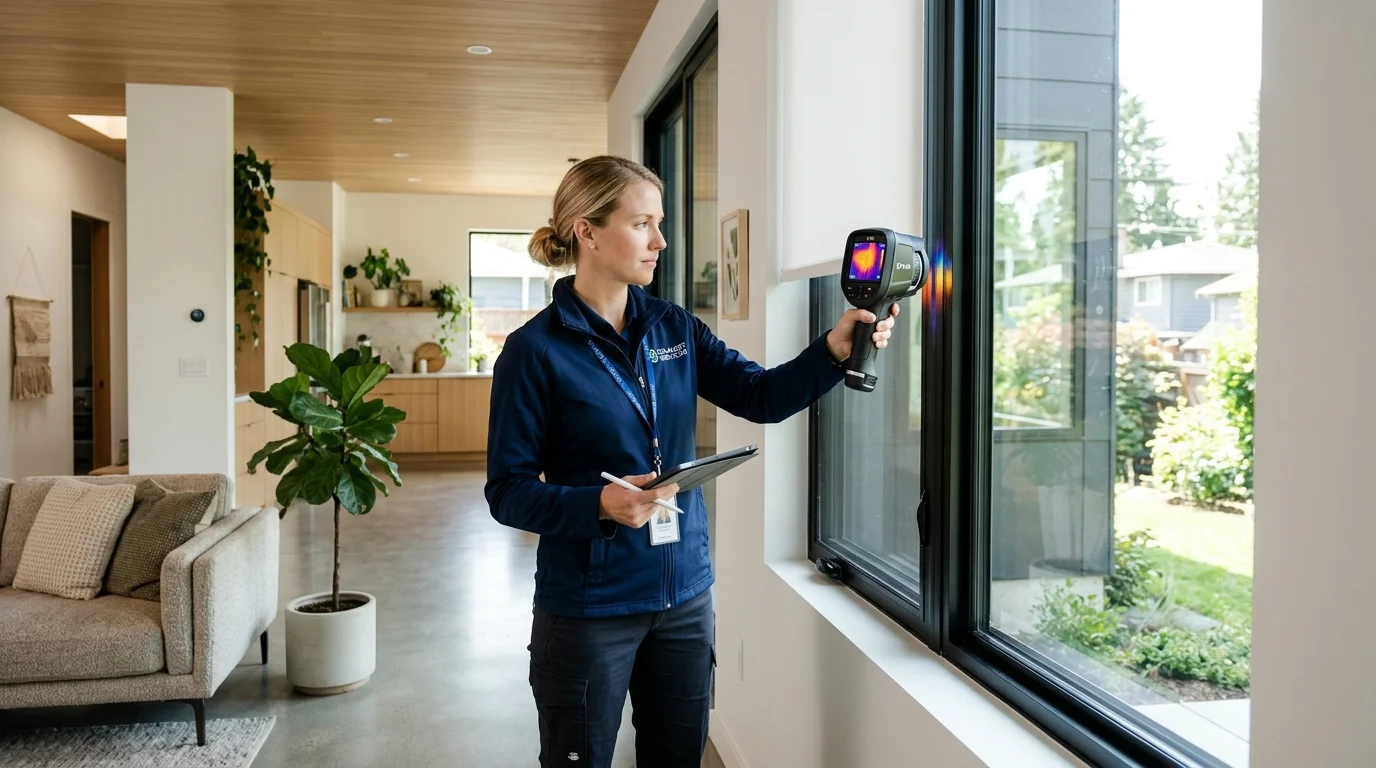
When residential electricity bills climb unexpectedly, many homeowners react with guesswork—turning off random lights or asking family members to run ceiling fans on lower settings. While well-intentioned, these isolated actions rarely produce substantial reductions on monthly utility statements. In many households, the primary contributors to elevated power bills—such as uncontrolled building envelope air infiltration, misconfigured water heater thermostats, degraded refrigeration door gaskets, and continuous phantom plug loads—operate silently out of sight.
To systematically lower your power bills without compromising everyday comfort, you can transition from passive habits to structured diagnostic energy auditing.
A home energy audit is a methodical investigation of how, where, and when electrical energy enters and is consumed across your living space. By treating your home as an interconnected thermal and electrical system, an audit helps identify specific sources of energy waste, benchmarks baseline consumption patterns, and provides an actionable framework of prioritized improvements ranked by estimated payback.
Whether you live in a detached residence or an urban apartment, conducting a DIY home energy audit (which typically takes approximately 2 to 4 hours) allows you to interpret utility data, inspect building air leaks, deploy basic diagnostic meters safely, and implement cost-effective retrofits.
1. What Is a Home Energy Audit?
In residential building science, a Home Energy Audit (or residential energy assessment) is a structured technical inspection that evaluates a dwelling's overall energy performance and identifies thermal and electrical inefficiencies.
Rather than looking at appliances in isolation, an audit evaluates the household energy ecosystem across four foundational pillars:
- The Thermal Envelope (Building Shell): How effectively exterior walls, ceilings, windows, doors, and floor slabs limit uncontrolled heat gain during summer and heat loss during winter.
- Major Mechanical Systems (HVAC & Water Heating): The operational efficiency, equipment sizing, airflow integrity, and thermostat coordination of cooling and water heating equipment.
- Appliance Electrical Duty Cycles: The real-world kilowatt-hour consumption of continuous and cyclical appliances (refrigerators, deep freezers, washing machines, and water pumps).
- Base Plug & Standby Loads: The cumulative baseline electrical power drawn 24 hours a day by electronics in sleep, standby, or passive charging states.
Actual Measurement vs. Estimated Modeling
A critical distinction in energy auditing must be maintained between actual physical measurement and theoretical estimation:
- Estimated Modeling: Involves multiplying an appliance's nameplate wattage (e.g., an 800W microwave) by an assumed daily operating duration. While useful for high-level approximations, nameplate ratings reflect peak laboratory operating limits rather than real-world continuous draw.
- Actual Measurement: Involves deploying physical diagnostic instruments—such as a plug-in digital wattmeter, a calibrated infrared thermometer, or digital utility meter logging—to capture actual cyclic compressor duty cycles, instantaneous power factor, and idle standby draw under real household operating conditions.
An effective DIY audit combines both approaches: using actual measurements for cyclical plug-in loads, and structured historical modeling for hardwired equipment.
The 5-Phase Residential Energy Audit Workflow
A methodical DIY audit follows a disciplined, 5-phase framework:
| Phase | Audit Domain | Core Diagnostic Activities | Key Deliverable |
|---|---|---|---|
| Phase 1 | Bill & Baseline Analysis | Compile 12-month utility statements, compute average daily kWh, review regional progressive tariff slabs, and record overnight base load. | Household Benchmark kWh/Day & Baseline Profile |
| Phase 2 | Building Envelope Inspection | Inspect perimeter window tracks, door thresholds, and wall penetrations for convective air leakage using draft testing. | Building Air Infiltration & Draft Map |
| Phase 3 | Major Loads & HVAC Diagnostics | Inspect air conditioning filters, condenser coils, operating setpoints, water heater temperatures, and refrigerator gaskets. | HVAC & High-Draw Appliance Duty Log |
| Phase 4 | Plug Loads & Standby Power | Measure idle and running wattage of consumer electronics, entertainment hubs, and home office gear using a plug-in wattmeter. | Phantom / Vampire Load Inventory |
| Phase 5 | Action Matrix & Prioritization | Classify corrective measures into zero-cost behavioral fixes, low-cost weatherization, and strategic capital upgrades based on estimated payback. | Prioritized Energy Improvement Action Plan |
The guiding principle of energy auditing is practical and straightforward: you cannot manage what you do not measure.
2. Why Should You Audit Your Home's Energy Use?
Conducting a home energy audit provides actionable value across three key dimensions:
1. Progressive Utility Slabs: The Compounding Financial Multiplier
In many utility markets worldwide—including Indian State Electricity Distribution Companies (DISCOMs) such as MSEDCL, TANGEDCO, UPPCL, and BESCOM, as well as various tiered municipal utilities internationally—residential electricity is billed on a graduated progressive slab tariff.
Under a progressive slab structure, the first 100 or 200 kWh are billed at a subsidized baseline rate (e.g., ₹3.50 to ₹4.50 per unit), while consumption exceeding 300, 400, or 500 kWh triggers higher rates (often ₹7.00 to ₹10.00+ per unit, plus proportional fuel surcharges and electricity taxes). In contrast, other regions utilize flat rates or Time-of-Use (TOU) tariffs where rates vary by time of day rather than cumulative monthly volume.
In jurisdictions with progressive tiered tariffs, energy efficiency improvements eliminate consumption from your highest, most expensive billing tier first. As a result, reducing total kilowatt-hour usage can yield a proportionally greater percentage reduction in your energy charges. However, exact financial savings depend on your local utility's tariff schedule and fixed meter charges.
2. Preventive Equipment Health and Fire Safety
During a home energy audit, a visual check of accessible switches, sockets, appliance cords, and electrical equipment may reveal warning signs such as:
- Discoloured, cracked, melted or visibly damaged socket outlets.
- Unusually hot plugs or sockets, which may indicate a loose connection, overloading or contact resistance.
- Repeated tripping of circuit breakers or RCCBs.
- Burning smells, buzzing sounds, sparks or electric shocks from appliances or switches.
Do not touch hot or damaged electrical fittings, open the distribution board, or attempt to measure live wiring. Stop using the affected equipment where it is safe to do so and contact a licensed electrician. Leakage-current and earthing tests require appropriate instruments and qualified personnel. Identifying these defects early prevents potential electrical fires, protects sensitive electronic circuitry, and extends the operational lifespan of expensive compressor-driven appliances.
3. Acoustic and Thermal Living Comfort
High energy waste is frequently accompanied by degraded living comfort. Drafty window sashes that leak cooled air also allow outdoor noise, dust, and humidity to infiltrate living spaces. Similarly, an air conditioner running continuously with a dust-choked evaporator coil creates excessive blower noise while struggling to dehumidify indoor air.
3. Understanding Your Electricity Bills: The Data Baseline
Before inspecting a single electrical socket, you must establish an empirical performance baseline. You cannot evaluate whether your household is wasting energy until you understand historical consumption patterns.
Step 1: Assemble 12 Months of Billing Records
Download the past 12 billing statements from your electricity provider's web portal or mobile app. A full annual cycle is necessary because residential electricity usage fluctuates with seasonal climate patterns.
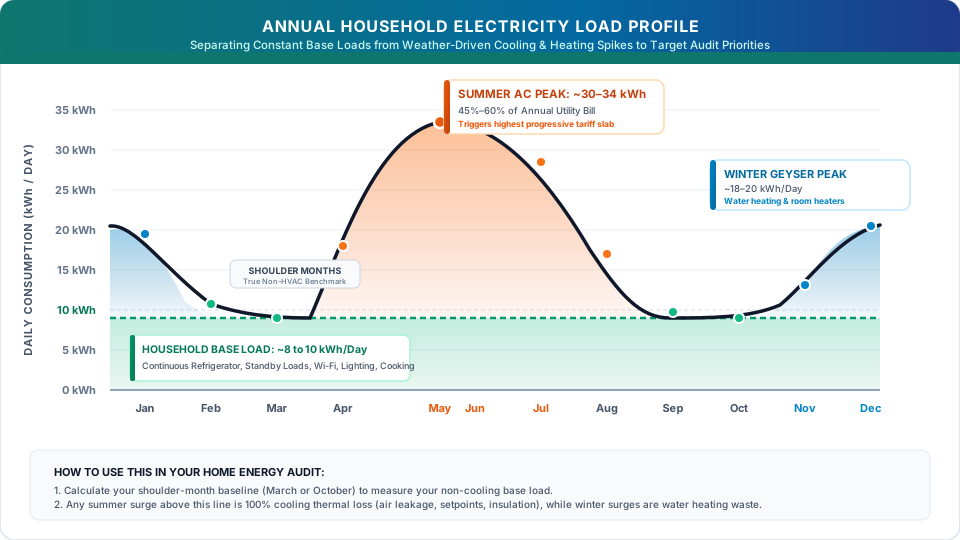
By converting each month's total billed units into Average Daily kWh, you can plot your household's annual load profile:
- Summer Cooling Peak: In hot and humid climates, daily consumption often surges substantially over baseline due to air conditioning compressor duty.
- Winter Heating Peak: In cold or temperate winter zones, daily usage rises due to electric storage geysers, space heaters, and heat pump operation.
- The Temperate Baseline (Shoulder Months): Months with mild ambient weather where neither space cooling nor space heating is actively run represent your True Base Load. Depending on your geographic region and climate, shoulder months often occur during transitional periods (e.g., February–March or October–November in northern subtropical zones).
Step 2: Measuring the Unattended "Nighttime Base Load"
To assess your home's continuous baseline load, perform an overnight meter check:
- Before retiring for the night, ensure that all high-power cyclical appliances (ACs, geysers, washing machines, dishwashers) are switched off.
- Record the cumulative active kWh reading from your utility digital meter display (or photograph the LCD).
- First thing in the morning, before switching on morning appliances, record the meter reading again.
- Calculate the overnight consumption across that sleeping window (e.g., 7 hours).
Overnight baseline consumption typically includes continuously running appliances such as the refrigerator, Wi-Fi router, security devices, and home electronics left in passive standby mode. If your overnight meter check reveals an unexpectedly high consumption relative to your household size and baseline appliances, inspect continuous and cyclical equipment individually using a plug-in meter to pinpoint the cause.
For detailed instructions on decoding utility rate structures, fixed charges, and reactive penalties, refer to our comprehensive guide on How to Read an Electricity Bill: Units, Fixed Charges and Taxes.
4. Checking Doors, Windows, and Air Leakage (The Building Envelope)
Space cooling and space heating account for a substantial share of residential utility expenses in climate-stressed regions. However, even high-efficiency inverter air conditioners cannot perform economically if conditioned air continuously escapes while hot, humid ambient air infiltrates through building envelope gaps.
Air leakage occurs via convective infiltration: outdoor air enters through gaps in window frames, door sweeps, architectural joints, and utility penetrations, forcing your air conditioner's compressor to run at elevated speeds to extract sensible heat and indoor humidity.
The DIY Smoke Pencil / Incense Stick Draft Test
You can locate major air infiltration pathways using an incense stick or smoke pencil under natural airflow conditions:
- Close all exterior windows and doors tightly.
- Ensure indoor conditions are calm (turn off ceiling fans, pedestal fans, and room air conditioners during the test).
- Light an incense stick and slowly trace the rising smoke trail along:
- The perimeter edges of all window sashes and sliding tracks.
- The gap beneath exterior doors and balcony doors.
- The junction where split-AC refrigerant copper tubing penetrates through external masonry.
- Recessed ceiling fixtures and exhaust fan backdraft dampers. (Precaution: Do not insert smoke-producing materials into electrical fixtures, ceiling cavities, exhaust ducts, or other enclosed openings. Never use an open flame near combustible insulation, wiring, curtains, or flammable materials.)
- Interpreting Results: The smoke test simply reveals the presence and general direction of airflow, rather than serving as a precise measurement tool. Depending on indoor-outdoor pressure differences and air currents, the smoke may move inward or outward, flutter, or disperse—indicating convective air movement through an unsealed joint that may warrant weatherization.
Combustion Appliance Hazard: If your home uses fuel-burning combustion appliances (such as a gas geyser, gas furnace, wood stove, or open fireplace), do NOT turn on mechanical exhaust fans to create artificial negative room pressure during draft testing. Depressurizing the home can cause backdrafting, drawing toxic flue gases—including lethal carbon monoxide (CO)—back into living quarters. Inspect drafts under calm, natural conditions only.
Fire Safety: Keep lit incense sticks and open embers well clear of curtains, bed linens, upholstery, solvents, and combustible materials at all times.
High-Impact Envelope Retrofits
Once air leaks are identified, seal them using targeted, durable architectural weatherization materials:
- Window Track & Sash Gaps: Install self-adhesive EPDM sponge rubber foam tape or silicone V-strips along the mating surfaces of window sashes. EPDM rubber retains its compressive elasticity significantly longer than standard open-cell foam under solar ultraviolet exposure.
- Exterior Door Thresholds: Standard interior-fitted doors often leave a substantial air gap at the floor. Install a rigid screw-on or adhesive door bottom sweep with a flexible neoprene or nylon bristle seal.
- AC Wall Penetrations: The opening drilled through exterior masonry for split-AC refrigerant lines is frequently left poorly sealed. Seal this opening using expandable polyurethane (PU) foam according to the manufacturer's application instructions. Because cured PU foam degrades under direct sunlight, trim it flush and protect it with exterior-grade acrylic caulk or paint.
To explore building insulation physics and conductive heat transfer mechanics in greater depth, review our guide on Home Insulation Explained: Walls, Roofs and Windows.
5. Identifying High-Energy Appliances & HVAC
In residential electrical auditing, major mechanical equipment and high-amperage appliances represent the vast majority of actionable energy consumption. While the exact breakdown varies by climate, house size, and appliance inventory, high-draw equipment requires focused technical scrutiny.
Key appliance categories that typically account for the largest shares of household energy include:
| Appliance Category | Audit Significance & Primary Cause of Inefficiency |
|---|---|
| Space Cooling (Air Conditioners / Inverters) | Primary seasonal energy consumer; inefficiencies often driven by dust-clogged filters, unnecessarily low thermostat setpoints (such as below 24°C), and room air leaks. |
| Domestic Water Heating (Electric Geysers) | High-wattage resistance elements (2–3 kW); waste driven by overheated thermostat setpoints, uninsulated tank jackets, and unattended runtime. |
| Continuous Refrigeration | 24/7 continuous thermodynamic cycle; waste driven by hardened door gaskets, dusty condenser coils, and inadequate wall clearance. |
| Ceiling Fans & Continuous Air Circulation | Multiple units running 10–16 hours daily; conventional induction motors draw significantly more power than modern BLDC motors. |
| Phantom Standby & Plug Loads | Continuous unmonitored draw from entertainment hubs, gaming consoles, set-top boxes, and smart home adapters. |
1. Air Conditioning Health Check
Air conditioners remove heat by evaporating and condensing refrigerant. Airflow restrictions directly degrade thermodynamic efficiency:
- Indoor Evaporator Filter Cleanliness: A clogged filter restricts airflow across the indoor coil. This can reduce cooling performance, increase operating time and, in some conditions, contribute to coil icing. Clean or replace filters according to the manufacturer's instructions to restore normal airflow.
- Outdoor Condenser Heat Rejection: Inspect the outdoor condenser unit. If aluminum fins are clogged with dust, grime, or blocked by exterior clutter, the system cannot reject heat efficiently into outdoor air, elevating head pressure and electrical amperage. Clear surrounding debris and follow manufacturer instructions for light exterior cleaning. For deep coil washing, fin straightening, or internal servicing, consult a qualified HVAC technician to prevent coil damage and ensure electrical safety.
- Thermostat Baseline Setting: AC cooling output and compressor operation depend on operating conditions, room heat load, and system design. Setting an excessively low setpoint increases the thermal demand required to keep the space at that colder temperature, which can increase overall energy use; it does not necessarily cool the room any faster. Setting a moderate baseline (such as 24°C to 26°C) and pairing it with gentle ceiling fan air circulation allows occupants to maintain comfort while curbing unnecessary compressor runtime.
For a deeper dive into optimizing air conditioning runtime, see our guide on How to Reduce AC Electricity Consumption Without Sacrificing Comfort.
2. Electric Water Heaters (Geysers)
An electric storage geyser utilizes a high-power resistance heating element (typically 2,000 to 3,000 Watts).
Balancing Hygiene and Scalding Risks: CDC guidance notes that storing hot water at 130°F–140°F (approximately 54°C–60°C) can help control germs such as Legionella. However, higher storage temperatures increase the risk of scalding. Temperature settings should follow local plumbing requirements and the water-heater manufacturer's instructions. Where appropriate, a thermostatic mixing valve can reduce the temperature delivered to taps and showers to a safer level (such as 49°C / 120°F).
- Timer Controls & Wiring: Avoid leaving storage geysers energized continuously throughout the day. However, do not universally connect high-wattage water heaters to generic plug-in timer adapters without verifying appliance ratings. Many geysers are hardwired to dedicated double-pole isolators or 16A/20A industrial circuits; any external timer or automated relay must be appropriately rated and installed by a licensed electrician.
- Internal Mineral Scaling: In hard water areas, calcium carbonate deposits form an insulating crust over heating elements, degrading heat transfer and lengthening heating cycles. Periodic element descaling restores thermal responsiveness.
3. Refrigerator Optimization
Because refrigerators operate continuously 365 days a year, minor inefficiencies compound over time:
- The Dollar Bill Gasket Test: Close the refrigerator door on a currency note or paper slip, then gently pull. If the paper slides out freely with zero resistance, the magnetic gasket is worn or warped. Replacing degraded gaskets prevents cold air spillage.
- Condenser Coil Hygiene & Clearance: Clean dust from rear or bottom condenser coils annually. Follow the manufacturer's clearance recommendations (often maintaining a clear gap from surrounding cabinetry) to allow adequate natural convective airflow.
For step-by-step diagnostic workflows on refrigeration, refer to our guide on How to Reduce Refrigerator Electricity Consumption.
6. How to Identify Standby Power Consumption (Vampire / Phantom Loads)
Standby power (or phantom load) is electricity drawn by electronic devices while switched "off" or placed in passive sleep mode. Modern electronics require standby power to energize switch-mode transformers, power infrared remote sensors, maintain memory states, and keep Wi-Fi connectivity active.
The table below illustrates representative standby power estimates across consumer electronics:
| Appliance / Device Category | Typical Operating State | Representative Standby Draw (Estimated) | Estimated Annual Energy (kWh) | Illustrative Annual Cost (@ ₹8.00 / kWh) |
|---|---|---|---|---|
| Smart TV (55"–65" LED / OLED) | Quick-Start / Remote Ready | 1.0W to 5.0W | 9 to 44 kWh | ₹72 to ₹352 |
| Digital Set-Top Box / Streaming Device | Passive Standby / Background Tuner | 6.0W to 18.0W | 53 to 158 kWh | ₹424 to ₹1,264 |
| Dedicated Video Game Console | Connected Sleep / Instant-On | 8.0W to 25.0W | 70 to 219 kWh | ₹560 to ₹1,752 |
| Audio Soundbar & Wireless Subwoofer | Standby / Bluetooth Listening | 2.5W to 7.0W | 22 to 61 kWh | ₹176 to ₹488 |
| Microwave Oven / Smart Appliances | Idle with digital clock / display | 1.5W to 4.0W | 13 to 35 kWh | ₹104 to ₹280 |
| Desktop PC & Monitors | Sleep mode / Suspended state | 3.0W to 10.0W | 26 to 88 kWh | ₹208 to ₹704 |
| Wi-Fi Routers & Mesh Extenders | 24/7 Active Broadcast (Essential load) | 7.0W to 15.0W | 61 to 131 kWh | ₹488 to ₹1,048 |
| Unloaded Device Chargers | Plugged in without connected device | 0.1W to 0.4W | 0.9 to 3.5 kWh | ₹7 to ₹28 |
*Note: Figures represent estimated ranges based on device age, features, and settings. Cost figures use an illustrative domestic tariff of ₹8.00/kWh. Actual utility rates and device consumption vary.
Calculating Cumulative Standby Drain
While an individual 4-Watt idle draw seems minor, modern households often contain dozens of connected electronics. If a home accumulates an aggregate idle load of 50 Watts:
The additional cost depends on the household's total monthly consumption and tariff structure. Under a progressive slab tariff, some of the additional units may fall into a higher-priced consumption tier. For official guidance on testing and identifying idle draw, consult the U.S. Department of Energy (DOE) Standby Power Measurement Guidelines.
7. Using a Plug-in Energy Meter and Smart Plug
A valuable diagnostic tool for any DIY audit is an inexpensive Plug-in Digital Wattmeter (such as a Kill-A-Watt or MECO digital power meter) or a Calibrated Smart Plug with Energy Monitoring.
When connected between a household appliance and a wall receptacle, a digital monitor measures four primary electrical parameters:
- Voltage (V) & Amperage (A): Displays line voltage stability and real-time current draw.
- Real Active Power (Watts): Displays the appliance's instantaneous active power consumption. Readings can vary with operating conditions, load, temperature and compressor cycles. Use cumulative kWh readings over a suitable period to understand actual energy consumption.
- Power Factor (PF): The ratio of real power to apparent power (ranging from 0 to 1.0). In many residential tariff structures, billing is primarily based on active energy (kWh). However, billing rules vary by utility and country, and some consumers may also be subject to power-factor or apparent-energy-related charges.
- Cumulative Energy (kWh): The integrated energy consumed over time, essential for auditing cyclical equipment like refrigerators.
How to Log Appliance Power Effectively
- Steady-State Loads (Televisions, Lamps, Monitors): Plug the device in, allow 60 seconds for currents to stabilize, and record active running Watts. Then place the unit in standby and record idle Watts.
- Cyclical Loads (Refrigerators, Inverter ACs): Because compressor motors cycle on and off based on internal temperature sensors, instantaneous wattage readings are misleading. Leave the meter connected for at least 24 to 48 continuous hours to capture full compressor cycles, defrost sequences, and ambient temperature swings.
To master basic electrical formulas and calculate exact equipment running costs, review our tutorial on How to Calculate Electricity Consumption in kWh.
8. Room-by-Room Energy Audit Checklist
Conducting an energy audit requires a disciplined walkthrough. Inspect each room systematically, noting baseline conditions and actionable findings:
Personal Safety Warning: Never open the main electrical service panel or distribution board. Do not touch or probe live exposed wiring, terminals, or busbars. Any hardwired timer installations, dedicated circuit additions, or breaker replacements must be performed by a licensed electrician. AC refrigerant service and internal compressor electrical work should always be handled by qualified HVAC technicians.
Room 1: Living & Dining Area
- Ceiling Fans: Check motor type and wattage. Conventional induction motor fans draw roughly 70 to 80 Watts on top speed, whereas modern Brushless DC (BLDC) fans consume 28 to 32 Watts while delivering comparable airflow.
- Entertainment Center: Measure collective standby draw across television, set-top box, gaming consoles, and soundbars. Group these devices on a master-switched power strip.
- Ambient Lighting: Replace legacy compact fluorescent lamps (CFLs, 18W–28W) or halogen fixtures with efficient 9W–12W LED bulbs.
- Window Glazing & Window Tracks: Inspect sliding tracks for convective drafts. Assess whether west-facing unshaded windows permit excessive radiant solar heat gain.
Room 2: Bedrooms
- AC Sizing & Heat Load: Evaluate cooling performance. Avoid crude square-footage sizing rules: proper cooling requirements depend on room volume, ceiling height, roof insulation, window glazing area, regional peak ambient temperatures, and direct sun exposure (e.g., top-floor rooms require higher cooling capacity than middle-floor shaded rooms).
- Under-Door Air Leaks: Check door bottom clearances. Airflow under an interior door does not necessarily cause energy loss if the adjoining hallway or room is also conditioned. The main concern is unwanted air movement between a conditioned room and an unconditioned area, which allows warm air to enter and cooled air to escape. Install door sweeps where conditioned and unconditioned spaces meet.
- Charger Discipline: Check for unloaded power bricks left plugged into active wall sockets.
Room 3: Kitchen
- Refrigerator Clearance & Internal Temperature: Follow manufacturer guidelines for wall clearance. Check gasket seal integrity. Recommended internal storage temperatures are roughly 3°C to 4°C for fresh food and -18°C for the freezer compartment.
- Water Purifiers (RO Systems): Verify that internal booster pumps shut off completely once storage tanks are full. A malfunctioning float valve can cause continuous pump operation.
- Small Countertop Appliances: Descale electric kettle heating elements periodically to maintain rapid thermal transfer.
Room 4: Bathrooms
- Geyser Operating Discipline: Avoid leaving water heaters energized for extended hours. Ensure timers or dedicated isolators are properly rated and installed.
- Exhaust Fan Dampers: Check exterior vent outlets to ensure backdraft dampers close properly when exhaust fans are switched off.
- Plumbing Leaks: Inspect faucets and showerheads for hot water drips, which waste both water and thermal energy.
9. Illustrative Example: A 2BHK Apartment Energy Audit
The following scenario represents a hypothetical illustrative example designed to demonstrate audit analysis, rather than actual measurements from a specific household. Individual household consumption and savings will vary based on climate, appliance inventory, and occupant habits.
Baseline Profile
- Apartment Inventory: Master bedroom (1.5 Ton split AC), guest bedroom (1.0 Ton inverter split AC), living area, kitchen, two bathrooms (each with a 15L electric geyser), and four ceiling fans.
- Baseline Electricity Consumption: 480 kWh per month during summer billing cycles.
- Illustrative Tariff Structure: 0–100 units @ ₹4.20, 101–300 units @ ₹7.10, and 301–480 units @ ₹9.80.
| Major Appliance / Sub-System | Baseline Operating Profile | Baseline Monthly kWh | Share of Billed Units |
|---|---|---|---|
| Master Bedroom Air Conditioner | 1.5 Ton split AC operated at 18°C setpoint (~7–8 hrs/night) with dust-clogged filters and unsealed window drafts. | 180 kWh | 37.5% |
| Guest Bedroom Air Conditioner | 1.0 Ton inverter split AC operated at 23°C (~3–4 hrs/night) with moderate door draft. | 65 kWh | 13.5% |
| Domestic Water Heating (2 Geysers) | Both geysers were switched on for approximately two hours each morning. The heating elements did not necessarily draw their full rated power continuously because thermostat cycling and hot-water demand affect actual energy consumption. | 75 kWh | 15.6% |
| Conventional Ceiling Fans (4 Units) | Each of the four 75W induction motor fans operated for an average of approximately 8.9 hours per day (4 × 75W × 8.89h × 30d ÷ 1,000 ≈ 80 kWh/month). | 80 kWh | 16.7% |
| Refrigeration, Kitchen & Base Lighting | 260L refrigerator, mixed CFL/LED lighting, and kitchen countertop appliances. | 55 kWh | 11.5% |
| Entertainment & Standby Vampire Loads | Living room television, soundbar, set-top box, and chargers drawing continuous idle power. | 25 kWh | 5.2% |
| TOTAL BASELINE CONSUMPTION | Summer Baseline Model | 480 kWh | 100.0% |
Key Diagnostic Audit Findings
- Master AC Filter & Thermal Drafts: The master bedroom AC ran at an aggressive 18°C setpoint with heavily soiled mesh filters. In addition, draft testing revealed outdoor heat entering through unsealed sliding window tracks.
- Excessive Geyser Storage Temperatures: Bathroom geysers were set to 65°C and left running for extended morning periods, resulting in high standby thermal loss.
- Continuous Entertainment Standby: The living room entertainment cluster drew continuous idle wattage around the clock.
- Induction Fan Wattage: Older 75W ceiling fans operated long daily hours at maximum speed settings.
10. Before vs. After Energy Consumption Table
Following the audit, the hypothetical household implemented targeted operational adjustments and low-cost weatherization retrofits. The table below details the estimated before-and-after performance:
| Audit Area & Appliance | Baseline (Before Audit) | Audit Intervention / Corrective Action Implemented | Estimated After Improvement | Estimated Monthly Energy Saved |
|---|---|---|---|---|
| Master Bedroom Air Conditioner | 180 kWh / month | Cleaned evaporator filters; raised setpoint to 24°C; installed EPDM weatherstripping on window tracks and fitted an under-door sweep. | 110 kWh / month | 70 kWh |
| Guest Bedroom Air Conditioner | 65 kWh / month | Adjusted setpoint to 25°C; sealed bottom door gap; coordinated low-speed ceiling fan air circulation. | 50 kWh / month | 15 kWh |
| Domestic Water Heating (2 Geysers) | 75 kWh / month | Adjusted geyser operating schedules to match actual hot-water demand while maintaining the manufacturer's recommended storage-temperature and hygiene requirements. | 45 kWh / month | 30 kWh |
| Ceiling Fans (4 Units) | 80 kWh / month | Replaced the two highest-runtime fans (living room and master bedroom) with energy-efficient 5-star BLDC motor fans (modeled at approximately 28W on medium-high speed; actual wattage varies by model and speed, so verify the BEE star label and manufacturer specifications). | 55 kWh / month | 25 kWh |
| Refrigeration & Lighting | 55 kWh / month | Cleaned rear refrigerator condenser coils, restored wall clearance, and replaced remaining CFL tubes with 9W LED battens. | 42 kWh / month | 13 kWh |
| Entertainment & Standby Loads | 25 kWh / month | Connected entertainment components to a master-switched surge strip, eliminating overnight idle draw. | 8 kWh / month | 17 kWh |
| TOTAL MONTHLY METRICS | 480 kWh / month | Structured DIY Audit & Low-Cost Implementation | 310 kWh / month | 170 kWh / mo (-35.4%) |
In this illustrative progressive tariff model, the baseline energy charges alone equaled ₹3,604 (100 units × ₹4.20 = ₹420; 200 units × ₹7.10 = ₹1,420; 180 units × ₹9.80 = ₹1,764, before fixed charges and duties).
By lowering monthly consumption from 480 kWh to 310 kWh, the household significantly reduces top-tier usage (paying for 100 units @ ₹4.20 = ₹420; 200 units @ ₹7.10 = ₹1,420; and remaining 10 units @ ₹9.80 = ₹98), reducing energy charges to ₹1,938—a saving of ₹1,666 (₹3,604 − ₹1,938) on energy charges. Actual monetary savings will depend entirely on your local utility's specific slab thresholds, fuel surcharges, and fixed meter charges.
The 35.4% reduction is an illustrative model outcome, not a typical or guaranteed saving. Actual results must be established by comparing electricity-meter readings under similar occupancy and weather conditions. In particular, the hypothetical reduction for air conditioning (from 180 kWh to 110 kWh) represents a modeled scenario based on combined adjustments; actual cooling energy depends on room heat load, ambient weather, and occupant usage.
11. How to Prioritize Energy-Saving Improvements (The Action Matrix)
A common post-audit error is purchasing expensive new appliances before implementing zero-cost behavioral adjustments and inexpensive weatherization. Prioritize improvements using this three-tier framework:
Tier 1: Zero-Cost Behavioral & Maintenance Fixes
- Upfront Cost: ₹0
- Estimated Payback: Immediate (Day 1)
- Core Interventions:
- Set AC thermostats to moderate settings (such as 24°C–26°C) and pair with ceiling fan circulation.
- Wash indoor AC mesh filters monthly.
- Adjust water heater temperatures responsibly in line with health guidelines and turn off after heating cycles.
- Turn off wall socket switches for entertainment and home office electronics when not in use.
- Clean refrigerator condenser coils and check door gasket tightness.
Tier 2: Low-Cost DIY Weatherization & Controls
- Estimated Upfront Cost: Modest (typically ₹500 to ₹3,500 for sealing supplies and accessories)
- Estimated Payback: Varies depending on measured energy savings, purchase cost, and local electricity tariffs
- Core Interventions:
- Install EPDM rubber foam tape along window sliding sashes.
- Fit durable neoprene door bottom sweeps beneath conditioned rooms.
- Deploy master-slave switched power strips for entertainment clusters.
- Complete conversion of remaining CFL or halogen lamps to high-lumen LED fixtures.
Tier 3: Strategic Capital Retrofits & Upgrades
- Estimated Upfront Cost: Substantial (typically ₹8,000 to ₹50,000+ depending on appliance scale)
- Estimated Payback: Depends on equipment purchase cost, daily usage hours, efficiency gains, and electricity tariffs
- Core Interventions:
- Upgrade high-runtime ceiling fans to energy-efficient 5-star BLDC motor fans (which typically consume 28W to 35W compared to 70W+ for conventional induction fans; check the BEE star label and manufacturer specifications).
- Replace aging, inefficient cooling systems with high-ISEER 5-star inverter air conditioners.
- Apply solar reflective roof coatings (high SRI) on exposed concrete roofs to reduce radiant ceiling heat gain.
- Upgrade aging single-speed refrigerators to multi-stage inverter models.
To evaluate whether an appliance upgrade is financially justified, calculate its simple payback period: Payback Period (Years) = Equipment Purchase Cost ÷ Annual Electricity Bill Savings. Always calculate payback using your actual measured appliance consumption and local electricity rates rather than relying on generalized marketing claims.
To calculate the financial viability and simple payback period of individual appliance upgrades, consult our interactive guide on How to Calculate the Electricity Cost of Any Appliance.
12. DIY Home Energy Audit vs. Professional Energy Audit
While an attentive DIY energy audit can address common air leaks and appliance inefficiencies, complex residential structures may benefit from certified professional building audits.
| Evaluation Factor | DIY Home Energy Audit | Certified Professional Energy Audit (BPI / RESNET / Commercial Standards) |
|---|---|---|
| Diagnostic Tools | Smoke pencil / incense stick, plug-in digital wattmeter, utility bill spreadsheets, visual inspection. | Calibrated Blower Door System, high-resolution Thermal Imaging Camera, Duct Blaster, Digital Manometer, Combustion Gas Analyzer. |
| Air Infiltration Testing | Qualitative (identifies visible draft locations around frames and sashes under natural airflow). | Quantitative: Measures air leakage at a specified pressure, commonly reported as air changes per hour at 50 pascals (ACH50). Note that while a blower-door test quantifies overall whole-house leakage, pinpointing specific leakage pathways typically requires pairing it with thermal imaging or smoke pencils. |
| Insulation & Thermal Bridging | Estimated by tactile checks, surface temperature probes, and room heat decay. | Infrared thermography can identify surface-temperature patterns that may indicate insulation gaps, air leakage or thermal bridging. Results depend on indoor-outdoor temperature differences and test conditions; further investigation may be needed to confirm the cause. |
| Ductwork Diagnostics | Visual inspection of accessible flexible duct joints and seam tape. | Pressurized Duct Blaster testing quantifies exact cubic feet per minute (CFM) of leakage from central ducted systems. |
| Estimated Upfront Cost | Minimal (low-cost diagnostic meters and weatherstripping materials). | Professional audit fees depending on dwelling size, location, and diagnostic depth. |
| Applicable Guidelines & Scope | Residential homeowner self-assessment frameworks (e.g., ENERGY STAR DIY guidelines). | Professional residential standards (such as BPI and RESNET in the United States; professional credentials and audit standards vary by country). Note: ASHRAE Standard 211 specifically governs commercial building energy audits. |
13. Home Energy Audit Reference Checklist
Use this structured diagnostic checklist during your room-by-room walkthrough to benchmark typical operating values, identify symptoms of energy waste, and prioritize corrective actions:
| Audit Zone / Inspection Item | Standard Diagnostic Inspection Procedure | Target Benchmark / Normal State | Problem Found / Warning Sign | Corrective Action Required |
|---|---|---|---|---|
| Utility Bill Baseline | Calculate daily kWh across past 12 months; record overnight meter reading. | 10–15 kWh/day baseline (typical 2BHK/3BHK) | Sudden surge into top progressive billing slab or high overnight draw. | Establish household consumption reduction target and audit continuous base loads. |
| Exterior Windows | Perform incense smoke draft test along window tracks and sashes. | Sealed; no noticeable convective airflow | Smoke trail bends sharply or disperses at sliding tracks and frame joints. | Install compressive EPDM rubber weatherstripping tape along contact edges. |
| Exterior & Bedroom Doors | Check bottom threshold clearance and frame alignment. | ≤3 mm gap or sweep-sealed threshold | Unwanted air movement between conditioned room and unconditioned area. | Install neoprene door bottom sweep on boundary doors. |
| AC Indoor Air Filters | Inspect nylon mesh filters for dust buildup and coil condition. | Clean, transparent mesh with unrestricted airflow | Dust-choked mesh restricting airflow across evaporator coils. | Wash mesh filters in lukewarm water; vacuum surface dust monthly. |
| AC Operating Setpoints | Verify thermostat setting on remote control. | 24°C–26°C paired with low ceiling fan circulation | Operating at an unnecessarily low setpoint (e.g., <24°C). | Set baseline to 24°C–26°C with gentle ceiling fan air circulation. |
| AC Wall Penetrations | Inspect exterior masonry opening where copper refrigerant lines pass through. | Fully sealed with airtight exterior barrier | Unsealed masonry void allowing outdoor heat and humidity infiltration. | Fill opening with expandable PU foam and exterior acrylic caulk. |
| Geyser Temperature & Controls | Check thermostat setting and daily runtime management. | 50°C–60°C; operated only during active demand | Thermostat set excessively high (>60°C) with continuous standby cycling. | Adjust thermostat safely; ensure dedicated circuit control. |
| Refrigerator Gasket & Coils | Perform dollar bill pull test on door gasket; inspect rear coil cleanliness. | Firm gasket magnetic grip; clean, ventilated coils | Paper slips out freely; heavy dust accumulation on condenser coils. | Clean/replace gasket; vacuum coils; follow manufacturer clearance guidelines. |
| Ceiling Fans | Inventory fan motor types (conventional induction vs. BLDC). | 28W–35W (5-star BLDC motor technology) | High-wattage (70W–80W) induction fans operating long daily hours. | Upgrade prioritized living areas and bedrooms to 28W BLDC fans. |
| Entertainment Standby Power | Measure cumulative idle draw of TV, set-top box, console with wattmeter. | ≤5W total aggregate idle draw | Continuous 20W–50W phantom drain when devices are powered off. | Connect to master-switched surge strip or turn off at wall switch. |
| Lighting Fixtures | Tally light fittings for legacy CFLs, halogens, or incandescent lamps. | 100% LED fittings (9W–12W per primary fixture) | Inefficient CFL (18W–28W) or halogen lamps in frequent-use rooms. | Replace with high-efficacy 9W–12W LED bulbs or batten fittings. |
14. Frequently Asked Questions (FAQs)
1. How often should a homeowner conduct an energy audit?
There is no universal schedule; repeat an audit or review when bills rise unexpectedly, major appliances change, or building renovation work is completed. In addition, a periodic seasonal check of window weatherstripping and AC air filters is practical ahead of peak cooling and heating seasons.
2. How much can a DIY home energy audit realistically save on electricity bills?
Savings vary widely based on your home's initial energy efficiency, local climate, appliance inventory, and occupant habits. Addressing basic sources of waste—such as raising air conditioning setpoints to moderate levels, weatherstripping drafty windows, cleaning clogged filters, and eliminating continuous standby loads—frequently achieves noticeable reductions in monthly energy consumption. In progressive tariff structures, eliminating consumption from top billing tiers can yield a meaningful reduction in monthly bill totals.
3. Which single appliance is typically the largest contributor to high electricity bills?
In warm climates, air conditioning is generally the largest single seasonal contributor to residential electricity consumption. However, in terms of unmonitored baseline waste relative to size, improperly managed electric water heaters and continuously active entertainment standby clusters frequently generate substantial ongoing waste across the entire year.
4. Is a plug-in energy meter worth buying?
A plug-in energy meter can be useful if you have several appliances whose actual consumption is unknown. Whether it pays for itself depends on the loads identified, how much energy can realistically be avoided, the meter's purchase price and your electricity tariff. Prices vary by model, brand, and feature set. Always check the meter's voltage, current and power rating before connecting an appliance.
5. Does turning off appliances with a remote control stop electricity consumption?
No. Powering off modern consumer electronics (such as smart TVs, set-top boxes, and gaming consoles) using a remote control places the device into standby mode. The internal power supply remains energized to monitor sensor inputs and network signals, drawing continuous current. To eliminate consumption completely, switch off the appliance at the wall socket.
6. Can conducting an energy audit help when planning a rooftop solar installation?
Conducting an energy audit before sizing a rooftop solar system is essential. Eliminating baseline household waste first reduces your overall daily kilowatt-hour demand. By lowering your daily consumption through cost-effective efficiency measures, you can install a smaller, properly sized solar photovoltaic system, saving significant capital expenditure on solar panels and inverters.
Summary: Key Takeaways for Home Energy Auditing
Conducting a home energy audit transforms energy conservation into an empirical, structured practice:
- Establish Your Data Baseline: Analyze 12 months of utility statements, determine your average daily kWh consumption, and benchmark your unattended overnight base load.
- Seal Building Envelope Leaks First: Weatherstrip drafty window sashes and install door sweeps to prevent conditioned air from escaping before replacing cooling equipment.
- Audit Major Loads with Actual Measurements: Inspect AC filters, condenser coils, and water heater settings responsibly. Use a plug-in energy meter to log real-world consumption.
- Eliminate Vampire Standby Losses: Group entertainment and home office electronics onto master-switched strips to prevent continuous idle drain.
- Follow the Prioritized Action Matrix: Implement zero-cost behavioral and maintenance measures first, followed by low-cost weatherization, reserving major capital retrofits for systems with verified long-term returns.
Official Industry Standards & Technical References
- Bureau of Energy Efficiency (BEE), Ministry of Power, Government of India: Official BEE Standards & Labelling — Appliance star rating specifications, energy efficiency benchmarks, and testing standards.
- ENERGY STAR (U.S. EPA & DOE): DIY Checks and Inspections — Practical homeowner guidance for inspecting home insulation, air sealing, and building envelope performance.
- U.S. Department of Energy (DOE): Home Energy Checklist and Measuring Standby Power — Structured checklists for identifying residential energy waste and quantifying phantom standby loads.
- ASHRAE (American Society of Heating, Refrigerating and Air-Conditioning Engineers): ASHRAE Standard Scope — Standard 211 defines formal assessment procedures specifically for commercial building energy audits.
- U.S. Centers for Disease Control and Prevention (CDC): Preventing Waterborne Germs at Home — Public health guidelines on water heater storage temperatures, Legionella bacterial control, and scalding prevention.
- Central Electricity Authority (CEA), Government of India: Measures Relating to Safety and Electric Supply Regulations — Statutory guidelines governing consumer electrical safety, earthing requirements, and residential installations.